Specs are compiled from manufacturer listings and verified buyer reviews and can change over time — please confirm the key details on the product page before buying.
If you want the short answer: buy a handheld unit you can point at the dog, use it the moment barking starts, and pair it with praise. A remote-controlled ultrasonic device works on your dog when you are standing right there, and it does very little for a dog barking alone in a yard all day. Most of the disappointment people feel with ultrasonic bark control comes from expecting a box hung on a fence to fix a problem that actually needs a person, timing, and repetition.
This guide is built by comparing the manufacturers’ published specifications and the patterns across verified customer reviews, so you get each pick’s real strengths and trade-offs instead of marketing spin.
Ultrasonic deterrents sit in a strange spot: they are gentler than a shock collar, but they depend on your dog hearing the tone and caring about it. That is why the picks below split so cleanly into handheld trainers for walks and reactions, and automatic boxes for boundary barking. For most households, a handheld trainer you can carry is the right choice, and the picks below are the best ultrasonic dog bark control devices for that job.
Top Picks
How To Choose The Best Ultrasonic Dog Bark Control Devices
Start with the shape of the device, not the feature list. A handheld trainer you point is a completely different tool from a box you hang on a fence and walk away from. Decide which of those two jobs you actually have before you read another spec.
Handheld trainer or automatic sound box
A handheld unit only works while you are there and pressing the button. That limitation is the point: you are in the loop, so the dog links the tone to your command and you can praise the quiet that follows.
An automatic box listens for barking and fires on its own, which suits a dog left in a yard or a neighbor’s dog on the other side of a fence. The catch is that an automatic box also fires at door slams, hammering, and lawnmowers, so placement and sensitivity settings matter more than anything on the box.
What kilohertz actually means for your dog
Devices list frequencies like 25 kHz or a 20–30 kHz variable range — that is kilohertz, meaning thousands of cycles per second, and it sits above what most people hear. A fixed 25 kHz setting is the common default for daily training. A variable 20–30 kHz setting sweeps through the range so the dog has less chance to tune the tone out.
Range decides where the device can be used
Ranges here run from 23 feet to 50 feet, and that number sets the job. A 23-foot handheld is an arm-extension tool for walks and the living room. A 50-foot box is a yard tool that can reach the fence line. Match the range to the distance you will actually be from the dog.
Age, hearing, and the dogs this will not touch
Puppies and dogs with hearing loss often do not register the tone at all, and several listings here state that outright. If your dog barks through the sound with no reaction, you have a fit problem rather than a broken device.
Side-by-Side Comparison
| Model | Best For | Frequency Range | Max Range | Power | Amazon |
|---|---|---|---|---|---|
| Dog Bark Deterrent Devices Dual Ultrasonic (Mzorts)★ Best Overall | All-round handheld trainer | 25 kHz / 20–30 kHz | 50 ft | Rechargeable, up to 60 days standby | Amazon |
| Anti Barking Device Rechargeable (ewrazi)Mount And Forget | Mount-and-forget indoor use | 3 adjustable modes | 33 ft | 1500mAh rechargeable | Amazon |
| Automatic AI Detection Bark Box (Holercoco Q13)Best For Home Working | Working from home, sleeping | 6 sensitivity levels | 50 ft | 2200mAh, up to 60 days | Amazon |
| YUYQA 3X Ultrasonic Deterrent | Pocket carry on walks | 25 kHz / 20–30 kHz | 23 ft | Lithium ion, up to 30 days | Amazon |
| PetSafe Collarless Trainer | Daily walks, travel | 25 kHz / 20–30 kHz | 30 ft | Rechargeable, up to 15 days | Amazon |
| 4 Transmitter Automatic Bark Box (Queenmew) | Multi-dog households | 15–30 kHz | 50 ft | 1500mAh, up to 30 days | Amazon |
| Owl Design Automatic Bark Box (CdFXor) | Neighbor’s dog at the fence | 25 / 30 / 20–30 kHz | 50 ft | 1200mAh, IP65, 30 days | Amazon |
| PetSafe Outdoor Bark Control Birdhouse | Large yard perimeter | Ultrasonic tone | Up to 1/4 acre | 1 x 9-volt battery (not included) | Amazon |
Detailed Reviews
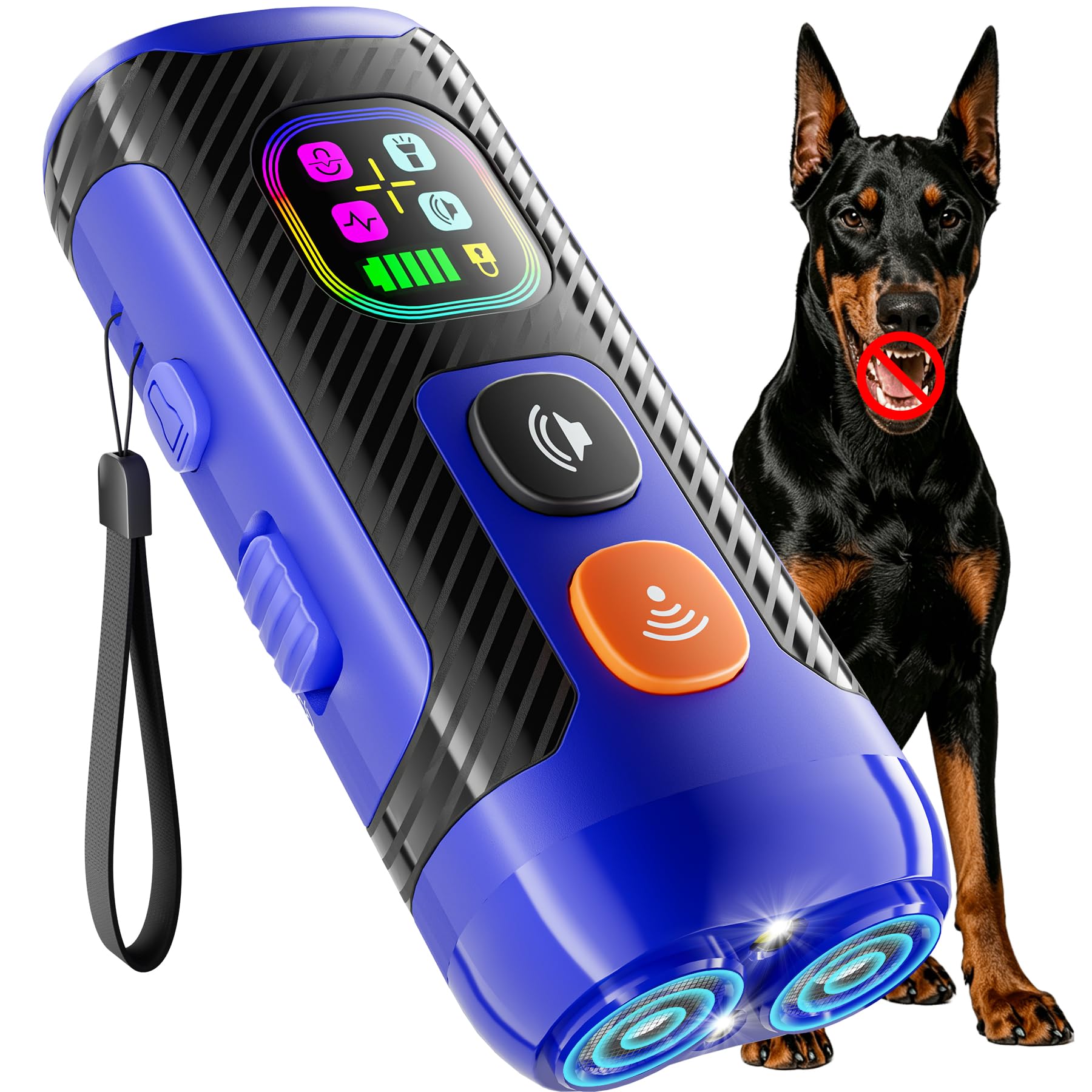
1. Dual Ultrasonic Anti Barking Device
Our pick — 4.5+★ from 300+ verified ratings; the strongest balance of quality and price.
Two frequencies, a flashlight, and a 60-day standby in one 5.3-ounce handheld.
You get two ways to pitch the tone at your dog. A fixed 25 kHz setting gives you the same steady sound every single time, which suits everyday repetition. The adaptive 20–30 kHz setting slides through the range on its own, so a dog that starts ignoring one tone gets a moving target instead. That dual approach is the standout feature here, and it is why this is the pick that covers the widest spread of dogs.
Reach is up to 50 feet, which means you can catch a dog across a yard or down a hallway. The built-in flashlight earns its place on evening walks with a steady mode plus a strobe for unfamiliar dogs ahead of you. A digital display shows battery level and operating mode at a glance, so you are not guessing before you head out.
The design detail worth knowing is the 10-second automatic stop — the ultrasonic output cuts itself off rather than running indefinitely while you hold the button. That 10-second cap keeps a single press from becoming a prolonged blast. Weighing 5.3 ounces, it rides in a jacket pocket without pulling, and the unit arrives charged with a cable so it is usable the day it lands.
Where it earns top spot
- Fixed 25 kHz and adaptive 20–30 kHz modes cover steady dogs and tone-desensitized dogs alike
- 10-second automatic cut-off keeps a press from turning into a prolonged blast
- 50-foot range handles yards, hallways, and open walks
- Digital display shows battery and mode in real time
- Up to 60 days standby between charges
The parts to weigh up
- It is a handheld — you have to be there and press the button, so it does nothing for a dog left alone
- One lithium polymer battery is built in and not user-replaceable
Reach for this if: you want one device that handles the reactive dog on the lead and the barker in the yard, with a light for after dark.
Look elsewhere if: your dog barks unattended all day and you need something that fires with nobody in the room.
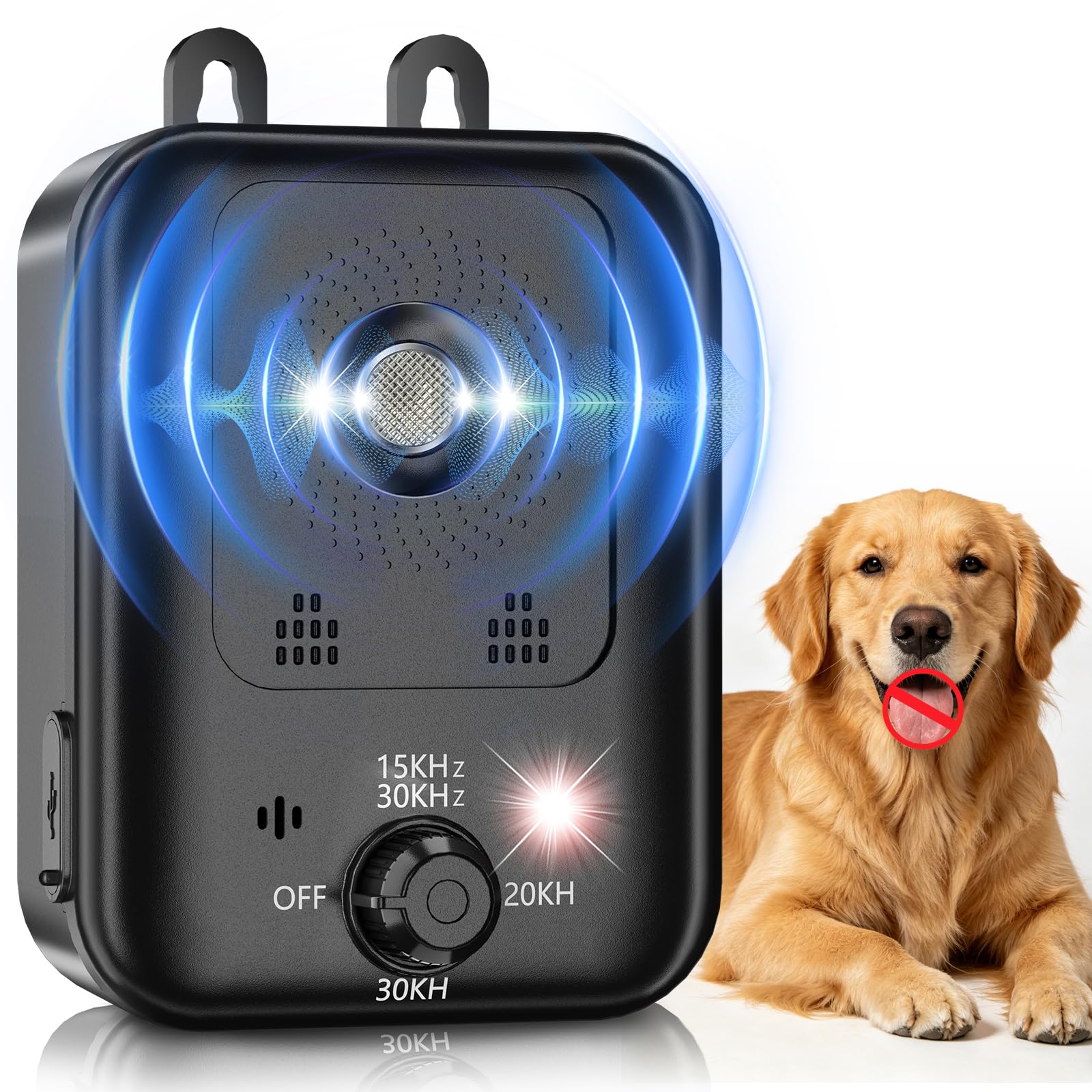
2. Rechargeable Dog Barking Control Devices
A set-and-stay unit that straps to a fence and runs itself.
Where the top pick expects you to stand there aiming it, this one is built to be left alone. Three modes are split by dog size — one for large or boisterous dogs, one for calm dogs, and one for small dogs — so you are matching the output to the animal in front of you rather than guessing. Coverage runs up to 33 feet, enough for a patio, a fence line, or a hallway.
Power is a built-in 1500mAh rechargeable battery, which the listing says gives 30 days of use from about 5 hours of charging. Charging beats swapping cells, and the weatherproof housing means it can sit outdoors in the yard rather than being packed back inside every time the sky looks grey. Mounting is the easy part — a dog house, a table, a fence post, or a tree all work.
The real limit is age. A pup under a year tends to bark straight through the tone, and one recurring theme in the feedback is exactly that — an eight-month puppy ignoring it while older dogs respond. Treat this as a tool for a grown dog whose hearing is normal, and plan on weeks of consistent use before you judge it.
What it does well: hands-free coverage in a compact, weatherproof box that you charge instead of feed batteries.
The catch to plan for: young dogs and stock-heavy chewers may need the training period stretched out, and results move at the dog’s pace, not yours.
Suits: a patio, garden, or hallway where you want a fixed deterrent running without you holding anything.
Skip it for: a puppy under a year, which the listing itself flags as unlikely to respond.
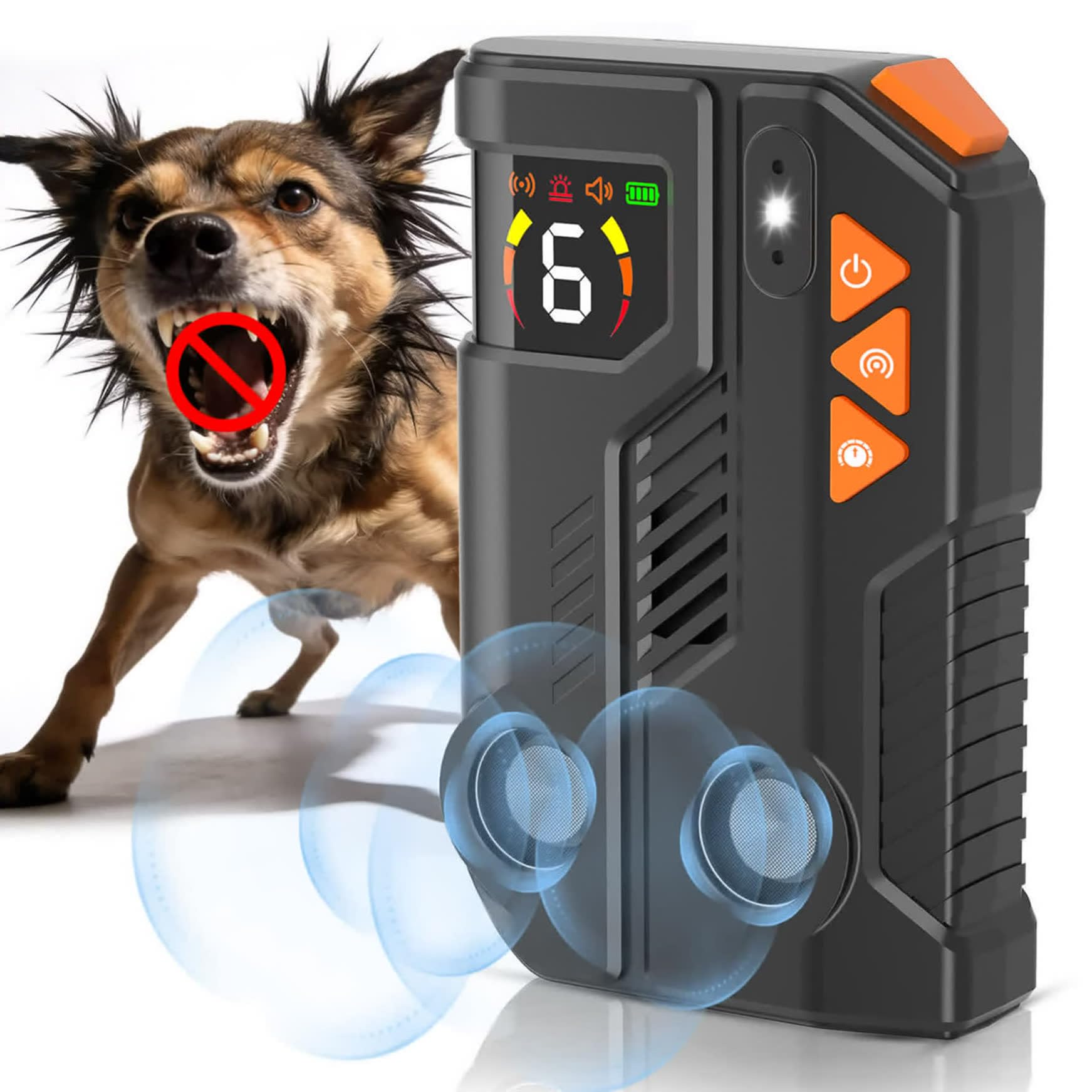
3. Holercoco Q13 Anti Barking Device
It listens for a real bark and ignores the television.
This is the pick for the person whose job happens at a desk with a dog in the next room. A dedicated AI sound recognition chip analyzes sound patterns and fires only on real barking, which is the whole reason it beats a plain sound-trigger box. Voices, the TV, and general household clatter are far less likely to set it off, so the dog is not being corrected for your conference call.
Two upgraded transmitters are described as equivalent to six standard heads, spreading the tone wider with fewer dead spots across a patio, balcony, hallway, or open living area. You then choose from four response modes — ultrasonic alone, ultrasonic plus beep, ultrasonic plus flash, or all three together — for a stubborn or easily distracted dog. On top of that sit 6 sensitivity levels and 3 intensity settings, so you can tune both how far away it listens and how strong the correction lands.
For outdoor use the housing is rated IPX6, which means it survives heavy spray and rain rather than a dunking. The 2200mAh battery is quoted at up to 60 days per charge, with 3 to 4 hours to fill it back up. It weighs 8.8 ounces, so it is a fixture rather than something you carry.
Why it stands out
- AI bark recognition cuts false triggers from speech and TV
- Dual emitters widen coverage and reduce blind spots
- 4 modes, 6 sensitivity levels, and 3 intensity settings give real adjustability
- IPX6 rating handles rain and spray outdoors
- 2200mAh battery quoted at up to 60 days per charge
Put on your radar
- An automatic box means the dog gets corrected whether or not you are in the room to follow up with praise
- Sensitivity tuning takes some trial and error before it settles
The match: anyone who needs quiet during work calls or daytime sleep and cannot be holding a device all day.
Not the match: households that want a person in the loop for every correction — a handheld does that better.
4. YUYQA Dog Bark Deterrent Device, 3X Ultrasonic Anti Barking

Three emitters in a body half the size of the usual handheld.
Compact is the headline, and the listing backs it up: 50% smaller than standard deterrent devices and just 6 ounces. It drops into a pocket or clips to a bag, which is the difference between a device that goes on every walk and one that stays in a drawer. The triple-emitter setup is the other selling point, spreading output wider than a single head.
Six modes cover a lot of ground: dual ultrasonic frequencies at a fixed 25 kHz or a variable 20–30 kHz, four ultrasonic modes, an audible beep, and an LED flashlight for low-light walks. Range is 23 feet, which is honest for a handheld — you aim it at the dog in front of you rather than across a field. Charging is Type-C and the listed time is 2 hours for a full pack, with up to 30 days of regular use and 180 days of standby.
Here is the trade-off to go in with open eyes. This device sits at 4.0+ stars from a very large pool of buyers, and the noise response splits — plenty of dogs quiet on the first press, while some bark harder at the sound. That split depends on each dog’s hearing and temperament, not a faulty unit. One thing to heed: the listing says it is not recommended for dogs with known neurological disorders such as epilepsy or seizures.
What buyers report: owners describe it halting a strong five-year-old pit and cutting barking sharply, with a dog that now settles when the device is simply shown.
Where it can fall short: it needs proximity — the listing’s 23-foot range means it is weaker across a big yard than up close.
It fits: walkers and commuters who want something small enough to always have on them.
Give it a miss if: you need to cover a wide open space — the range here is short by design.
5. PetSafe Collarless Trainer Handheld Ultrasonic Bark Deterrent

At 3.2 ounces, it disappears into a jacket pocket until you need it.
PetSafe strips this down to the essentials and makes them light. The whole unit weighs 3.2 ounces — noticeably lighter than the 5.3-ounce Mzorts up top — and the built-in wrist strap means it stays on your hand through a whole walk. There is no collar, no spray, and no physical correction, which is the entire pitch.
Modes run tone, ultrasonic, ultrasonic plus flashing light, and flashlight-only, so you can pick the response that gets through to a particular dog. Frequencies are 25 kHz fixed or 20–30 kHz variable, and the working range reaches 30 feet. A 2-hour charge gives battery life quoted at up to 15 days — shorter than the automatic boxes here, but fine for a device that comes home on your wrist.
The honest caveat: durability is the weak point. There is a report of a unit working perfectly for a month and then refusing to hold a charge right after the return window shut, and that patterns into a durability question rather than a training one. Most units run for years, but if you are hard on gear, it is worth noting. On the training side the picture is brighter — stubborn dachshunds bringing the device along on every walk is exactly the use case it was built for.
Where it wins: featherweight carry with a wrist strap, a flashlight, and four modes for the price of a mid-range pick.
The concern to keep in mind: at 4.0+ stars, a small share of units have trouble holding charge over time — worth buying from a seller with a clear return route.
Best for: walkers who want the lightest thing on their wrist and a name they recognise.
Look past it if: you need a long field life between charges or a device that runs itself.
6. Queenmew Anti Barking Device
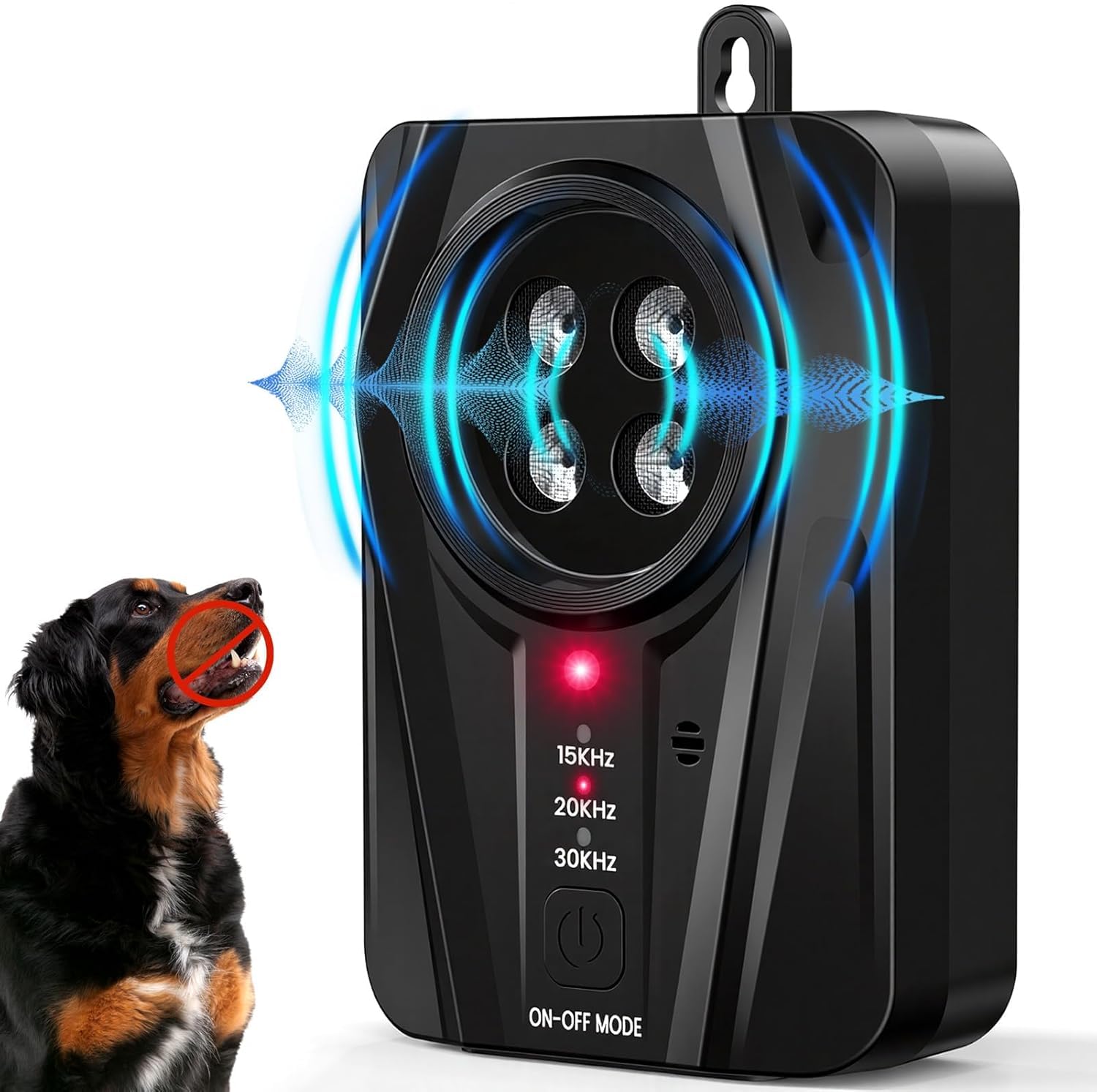
Four transmitters aimed at a house full of dogs that set each other off.
When one dog starts and the rest pile in, a single-emitter box loses the plot. This one uses four built-in transmitters and three adjustable frequencies spanning 15–30 kHz, so you match the tone to a small, medium, or large dog. Coverage is quoted at 50 feet in one place and 33 feet in another; either way it handles a patio or a fence line rather than a whole street.
It runs automatically — the moment barking starts, the unit responds — so it is a hands-free solution for a dog left out back or a training session you cannot supervise. The IP65 housing takes rain and snow on a fence, wall, or tree. Power is a 1500mAh battery quoted at up to 30 days per charge over USB.
This is the one place where patience is spelled out in the instructions: give a dog two weeks to get used to the sound before you judge whether it works. That aligns with what owners describe — a confused first few days, then quieter play and fewer chain reactions. The housing feels sturdy, though it is light enough that a strong gust can shift it, and driving rain can find a seam on an outdoor mount.
The multi-dog edge: four transmitters catching barking from several angles in a household where dogs trigger each other.
Plan around: the two-week acclimation window and a light build — mount it where wind and rain will not move it.
Made for: homes with two or more dogs where the barking is a chorus rather than a solo.
Not for you if: you expect same-day results — this one asks for a fortnight of patience.
7. CdFXor Owl Design Bark Control Box

The owl on the fence is quietly handling the neighbour’s dog.
Two owl-eye emitters sit on the front of this box and aim the tone outward, which is the right shape for a boundary problem. Instead of a single fixed reach, the range is adjustable at 15, 30, or 50 feet, so you tune it to your fence line rather than blasting the whole garden. Three frequency modes — 25 kHz, 30 kHz, and a 20–30 kHz sweep — let you step up the tone for larger or more stubborn dogs.
Operation is automatic and continuous, which suits a neighbor’s dog barking at a fence while you are inside. There is a smart LED display showing mode and battery status, so you can see at a glance whether it is running. The housing is IP65 rated for rain and snow, and the 1200mAh battery is quoted at up to 30 days per charge from about 2 hours of charging.
Placement is what makes it work. Hang it on a post or a wall facing the open side where the barking comes from, and let the dual emitters cover the spread. Owners describe the automatic mode reacting the moment barking starts, with their own dog settling faster and the neighbor’s side going quieter over time. At 7.7 ounces it is light enough to reposition when the barking moves.
The reasons it works
- Adjustable 15/30/50-foot range lets you cover a fence line without overreaching
- Dual owl-eye emitters spread the tone wider across an outdoor boundary
- Three frequency modes including a 20–30 kHz sweep
- IP65 waterproof housing for year-round outdoor mounting
- Smart LED display shows mode and battery status at a glance
The honest limits
- Automatic operation means the dog is corrected whether or not you follow up with praise
- 1200mAh is the smallest rechargeable pack in this lineup, so charging comes around sooner than on the larger boxes
It belongs: on a fence or wall where the neighbor’s dog barks across the boundary and you want zero confrontation.
Think again if: the barking happens all over the house — a portable or handheld unit serves that better.
8. PetSafe Outdoor Bark Control, Hanging Birdhouse
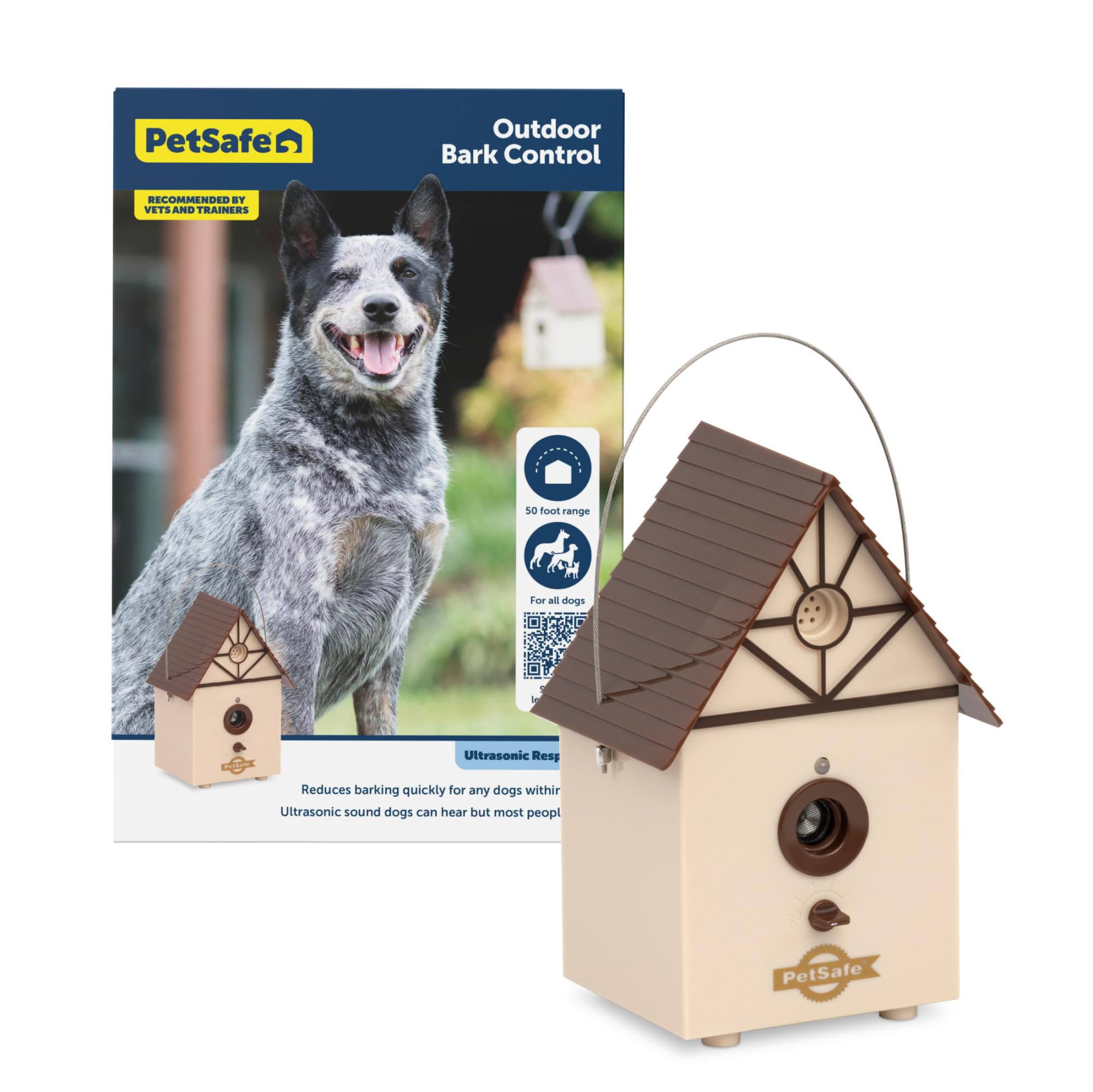
A birdhouse that covers a quarter acre — and asks for the most patience.
Coverage here is measured in land, not feet: up to a 1/4-acre area, which is the largest footprint in this lineup by a wide margin. The trick is that it hangs and works within 5 feet of the ground, in a tree or on a fence post, so the tone reaches the dog at ear level rather than sailing over its head. The birdhouse shape keeps it unobtrusive on a lawn.
When the dog barks, the unit emits a high ultrasonic tone and stops the moment barking stops. It runs on a single 9-volt alkaline battery, which the listing says lasts up to 2 months depending on how often the dog barks — and that battery is not included. The weatherproof build lets it sit outside in any season. There is a one-year limited warranty and PetSafe’s own honest note that all dogs respond differently to ultrasonic tone.
This pick needs the most caveats. It sits at 3.0+ stars from 7,500+ buyers, and the split is real: the design is well liked and the coverage is genuinely wide, but plenty of dogs tune the sound out after a few months. It can also over-fire — hammering or a lawnmower can trigger it, and in a multi-dog household it corrects the quiet dogs along with the barker. Start with a handheld to test whether your dog reacts at all before you commit to a permanent fixture.
The reach advantage: 1/4-acre coverage from one hanging unit beats every other box here for sheer area.
The realistic picture: acclimation is the recurring issue — some dogs respond for months and then stop, and sensitivity settings need dialing in to avoid false triggers.
Worth it for: large yards where a single box needs to cover serious ground and the dog has already proven it reacts to ultrasonic tone.
Try before you commit if: your dog has never shown a reaction — a handheld test tells you a lot before you mount anything.
Know the Specs
Frequency in kHz
A device’s frequency is measured in kilohertz — thousands of cycles per second — and it typically sits above the range most people can hear. A fixed 25 kHz setting plays the same tone every time, which is simple to train with. A variable 20–30 kHz setting sweeps across the range, so a dog with a habit of ignoring one tone has a harder time shutting it out. Neither is better in the abstract; it depends on how your dog responds.
Handheld vs automatic
A handheld trainer only fires while you press the button, which keeps a person in the loop and lets you follow a correction with praise. An automatic box listens for barking and fires on its own, so it suits a dog alone in a yard. The trade-off is control — an automatic box can also fire at a door slam, and it corrects every dog in range, not just the one barking.
Common Questions
Will an ultrasonic bark device work on my dog?
Do these devices hurt the dog?
Will it stop the neighbour’s dog barking?
Can I use one around a puppy?
How far does the sound actually reach?
Why does my dog ignore it after a few weeks?
Do I need a collar for these to work?
How long does the battery last on these devices?
Can I use it indoors and outdoors?
Is ultrasonic better than a shock collar?
The Bottom Line
For most people, the ultrasonic dog bark control devices winner is the Mzorts dual ultrasonic handheld, because it pairs a fixed 25 kHz setting with an adaptive 20–30 kHz sweep, covers 50 feet, and adds a flashlight for evening walks. The 10-second cut-off makes it a safer press than most handhelds, and the digital display means you always know your battery before you head out.
If your problem is a dog barking while you work or sleep, the Holercoco Q13 is the honest step up — its AI bark recognition ignores the TV and voices, and its 4 modes plus 6 sensitivity levels are the most adjustable setup here. For a yard that needs covering from one spot, the CdFXor owl box gives you adjustable 15/30/50-foot range right at the fence line.
One nudge before you buy: the strongest-rated pick on this entire list is the Mzorts handheld, and it is also the one most likely to fit how you will actually use the device — in your hand, not on a fence.
How we choose
We do not accept paid placement. Every pick is matched to a real buyer and a real use-case; we do not hands-on test units.
Sources
Specifications: manufacturer listings and product documentation. Review insights: verified customer reviews, as of October 2026. Pricing: not shown on this page (it changes often); check the current price via the retailer link.
As an Amazon Associate, How Dog Care earns from qualifying purchases. This does not affect which products we feature.