





The moment you decide on bringing a new puppy home, your life changes forever. You are likely feeling a massive wave of excitement mixed with a healthy dose of anxiety. This reaction is completely normal for new pet parents. Raising a young dog requires immense patience, consistency, and a solid plan of action.
At HowDogCare.com, we understand that these first few weeks dictate your long-term success. This comprehensive 30-day survival guide will walk you through everything you need to know. We cover all the essentials, from buying the right supplies to surviving that exhausting first night.
The Reality of Puppyhood: Setting Expectations for the First Month
Let’s be honest: those perfectly curated social media photos rarely show the messy reality of puppyhood. The first month is often exhausting, loud, and full of sharp puppy teeth. However, setting realistic expectations instantly lowers your daily stress levels.
Your new furry friend is currently experiencing a massive life transition. They just left their mother and littermates—the only family they have ever known. Therefore, your primary goal right now is building trust, not demanding perfect obedience.
This guide provides a clear, step-by-step roadmap to navigate your first 30 days successfully. We will cover the crucial preparation phase, the chaotic first 24 hours, and the foundational training milestones you need to hit by week four.
Understanding the 3-3-3 Rule for Canine Adjustment
Animal behaviorists widely recognize the “3-3-3 Rule” as the standard timeline for canine adjustment. Understanding this psychological framework prevents you from rushing the bonding process. While every dog is unique, this timeline offers a reliable baseline for their emotional journey.
Here is how the standard 3-3-3 transition period breaks down:
- 3 Days to Decompress: Your puppy will likely feel overwhelmed, scared, and unsure of their new environment. They might refuse food, hide under furniture, or sleep constantly. Keep your home quiet and avoid forcing intense interactions.
- 3 Weeks to Learn the Routine: By day 21, your dog starts figuring out your daily schedule. They will understand when meals happen, anticipate potty breaks, and begin showing their true personality. Setting clear behavioral boundaries becomes crucial during this phase.
- 3 Months to Feel Completely at Home: After 90 days, your puppy finally realizes they are a permanent family member. True trust is fully established, and a deep, lasting bond is securely formed.
Phase 1: Preparation Before Bringing a New Puppy Home
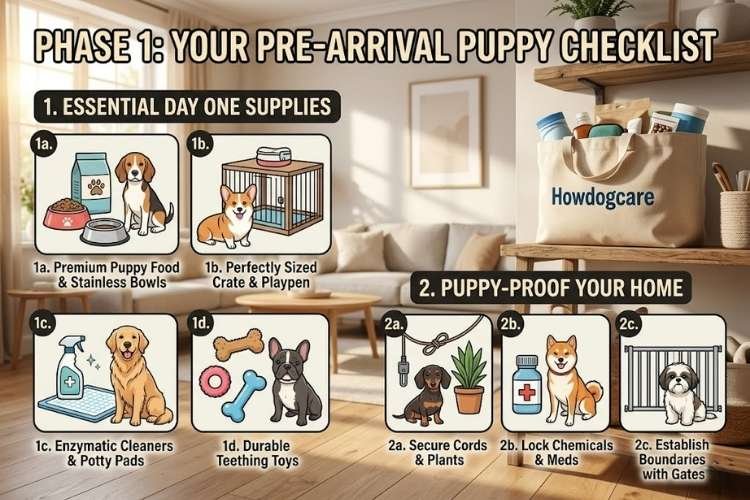
The secret to a smooth transition starts long before pick-up day. Proper preparation before bringing a new puppy home drastically reduces your stress and prevents early behavioral problems.
By having your house fully equipped and secured, you can focus entirely on bonding with your new companion rather than scrambling for supplies.
Essential Puppy Supplies You Actually Need on Day One
Pet store aisles are packed with unnecessary gimmicks designed to drain your wallet. To ensure a successful start, stick to the absolute essentials that promote health, safety, and effective early training.
Premium Puppy Food, Stainless Steel Bowls, and Training Treats
Nutrition plays a massive role in your puppy’s physical and cognitive development. Ask your breeder or shelter what brand they currently feed, and purchase the exact same formula to prevent severe gastrointestinal upset.
- Stainless steel bowls: They are durable, chew-proof, and harbor far less harmful bacteria than cheap plastic alternatives.
- High-value training treats: Buy soft, pea-sized, strongly scented treats to instantly reward good behavior during those crucial early training sessions.
Related: Top 10 Best Elevated Slow Feeder Dog Bowls Reviews
Sizing the Perfect Crate and Escape-Proof Playpen
A safe confinement area is absolutely mandatory for house training and preventing destructive chewing. Your puppy needs a secure den to retreat to when they feel overwhelmed.
- The perfect crate size: It should only be large enough for your puppy to stand up, turn around, and lie down comfortably. Too much extra space encourages potty accidents in the corners.
- An escape-proof playpen: Use flexible metal fencing to create a safe, supervised play area in your main living space when you cannot actively watch them.
Enzymatic Cleaners and Potty Pads for Inevitable Accidents
Accidents are guaranteed during the first few weeks. Standard household cleaners simply mask the smell of urine to human noses, but a dog’s powerful scent receptors can still easily detect it.
- Enzymatic cleaners: These specialized sprays specifically break down uric acid proteins, permanently eliminating the odor and preventing repeat marking in the house.
- Potty pads: If you live in a high-rise apartment or have an unvaccinated puppy in a high-risk parvo area, keep a large supply of highly absorbent training pads on hand.
Durable, Age-Appropriate Chew Toys for Teething
Puppies explore the world primarily with their mouths, and teething causes significant gum discomfort. Providing the right outlets saves your furniture and protects your fingers.
- Rubber chew toys: Brands like KONG offer durable, puppy-specific rubber that can be stuffed with peanut butter and frozen to effectively soothe inflamed gums.
- Avoid dangerous chews: Never give a young puppy rawhide, cooked bones, or easily shredded plush toys, as these can cause deadly intestinal blockages.
How to Thoroughly Puppy-Proof Your Home Room by Room
Think of a puppy as an incredibly fast toddler with razor-sharp teeth. Getting down on their eye level is the best way to identify hidden dangers before bringing a new puppy home. Thoroughly securing your environment prevents tragic emergency vet visits.
Securing Hazardous Cords, Toxic Houseplants, and Chemicals
An unguarded living room or kitchen is a minefield for a curious young dog. You must systematically remove access to anything they can swallow, chew, or pull down.
- Electrical cords: Use thick PVC cord protectors or tape loose wires completely flush against the baseboards to prevent fatal electrical shocks.
- Toxic houseplants: Relocate popular but deadly plants—like Sago Palms, Pothos, and Lilies—completely out of reach or remove them from the home entirely.
- Household chemicals: Move all cleaning supplies, medications, and toxic antifreeze to high cabinets, or install heavy-duty childproof locks on lower doors.
Establishing Boundaries with Baby Gates
You simply cannot supervise a hyperactive puppy every single second of the day. Proper environmental management is the ultimate key to preventing bad habits from forming early on.
- Install sturdy baby gates: Securely block off staircases, carpeted dining rooms, and any zone where the puppy is not actively supervised.
- Keep doors closed: Get into the strict habit of shutting bathroom and bedroom doors to prevent stealthy chewing or hidden potty accidents on your rugs.
Phase 2: Surviving the First 24 Hours with Your New Puppy
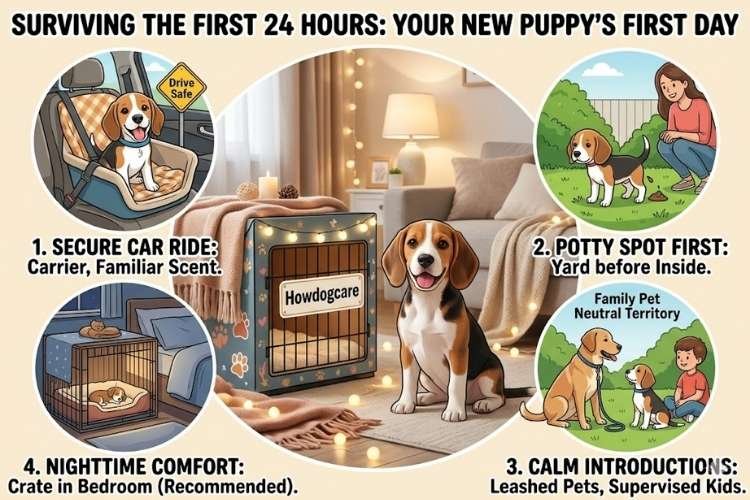
The actual day of bringing a new puppy home is often an exhausting blur of excitement and chaos. This initial 24-hour period is highly stressful for your new companion.
Your primary goal is to keep the environment calm, quiet, and incredibly structured. By following a clear, step-by-step approach, you can successfully navigate this overwhelming day and set a positive tone for your life together.
The Car Ride Home: Minimizing Stress and Motion Sickness
For many dogs, the car ride home is their first time ever leaving their littermates. This experience can easily trigger severe motion sickness and deep anxiety. Prepare your vehicle properly to ensure a safe, calm journey.
- Use a secure travel carrier: Never let a puppy roam freely in the car. Secure them in a well-ventilated travel crate to prevent sudden injuries and contain inevitable accidents.
- Bring a comforting scent: Ask the breeder or shelter for a towel or blanket rubbed on the puppy’s mother. This familiar scent dramatically reduces travel panic and provides emotional security.
- Drive cautiously: Take turns slowly and avoid sudden braking. If the journey takes longer than an hour, schedule brief, quiet stops for fresh air and water.
The Grand Entrance: Introducing Your Puppy to Their Potty Spot First
Your puppy’s first steps at your house should never be directly onto your living room carpet. Their bladder is tiny, and the stress of travel usually guarantees they need to pee immediately.
- Head straight to the yard: Before walking through the front door, carry your puppy directly to their designated outdoor potty spot.
- Wait patiently: Stand completely still and let them safely sniff the grass. Do not initiate exciting play until they successfully relieve themselves.
- Reward heavily: The moment they finish, immediately praise them and offer a high-value treat to instantly reinforce this critical bathroom habit.
Managing Calm Introductions with Existing Family Pets and Children
First impressions matter immensely when introducing a new pack member. Rushing this fragile process can trigger defensive aggression or long-term behavioral issues in your existing pets.
- Use neutral territory: Introduce existing dogs to the new puppy in a quiet, nearby park rather than your living room. This prevents territorial resource guarding.
- Keep all dogs leashed: Allow brief, three-second sniffs while keeping the leashes loose. If any tension arises, calmly walk them away to decompress.
- Guide your children: Teach kids to sit quietly on the floor and let the puppy confidently approach them. Enforce strict rules against pulling ears, hugging tightly, or shouting near the puppy.
Related: Top 10 Best Dog Leashes Reviews (Updated Guide)
Conquering the First Night: Expect Whining and Sleeplessness
Your puppy’s first night away from their mother is terrifying for them. Expect significant whining, crying, and interrupted sleep as they navigate this frightening new isolation. Preparation and patience are your best tools.
Should Your Puppy Sleep in Your Bedroom or Another Room?
Choosing where to place the overnight crate is a highly debated topic. However, placing the crate in your bedroom is highly recommended for the first few weeks of transition.
- The Bedroom Advantage: Hearing your gentle breathing provides immense comfort to a terrified puppy. You can also easily hear their restless whining, which signals an urgent midnight potty break.
- The Living Room Risk: Isolating a scared puppy in a dark, distant room often escalates mild whining into full-blown panic. This can easily create a severe, long-term fear of the crate itself.
- Gradual transition: If you ultimately want them sleeping in the living room, start with the crate directly near your bed. Slowly move it a few feet closer to the bedroom door each subsequent night.
Phase 3: Week 1 – Establishing Boundaries and Routines
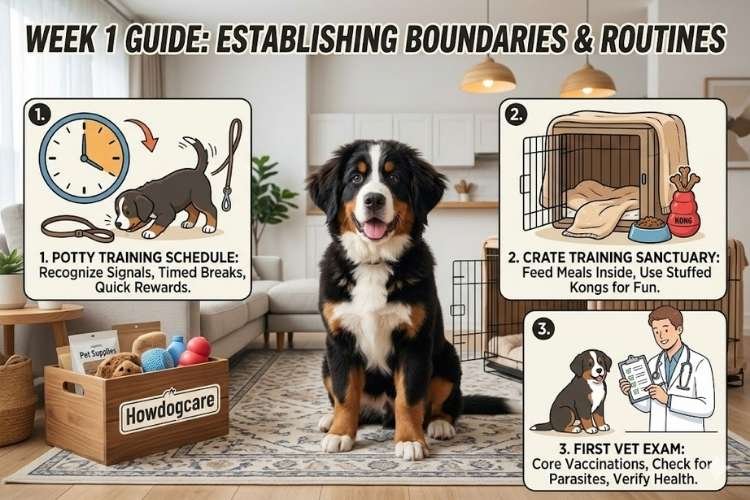
After the initial exhaustion of bringing a new puppy home begins to fade, you enter a critical period of habit-building. Week one is entirely about moving past survival mode and laying foundational rules.
Dogs inherently thrive on clear predictability. Establishing a strict daily routine instantly lowers their anxiety and dramatically accelerates their training progress.
Setting a Bulletproof Potty Training Schedule
Successful housebreaking requires relentless consistency on your part. A young puppy physically cannot hold their tiny bladder for more than a couple of hours.
You must proactively prevent accidents rather than waiting for the dog to ask to go out. Create a strict, non-negotiable schedule where you take them to their outdoor spot immediately after waking up, within fifteen minutes of eating, and right after intense play sessions.
Recognizing Your Puppy’s “I Need to Go” Pre-Potty Signals
Indoor accidents usually happen when busy owners miss the subtle physical cues. Watch your puppy closely for these classic, urgent pre-potty behaviors:
- Intense ground sniffing: If their nose suddenly glues to the floor with purpose, they are actively searching for a bathroom spot.
- Frantic circling: Spinning in tight circles or pacing nervously is a clear, immediate indicator they are about to squat.
- Sudden disengagement: If they abruptly drop a favorite toy and wander away from the action, immediately pick them up and carry them outside.
Introduction to Positive Reinforcement Crate Training
Proper crate training is a highly effective management tool. It leverages a dog’s natural denning instinct to provide a secure, relaxing environment.
However, you must introduce it slowly and carefully. Forcing a terrified puppy into a locked metal cage will instantly create severe behavioral trauma and separation anxiety.
Related: Crate Training Basics for New Dog Owners – Easy Steps to a Calm Pup
Making the Crate Feel Like a Safe, Den-Like Sanctuary
You must actively teach your puppy that the crate is the absolute best place in the house. Always use positive reinforcement to build their confidence.
- Serve all meals inside: Place their daily food bowl at the very back of the crate to build a powerful, positive association with entering the space.
- Use high-value distractions: Give them a durable rubber toy stuffed with frozen, dog-safe peanut butter to keep them happily occupied while resting inside.
- Keep the door open initially: Let them freely enter, explore, and exit during the day so they never feel trapped or isolated.
The Crucial First Veterinary Wellness Exam
Scheduling a comprehensive wellness exam is vital during your first week together. This initial visit establishes a medical baseline and verifies the accuracy of the health records provided by your breeder or shelter.
Safety Note: Carry your puppy directly from your car to the examination table. Do not let them walk on the clinic floor or interact with other dogs in the waiting room to avoid exposure to dangerous viruses.
What to Ask Your Vet About Vaccination Schedules and Parasite Control
Come fully prepared with a list of questions for your veterinarian. A proactive medical approach protects your vulnerable puppy from deadly, preventable diseases.
- Vaccination timeline: Ask exactly when your puppy needs their core vaccines (like Parvovirus, Adenovirus, and Distemper) to safely achieve full immunity.
- Parasite prevention: Request safe, age-appropriate preventative treatments to protect against fleas, ticks, heartworms, and common intestinal parasites.
- Microchipping options: Discuss the best time to insert a permanent identification microchip to ensure your pet can be safely returned if they ever get lost.
You might also like
Phase 4: Weeks 2 and 3 – Tackling Behavior and Early Socialization
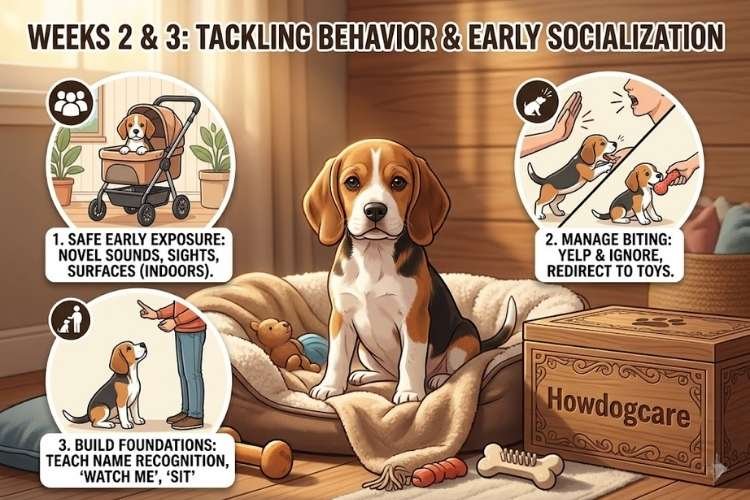
By the second and third weeks after bringing a new puppy home, the initial honeymoon phase usually ends. Your puppy is now comfortable enough to test boundaries and boldly explore their environment.
This period is critical for addressing common behavioral complaints before they become permanent habits. You must shift your focus from basic survival to active teaching and vital early socialization.
The Golden Window: Safe Socialization Before Full Vaccination
Early socialization is the most time-sensitive task in puppy rearing. The critical socialization window permanently closes around 14 to 16 weeks of age.
However, veterinarians rightly warn against exposing unvaccinated puppies to public grounds where deadly diseases like Parvovirus linger. Striking a safe balance between necessary exposure and medical safety is entirely possible.
Introducing Novel Sounds, Surfaces, and Experiences Indoors
You can safely build your puppy’s confidence without ever letting their paws touch contaminated public soil. Be creative and focus on positive, heavily rewarded exposure rather than forced interactions.
- Stroller or wagon walks: Carry your puppy or use a pet stroller to safely expose them to neighborhood sights, loud sirens, and passing traffic.
- Playdates with vaccinated dogs: Invite healthy, fully vaccinated, and friendly adult dogs to your private, enclosed backyard for safe, supervised play.
- Household desensitization: Introduce them to opening umbrellas, running vacuums, clattering pots, and various floor textures right inside your safe home environment.
Managing the “Land Shark” Phase: Puppy Biting and Nipping
Around week two, most new owners feel like they have adopted a tiny alligator. Puppy biting is a completely natural behavior, as dogs instinctively explore the world and initiate play using their mouths.
However, you must actively teach them that human skin is incredibly fragile. Allowing hard bites now will lead to dangerous behavioral issues when they reach full adult size.
Bite Inhibition Techniques That Actually Work
Consistency from every single family member is the only way to quickly stop painful nipping. Mixed signals will only confuse your puppy and prolong this highly frustrating phase.
- The “yelp and ignore” method: When sharp teeth touch your skin, let out a sharp “Ouch!” and immediately turn your back for ten seconds. This directly mimics how littermates communicate that play has gone too far.
- Immediate toy redirection: If your puppy is highly aroused, a high-pitched yelp might actually excite them further. Instead, firmly say “No bite,” and immediately place a durable chew toy into their mouth to satisfy the urge.
Redirection Strategies for Destructive Chewing
Your young puppy fundamentally cannot differentiate between your expensive leather shoes and their designated rubber toys. Scolding them hours after the damage is done is completely useless, as dogs do not connect past actions with current punishments.
Instead, utilize active supervision and the highly effective “trade-up” game. If you catch them chewing a forbidden table leg, happily call their name and offer a high-value treat or a stuffed KONG. When they drop the household item to take the approved toy, praise them enthusiastically.
Teaching Foundational Commands: Name Recognition, Sit, and “Watch Me”
Weeks two and three are the perfect time to start formal, positive reinforcement training. Keep these sessions extremely brief—under five minutes—to prevent frustrating your puppy’s incredibly short attention span.
Always use high-value, strong-smelling training treats to keep their focus entirely locked on you.
- Name Recognition: Say their name in an upbeat, exciting tone. The exact millisecond they make eye contact, mark the behavior with an enthusiastic “Yes!” and deliver a treat.
- “Watch Me”: Hold a treat near your own nose to instantly capture their gaze. This foundational command teaches them to check in with you during highly distracting situations.
- The “Sit” Command: Hold a treat right at their nose and slowly lure it backward over their head. As their nose follows the treat upwards, their bottom will naturally hit the floor. Reward immediately.
Phase 5: Week 4 – Fostering Independence and Grooming Habits

By week four of bringing a new puppy home, your dog is likely fully settled into their new environment. It is now time to focus heavily on fostering independence and establishing lifelong hygiene habits.
Preparing your puppy for a normal adult life now prevents severe, deep-rooted behavioral issues later. You are laying the final groundwork for a confident, well-adjusted canine citizen.
Preventing Separation Anxiety: How to Leave Your Puppy Alone
Dogs are highly social pack animals, making isolation feel incredibly unnatural to them. However, you cannot stay home every hour of the day. Actively teaching your puppy how to be alone safely is the only way to prevent devastating separation anxiety from taking root.
Gradual Desensitization to Your Departure Cues (Keys, Shoes, Coats)
Your puppy closely watches your daily routine. They quickly learn that jingling keys or putting on shoes means they are about to be left behind. You must break this stressful association through gradual desensitization.
- Fake your departures: Put on your coat, grab your car keys, and simply sit down on the couch. Repeat this strange behavior until your puppy completely ignores these previously stressful triggers.
- Start with micro-absences: Step outside your front door for just five seconds, then return before they have a chance to panic or whine. Reward their calm, quiet behavior instantly.
- Slowly increase the duration: Gradually extend your training absences to five minutes, then fifteen, and eventually a full hour. Never make a huge emotional fuss when leaving or returning, as this validates their anxiety.
At-Home Grooming: Desensitizing Paws, Ears, and Teeth
Routine grooming should never turn into a daily wrestling match. Introducing grooming handling during this early developmental window ensures they tolerate—and even enjoy—lifelong physical maintenance.
Routinely massage their paws, gently rub the inside of their ears, and lift their lips to check their teeth. Always pair this physical handling with high-value treats to create a positive emotional response.
The Importance of Early, Stress-Free Nail Trimming Practice
Overgrown nails cause severe joint pain and permanent mobility issues. Unfortunately, nail trimming is often the most dreaded grooming task for both dogs and owners. Early, highly positive exposure completely eliminates this lifelong fear.
- Introduce the tool safely: Place the metal clippers flat on the floor. Let your puppy confidently sniff and investigate them while you deliver tasty treats.
- Tap without cutting: Gently tap the metal clippers against their paws and nails without actually making a cut. Immediately reward them for staying still and remaining calm.
- Trim one nail a day: When they are finally relaxed, clip just the tiny, sharp tip of a single nail. Slowly work your way up to completing a full paw over several days to keep stress levels low.
Related: Top 10 Best Dog Nail Clippers Reviews (Updated Guide & Tips)
Transitioning to a Long-Term Feeding and Exercise Schedule
As your puppy rapidly grows, their daily nutritional and physical needs begin to shift. Around the end of the first month, you must start transitioning them toward a sustainable adult routine.
Always consult your veterinarian to ensure these adjustments align with your specific breed’s growth chart.
- Adjusting meal frequency: Slowly transition your puppy from three small daily meals to two slightly larger meals, fed once in the morning and once at night.
- Safely increasing physical activity: You can carefully begin extending their daily walks. However, strictly avoid forced running, jumping off furniture, or intense agility exercises, as their skeletal growth plates are still highly fragile.
- Prioritizing mental fatigue: Continue relying heavily on brain games, stuffed puzzle toys, and short obedience training sessions. Mental stimulation actually burns significantly more energy than physical exercise alone.
Expert Answers to Your Biggest Puppy FAQs
As you navigate the process of bringing a new puppy home, you will inevitably run into questions that need immediate, definitive answers. Here are the most common concerns new pet parents face, answered clearly to help you stay on track.
1. How long does the “puppy blues” phase typically last?
The “puppy blues”—intense feelings of regret, overwhelming exhaustion, and anxiety—are completely normal. These feelings typically peak during the first two to three weeks of ownership. As your puppy establishes a reliable routine and begins sleeping through the night, this emotional exhaustion usually fades significantly by the end of the first month.
2. When is it finally safe to take my new puppy for a walk outside?
It is generally safe to take your puppy for public walks one to two weeks after their final round of core vaccinations, which usually occurs around 14 to 16 weeks of age. Until your veterinarian clears them, strictly limit outdoor time to your private, fully fenced backyard to prevent exposure to deadly viruses like Parvovirus.
3. How many hours a day should an 8-week-old puppy sleep?
A healthy 8-week-old puppy requires a massive amount of physical rest, typically sleeping between 18 to 20 hours a day. If they are constantly awake, they will quickly become overstimulated. Enforce strict, scheduled naps in their covered crate every couple of hours to prevent aggressive nipping and hyperactive behavior.
4. What is the fastest way to potty train a stubborn or distracted puppy?
The absolute fastest method is combining strict crate confinement with leashed potty breaks. If you cannot actively supervise them with 100% of your attention, they must be in their crate or playpen. When taking them outside, keep them on a short leash to prevent them from playing in the grass, and deliver a high-value treat the exact second they finish eliminating.
The Journey Ahead: Embracing Your Dog’s First Year
The first 30 days of bringing a new puppy home will undoubtedly test your patience, your sleep schedule, and your sanity. However, this exhausting survival phase is incredibly brief in the grand scheme of your dog’s life.
By consistently enforcing these foundational rules, setting clear boundaries, and prioritizing early socialization, you are actively preventing years of stressful behavioral issues. You are building a confident, well-adjusted canine citizen.
Remember to take a deep breath and genuinely celebrate the tiny daily victories. The sleepless nights and sharp puppy teeth are only temporary. The deep, unbreakable bond you are building right now, however, will reward you with a lifetime of unwavering loyalty and love.