


Entering the Canine Mind: Why Decoding Your Dog’s Brain Matters
For modern pet parents, understanding dog psychology is the fundamental key to unlocking a harmonious relationship with your canine companion. Teaching basic obedience commands like “sit” and “stay” is certainly important for daily safety and management. However, true connection requires you to look much deeper into how your dog actually perceives the world around them.
When you actively decode your dog’s brain, you transition from simply managing their surface-level behavior to truly fulfilling their underlying emotional needs. You stop asking “how do I stop this behavior?” and start asking “why is this behavior happening?”
This profound psychological shift drastically reduces household behavioral problems and completely eliminates training frustrations. Ultimately, viewing the world through a canine cognitive lens elevates the human-animal bond to a level built on deep, mutual trust.
The Evolutionary Cognitive Journey from Wolf to Couch Companion
To accurately grasp how dogs think, we must first examine their remarkable evolutionary history. Dogs share a common ancestor with the gray wolf, but thousands of years of intense domestication have fundamentally rewired their cognitive processing.
Unlike their wild ancestors, domestic dogs have specifically evolved to read, interpret, and rely upon human social cues. This incredible evolutionary journey transformed a highly independent predator into a deeply collaborative, household partner.
- Social Adaptation: Dogs developed the unique cognitive ability to make direct eye contact with humans to ask for help, a trait entirely absent in wolves.
- Emotional Attachment: Their brains physically evolved to release oxytocin (the “love hormone”) when interacting with their human families.
- Softened Instincts: Domestication effectively lowered their primitive fight-or-flight reactivity, allowing them to safely thrive in complex, human-centric environments.
How Modern Veterinary Science Has Reshaped Our View of Canine Intelligence
For decades, traditional trainers viewed dogs as simple, stimulus-response machines incapable of complex thought. Today, modern veterinary behaviorists have completely shattered that outdated perspective. Advanced neuroimaging, specifically fMRI brain scans of awake dogs, proves that the canine mind is incredibly rich and active.
Scientists now know that the canine brain processes positive emotions and rewards in the exact same physical region as the human brain. This groundbreaking scientific discovery confirms that dogs experience genuine, complex feelings rather than just robotic survival instincts.
We now understand that canine intelligence goes far beyond learning basic parlor tricks. It involves complex problem-solving, advanced spatial memory, and an astonishing level of emotional empathy toward their chosen human caregivers.
Insight 1: The Sensory World and How Canines Perceive Reality

To truly master understanding dog psychology, you must first realize that dogs experience a completely different physical reality than we do. Humans navigate the world primarily through sight, but a dog’s brain is fundamentally wired to prioritize smell and sound over visual input. Acknowledging this dramatic sensory shift is the first step toward building profound cognitive empathy with your pet.
The Unrivaled Power of the Canine Olfactory System
A dog’s sense of smell is their dominant lens for viewing the world. While humans possess around 6 million olfactory receptors, dogs boast up to 300 million receptors within their complex nasal cavity. Furthermore, the portion of a dog’s brain devoted specifically to analyzing and categorizing odors is proportionally 40 times larger than ours.
This incredible biological advantage allows them to detect incredibly subtle chemical changes in their environment. They can easily smell human stress hormones, track microscopic scent trails left days ago, and even detect early chemical signs of medical emergencies like sudden drops in blood sugar.
Why a “Sniffari” Walk is Equivalent to Reading the Morning News
Many pet parents rush their dogs through daily walks, prioritizing physical distance over mental exploration. However, pulling your dog away from an interesting scent actively deprives them of vital psychological stimulation.
A slow, scent-focused walk—frequently called a “sniffari”—allows your dog to thoroughly process complex environmental data. Through scent, they actively learn which animals recently passed by, the health status of neighborhood dogs, and even subtle shifts in the local weather.
- Reduces anxiety: Deep, rhythmic sniffing naturally lowers a dog’s heart rate and calms their nervous system.
- Burns mental energy: Ten minutes of intense, focused sniffing is often far more exhausting for a dog than a mile-long run.
- Builds confidence: Allowing them to independently investigate their surroundings safely fulfills a core primitive instinct.
Visual Perception, Color Blindness Myths, and Motion Detection
A persistent, outdated myth claims that dogs only see the world in black and white. Modern veterinary ophthalmology proves this is entirely false. Dogs actually possess dichromatic vision, meaning they can clearly see varying shades of blue, yellow, and gray, but they cannot distinguish between red and green.
When you throw a bright red toy onto a green lawn, your dog relies heavily on the movement, rather than the color contrast, to track it. Their eyes have specifically evolved with a high concentration of light-sensitive rods, granting them exceptional night vision and an unparalleled ability to detect subtle, fast-paced motion across vast distances.
Acoustic Sensitivity: High-Frequency Hearing in Everyday Environments
Dogs process sounds at distances and frequencies completely undetectable to the human ear. While human hearing taps out around 20,000 Hertz, a dog’s acoustic range extends up to an astonishing 65,000 Hertz.
Their highly mobile, radar-like ears contain 18 distinct muscles, allowing them to pinpoint the exact location of a microscopic noise in a fraction of a second. This extreme acoustic sensitivity explains why common household appliances, distant sirens, or the high-pitched hum of electronics can trigger sudden behavioral reactions that seem entirely unprovoked to us.
Insight 2: Decoding Canine Body Language and Vocalizations

While humans rely heavily on complex verbal communication, dogs express their deepest emotions physically. A core component of understanding dog psychology requires you to become completely fluent in canine body language. Every subtle shift in their posture, from the tip of their ears to the base of their tail, provides a direct window into their current mental state.
By actively observing these physical cues, you can accurately predict and safely manage their behavior before vocalizations even occur. Let’s break down exactly what your dog’s body is trying to tell you.
The Subtle Nuances of Tail Wagging (It Doesn’t Always Mean “Happy”)
One of the most dangerous, widespread misconceptions in pet ownership is the belief that a wagging tail universally indicates a friendly dog. In reality, a wagging tail simply signifies high emotional arousal or intense active engagement with their immediate environment.
A stiff, rapid wag held high over the back often signals deep agitation or potential offensive aggression. Conversely, a relaxed, wide, sweeping wag that actively involves their entire hindquarters genuinely reflects joy, comfort, and peaceful submission.
Directional Bias: What Left vs. Right Tail Wags Actually Mean
Modern veterinary science has uncovered a fascinating neurological link between a dog’s tail movements and their brain hemispheres. A dog’s tail wag actually contains a highly specific directional bias directly tied to their emotional state.
- Right-Sided Wagging: Indicates positive emotions, confidence, and approachability. This movement is actively driven by the left hemisphere of the canine brain.
- Left-Sided Wagging: Signals negative emotions, acute anxiety, or a strong desire to retreat. This is physically controlled by the right hemisphere.
Evaluating Ear Positioning and Facial Muscle Tension
A dog’s face contains intricate musculature specifically designed to communicate complex psychological shifts. When evaluating ear position, you must always establish your specific dog’s relaxed, neutral baseline first, as breed anatomy heavily dictates natural ear carriage.
Ears pinned completely flat against the skull universally indicate severe fear, stress, or extreme submission. Alternatively, ears pitched sharply forward, combined with a stiff, unblinking stare and a tightly closed mouth, demonstrate intense hyper-focus or an impending offensive reaction.
Recognizing “Whale Eye” and Lip Licking as Crucial Stress Signals
Dogs display highly specific micro-expressions when attempting to peacefully defuse a stressful situation. These physical “calming signals” are frequently ignored by humans, which rapidly leads to completely preventable behavioral escalations and bites.
- Whale Eye: Occurs when a dog nervously averts their head but keeps their eyes fixed on a perceived threat, revealing the whites of their eyes in a distinct half-moon shape. This is a primary warning sign of extreme discomfort.
- Lip Licking and Yawning: In the complete absence of food or actual fatigue, rapid lip licking and exaggerated, stressed yawning are primary indicators of acute nervous tension.
Translating the Spectrum of Barks, Growls, and Whines
While physical body language always comes first, vocalizations provide critical secondary context to a dog’s emotional reality. Not all growls are created identically; a low, rumbling, loose-bodied play-growl during tug-of-war is psychologically distinct from a sharp, sudden, stiff warning growl over a resource.
Similarly, high-pitched whines often indicate sheer frustration, barrier reactivity, or hidden physical pain. Meanwhile, a deep, repetitive, booming bark usually signifies a serious territorial alert. Paying close attention to the pitch, duration, and body language accompanying these sounds perfectly rounds out your canine communication toolkit.
Related: How to Stop Dog Barking at Night: Proven Tips That Work
Insight 3: The Science of Canine Learning and Memory

When delving into understanding dog psychology, grasping exactly how their brain absorbs and stores information is absolutely vital. Professional behaviorists rely entirely on scientifically proven learning theories, rather than guesswork, to shape canine habits. By applying these exact same psychological principles at home, you can teach any dog complex behaviors rapidly and reliably.
Classical Conditioning: The Pavlovian Response in Your Living Room
Classical conditioning occurs when a dog forms an involuntary, subconscious association between two previously unrelated events. The most famous scientific example is Ivan Pavlov’s dogs, who began salivating simply at the sound of a ringing bell.
In your own home, this psychological phenomenon happens every time your dog excitedly runs to the front door just because you picked up your car keys. They have deeply linked the mundane, metallic jingle directly to the thrilling experience of a car ride.
You can actively harness this mechanism to build powerful training foundations. By consistently pairing a neutral sound—like the sharp “click” of a training clicker—with a high-value food reward, you instantly create a highly effective communication tool.
Operant Conditioning: How Consequences Drive Future Behavior
While classical conditioning is entirely involuntary, operant conditioning requires the dog to make a conscious, deliberate choice. This fundamental psychological principle states that a dog will eagerly repeat a behavior if it results in a pleasant consequence, and they will abandon a behavior if it yields nothing.
When your dog chooses to sit and immediately receives a piece of roasted chicken, their brain actively registers that specific action as highly profitable. They quickly learn that their physical actions directly control the positive outcomes within their environment, creating a highly motivated, eager learner.
The Psychological Impact of Positive Reinforcement vs. Aversive Methods
The specific conditioning method you use to teach consequences drastically alters your dog’s overall mental health and neurological development. Modern veterinary behavioral science unanimously champions positive reinforcement, which focuses entirely on rewarding desired behaviors while gently redirecting failures.
Conversely, aversive training methods—such as shock collars, prong collars, or physical corrections—rely heavily on inducing acute fear and physical discomfort to quickly suppress unwanted actions.
- Positive Reinforcement: Actively builds immense confidence, encourages creative problem-solving, and deeply strengthens the human-animal bond built on mutual trust.
- Aversive Methods: Frequently trigger dangerous defensive aggression, create a state of chronic anxiety, and often result in “learned helplessness,” where the dog becomes utterly terrified to try anything new.
The Concept of Shaping and Rewarding Successive Approximations
You simply cannot expect a dog to immediately understand a complex, multi-step command on the very first try. Instead, professional behaviorists use a highly effective psychological tool called “shaping” to teach advanced, difficult skills without causing any frustration.
Shaping involves heavily rewarding tiny, incremental baby steps—scientifically known as successive approximations—toward the final desired goal.
If you want your dog to comfortably enter a dark travel crate, you never force them inside. First, you heavily reward them simply for looking at the crate. Next, you reward a single step toward it, then a paw inside the door. This highly structured, psychological approach completely eliminates stress and makes learning feel like an incredibly fun puzzle.
Insight 4: The Emotional Capacity and Empathy of Your Dog

A crucial aspect of understanding dog psychology requires recognizing the strict boundary between genuine canine emotions and human projection. We naturally engage in anthropomorphism, routinely assigning highly complex human feelings to our pets’ everyday behaviors.
While dogs undeniably possess a rich, vibrant emotional life, they experience the world with the cognitive capacity of a human toddler. They clearly feel fundamental emotions like profound joy, acute fear, deep anger, and immense love. However, they completely lack the advanced neurological wiring necessary for complex, human-level moralizing.
Do Dogs Really Feel Guilt, Jealousy, or Spite?
Humans frequently claim their dog destroyed the living room couch out of pure spite after being left home alone. However, true spite requires complex, premeditated revenge, which is entirely beyond a dog’s physical cognitive ability. The destruction actually stems from acute separation anxiety or severe boredom.
Jealousy, conversely, has been thoroughly and scientifically documented in canines. Dogs will actively push a rival pet away to secure your undivided attention. They are acting entirely on a primitive, survival-based instinct to aggressively guard a highly valuable resource—you.
The “Guilty Look” Completely Debunked by Canine Behaviorists
We have all seen the viral videos of a cowering dog sitting next to a shredded garbage bag. Humans instinctively interpret those tucked ears and wide eyes as a clear, conscious admission of guilt. Modern veterinary behaviorists have completely debunked this incredibly persistent myth.
- Appeasement, Not Guilt: The dog is absolutely not apologizing for the garbage. They are reacting directly to your current angry tone, rigid body posture, and intense staring.
- Defusing Conflict: The famous “guilty look” is actually a desperate collection of submissive calming signals designed strictly to appease a highly agitated human.
- Timing Disconnect: If you heavily scold a dog hours after they made a mess, they physically cannot connect your current anger to their past action.
The Chemistry of Love: Oxytocin Release During Human-Dog Interactions
While dogs lack complex moral reasoning, their capacity for deep, empathetic love is an undeniable, proven scientific fact. When you gaze warmly into your dog’s eyes, both of your brains immediately release massive surges of oxytocin into the bloodstream.
This highly powerful chemical, often called the “cuddle hormone,” drives the exact same biological mechanism that successfully bonds human mothers to their newborn infants. This entirely unique, cross-species hormonal feedback loop proves that your dog’s deep attachment to you is biologically identical to genuine human love.
Recognizing the Silent Signs of Canine Depression and Anxiety
Because dogs experience such intense emotional bonds, they are highly susceptible to severe, debilitating psychological distress. Unfortunately, clinical canine depression and chronic anxiety rarely present as obvious, dramatic behavioral outbursts.
Pet parents must actively monitor their dogs for highly subtle, silent shifts in their daily routines to catch mental health issues early.
- Appetite Disruption: Look for a sudden, unexplained disinterest in high-value treats or the complete refusal of their daily meals.
- Lethargy and Isolation: Notice if your dog begins actively avoiding the family, hiding deeply under furniture, or sleeping excessively during normal play hours.
- Compulsive Behaviors: Obsessive paw licking, repetitive flank sucking, or relentless pacing almost always indicate severe, underlying mental distress rather than simple boredom.
Insight 5: Social Structures and the Complete Myth of the “Pack Alpha”

A massive paradigm shift in understanding dog psychology requires completely discarding the toxic myth of the “pack alpha.” For decades, popular media convinced pet owners that dogs were engaged in a constant, aggressive battle for household dominance. Modern veterinary science proves this is entirely false.
Viewing your dog as a tiny wolf plotting a mutiny actively harms your relationship. To build true obedience and mutual respect, we must completely dismantle these outdated, adversarial training ideologies.
Why Traditional “Dominance Theory” is Scientifically Flawed
Traditional dominance theory was originally based on highly flawed 1940s studies of captive, unrelated wolves forced into artificial enclosures. These stressed, captive animals fought violently for resources, leading early observers to incorrectly assume that wild canines operated under a strict, aggressive hierarchy.
Wildlife biologists later studied natural wolf packs and discovered a completely different reality. Natural packs operate as cooperative family units gently guided by a breeding pair, not aggressive dictators. Because domestic dogs are thousands of years removed from even these cooperative wolves, applying this flawed, captive-wolf model to your living room is scientifically baseless.
How “Alpha Rolls” Actively Damage the Human-Canine Bond
The highly dangerous training technique known as the “alpha roll” involves physically pinning a dog to the ground to assert dominance. This method is incredibly harmful and fundamentally misinterprets natural canine communication.
When a dog rolls over naturally, it is a willing, peaceful gesture of appeasement to defuse tension. Forcing a dog into this highly vulnerable position triggers pure panic and their primitive fight-or-flight response.
- Destroys Mutual Trust: It actively teaches your dog to view you as unpredictable, erratic, and physically dangerous.
- Triggers Defensive Bites: A terrified, physically pinned dog will frequently bite out of pure self-defense and survival instinct.
- Fails to Teach: It entirely fails to teach the dog the correct behavior, relying solely on suppressing them through sheer terror.
Related: Top 10 Best Puzzle Toys for Dogs Reviews
Modern Perspectives on Canine Family Dynamics and Collaboration
Instead of viewing your dog as a subordinate trying to steal your throne, modern psychology views the human-dog relationship as a collaborative, cross-species family. Dogs actively look to us for safe guidance, clear boundaries, and consistent access to vital resources.
When your dog happily walks through a doorway before you or jumps onto the living room couch, they are absolutely not trying to dominate you. They are simply moving faster or seeking a highly comfortable resting spot. True leadership is built entirely on managing their environment and consistently rewarding good choices, not asserting physical power.
The Psychology of Resource Guarding Built on Insecurity, Not Dominance
Resource guarding occurs when a dog aggressively protects food bowls, stolen tissues, or even their favorite human. Old-school trainers mistakenly labeled this intense reaction as an arrogant “alpha” power play. In reality, this highly dangerous behavior is rooted entirely in deep insecurity and acute fear of loss.
The guarding dog is essentially experiencing a panic attack, completely terrified that you will steal their highly prized possession. Treating this intense fear with physical punishment only confirms their suspicion that you are a thief, rapidly escalating the aggression.
Instead, professional behaviorists use psychological trading games. By consistently tossing high-value treats to a guarding dog from a safe distance, you effectively rewire their brain to understand that human approach always brings something better.
Insight 6: Memory Processing and Time Perception in Dogs

A crucial component of understanding dog psychology is realizing exactly how canines process the passage of time and store long-term memories. Humans constantly ruminate on past regrets and intensely worry about future events. Dogs, however, are profoundly rooted in the present moment, which fundamentally dictates how they learn and why they develop separation anxiety.
By aligning your training expectations with their actual cognitive timeline, you eliminate deep frustration and drastically improve their learning retention.
Episodic vs. Associative Memory: Do Dogs Remember Their Past?
Humans rely heavily on episodic memory, allowing us to mentally “time travel” and consciously replay specific past events like a movie. Modern veterinary science suggests that dogs navigate the world using a highly powerful system called associative memory. They remember specific people, places, or objects based entirely on the intense emotional associations formed during past interactions.
If a dog was previously mistreated by someone wearing a large hat, they do not consciously replay the specific memory of the abuse. Instead, their brain instantly triggers a powerful, involuntary fear response the moment they see a hat.
- Negative Associations: Your dog fears the veterinary clinic simply because the unique smell of the building is permanently linked to physical discomfort.
- Positive Associations: They consistently run to the kitchen at the exact sound of a specific cabinet opening because that noise is deeply tied to receiving high-value treats.
Spatial Memory: How Dogs Navigate and Map Their Surroundings
While their episodic memory operates differently than ours, a dog’s spatial memory is extraordinarily advanced. They actively construct incredibly detailed mental maps of their immediate environment and routine walking routes. This impressive cognitive mapping allows them to easily navigate complex terrains and immediately notice if a single piece of living room furniture is moved.
This advanced spatial awareness relies heavily on their dominant olfactory system. Dogs physically map their neighborhood entirely through scent markers, leaving and reading highly detailed chemical messages on local trees and fire hydrants.
The Circadian Rhythm: How Dogs Accurately Perceive the Passage of Time
Pet parents frequently wonder if their dog actually knows how long they have been left home alone. Dogs certainly do not understand abstract hours or minutes, but they accurately track time through their internal circadian rhythm. Their bodies naturally recognize the daily, predictable cycles of shifting sunlight, changing temperatures, and internal digestion cues.
Fascinatingly, dogs can literally “smell” time passing inside your home. When you leave for work, your unique personal scent hangs heavily in the air and slowly, predictably fades throughout the afternoon.
- Predicting Arrivals: Your dog eagerly waits by the front door at 5:00 PM because your lingering scent has specifically decayed to the exact concentration that historically predicts your return.
- Managing Anxiety: Understanding this sensory timeline helps behaviorists treat severe separation anxiety by systematically altering departure routines to break the dog’s predictable anxiety triggers.
You might also like
- Puppy Obedience Training: A Step-by-Step Plan to Raise a Well-Behaved Dog
- Raising a Puppy Month by Month – A Complete Growth & Training Timeline
- Top 10 Best Dog Car Seat Cover ‒ Back Seat Clean & Protected
- Top 10 Best Collapsible Dog Bowls for Camping Reviews
- Best Dog Costumes for Halloween 2026 – Dress Your Pup to Impress!
Insight 7: Applying Psychological Principles to Behavioral Modification
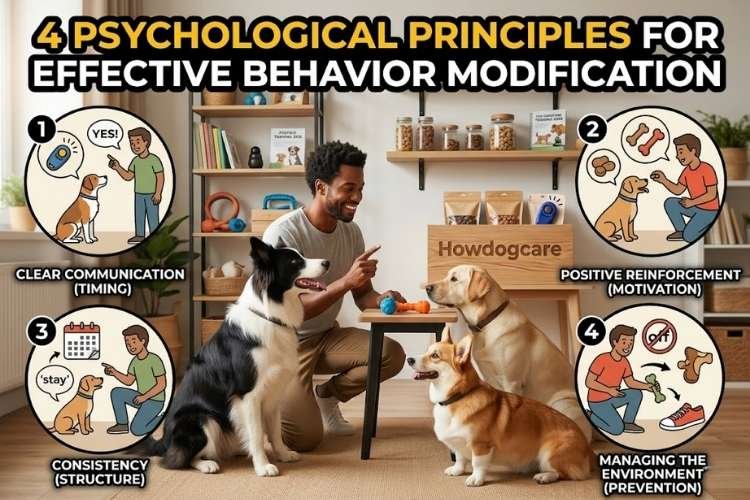
The true power of understanding dog psychology lies in practical, everyday application. Once you grasp exactly how your dog perceives the world, you can effectively resolve deeply frustrating household issues.
By combining patience with science-backed behavioral modification techniques, you can help your dog comfortably overcome their deepest fears. Let’s explore highly actionable, psychological strategies for managing the most common behavioral challenges.
Overcoming Fear Periods Through Gentle Desensitization
All puppies go through scientifically documented “fear periods” during their neurological development. During these sensitive biological phases, previously ignored objects—like a harmless vacuum cleaner or a rustling trash bag—can suddenly trigger intense, irrational panic.
Never forcefully drag a terrified dog toward their trigger, as this completely shatters their trust and worsens the phobia. Instead, utilize systematic desensitization to slowly introduce the scary object at a highly manageable, safe distance.
- Start incredibly small: Place the scary vacuum in the corner of the room, completely turned off, and casually scatter high-value treats around it.
- Control the environment: Only move the object slightly closer when the dog shows completely relaxed, neutral body language.
- Never rush the process: Allow the dog to investigate entirely at their own pace, heavily rewarding every single step of brave curiosity.
Differentiating Between Separation Anxiety and Pure Isolation Distress
Pet parents frequently confuse true separation anxiety with isolation distress, but effectively treating them requires entirely different psychological approaches. Pure separation anxiety means the dog is absolutely terrified of losing access to one specific, hyper-attached human. They will frequently panic even if other family members or pets are present in the room.
Isolation distress, conversely, means the dog simply panics when left entirely alone in a space. These dogs instantly calm down the moment any human, or even another confident dog, enters the room. Accurately diagnosing the core emotional issue dictates your exact training protocol.
Counter-Conditioning Strategies to Empower Anxious Pups
For both separation and isolation issues, professional behaviorists rely heavily on counter-conditioning. This highly effective psychological technique actively changes the dog’s underlying emotional response to a trigger, successfully flipping it from extreme fear to joyful anticipation.
If your dog immediately panics the moment you grab your work coat, your coat has become a poisoned trigger. You must actively break this deeply ingrained negative association through repetition.
- Devalue the departure trigger: Randomly put your coat on, sit calmly on the couch for five minutes, and then take it off without ever actually leaving the house.
- Create powerful positive associations: Provide a highly engaging, frozen puzzle toy only when you walk out the door, promptly picking it up immediately upon your return.
- Build spatial independence: Actively encourage your dog to settle on a comfortable mat in a completely separate room while you are still safely home.
Managing Leash Reactivity by Changing the Emotional Response
Leash reactivity—explosive barking and lunging at passing dogs—is very rarely driven by genuine, offensive aggression. It is almost always a frantic display of fear-based frustration. The leash physically traps the dog, removing their natural flight response and actively forcing an explosive “fight” reaction to create distance.
Punishing a reactive dog with leash pops merely confirms their intense fear that the approaching dog brings physical pain. Instead, you must actively change their emotional response using the highly effective “Look at That” (LAT) psychological game.
The exact moment your dog spots a trigger from a safe distance, cheerfully mark the behavior with a “yes!” and immediately feed a high-value treat. Over time, the sight of a strange dog psychologically transforms from a terrifying threat into a highly predictable indicator that roasted chicken is arriving.
Fostering a Lifelong Connection Through Canine Cognitive Empathy
Ultimately, understanding dog psychology is the absolute greatest gift you can offer your canine companion. When you actively choose to view the world through their unique sensory and emotional lens, everyday household frustrations rapidly disappear. You stop fighting against their natural, primitive instincts and start working collaboratively alongside them.
This profound cognitive empathy completely transforms your daily relationship. By respecting their subtle body language, utilizing science-backed positive reinforcement, and honoring their physical reality, you build a foundation of unbreakable mutual trust. True leadership is never about asserting physical dominance; it is entirely about becoming the safe, predictable anchor in your dog’s complex world.
Frequently Asked Questions About Dog Psychology
1. Do dogs understand human words, or do they just react to the tone of voice?
Dogs absolutely understand specific human words, but their vocabulary is built entirely on associative learning rather than actual language comprehension. While they heavily rely on your tone of voice and physical body language for immediate emotional context, the average dog can easily learn to recognize over 160 distinct words when those sounds are consistently paired with specific outcomes.
2. How long does a dog’s short-term memory actually last?
A dog’s short-term, working memory is incredibly brief, scientifically proven to last only about 1 to 2 minutes. This rapid memory decay is exactly why you must reward or redirect a behavior within mere seconds of it occurring. If you wait five minutes to correct a mistake, their brain has completely moved on, and the correction will simply cause severe confusion.
3. Can an older, senior dog really learn new psychological behavioral patterns?
Yes, an older dog can absolutely learn new behavioral patterns, completely debunking the harmful myth that you cannot teach an old dog new tricks. While senior dogs frequently have deeply ingrained habits that require more patience to safely rewrite, their canine brains remain highly neuroplastic and remarkably responsive to positive operant conditioning throughout their entire lives.
4. Are certain working dog breeds psychologically more intelligent than others?
Canine intelligence is highly subjective and depends entirely on what the specific breed was genetically engineered to accomplish. A Border Collie possesses incredible psychological aptitude for rapid obedience and complex problem-solving, while a Bloodhound exhibits unparalleled, independent olfactory intelligence. Neither breed is inherently “smarter” than the other; their brains simply excel in entirely different cognitive domains.