


Bringing home a new shelter dog is an incredibly rewarding experience, but the initial reality often feels overwhelming. Instead of an instantly joyful companion, you might face a terrified, shut-down animal hiding under your dining table.
Understanding basic rescue dog psychology is the absolute most critical step to bridging this emotional gap. This comprehensive guide breaks down exactly how to navigate canine trauma, build lasting trust, and help your adopted dog finally feel completely safe.
Decoding the Mind of an Adopted Dog: Why They Act Differently
Many new owners panic when their newly adopted pet acts distant, fearful, or entirely unresponsive to affection. If you feel anxious or rejected by your new dog’s behavior, know that your feelings are completely valid.
However, your dog is not being stubborn, ungrateful, or difficult on purpose. To them, your living room is simply another unpredictable environment in a long series of confusing changes. We must utilize rescue dog psychology to understand that these frustrating behaviors are actually deeply ingrained survival mechanisms.
The Impact of Shelter Stress on Canine Brain Chemistry
The modern shelter environment, while necessary, is a sensory nightmare for any animal. The constant, echoing barking, strange odors, and complete lack of a stable routine create immense, chronic stress.
This daily chaos literally alters their brain chemistry, constantly flooding their system with cortisol, the primary stress hormone.
- Constant hyperarousal: Elevated cortisol levels force the dog to remain in a perpetual “fight or flight” state, constantly scanning for danger.
- Slow chemical reset: It takes several days, and sometimes weeks, for these accumulated stress hormones to naturally leave their bloodstream.
- Learning blocks: A dog’s brain physically cannot process new training commands or accept affection until this chemical flood completely subsides.
Dispelling the “Abuse” Myth: Lack of Socialization vs. Trauma
When a rescue dog actively cowers at a quickly raised hand or a loud voice, owners immediately assume a history of severe physical abuse. While tragic abuse certainly happens, these specific cases are statistically much less common than you might think.
In reality, the vast majority of fear-based rescue behaviors directly stem from severe under-socialization and environmental unpredictability.
- Fear of the unknown: A street dog who has never lived indoors will view a ceiling fan or a ticking clock with pure, unfiltered terror.
- Survival instincts: Dogs with unpredictable pasts survive strictly by avoiding strange objects, loud noises, and sudden human movements.
- Missed milestones: Missing the critical socialization window during puppyhood creates deeply rooted anxieties that perfectly mimic the signs of physical trauma.
The Foundational “3-3-3 Rule” of Rescue Dog Adoption
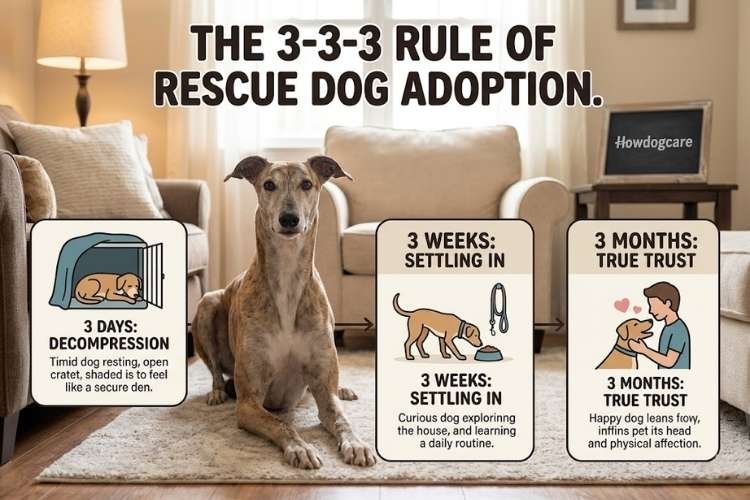
Managing your expectations is arguably the most important aspect of bringing home a shelter animal. To successfully apply rescue dog psychology, professional trainers universally rely on the foundational “3-3-3 Rule” as a clear chronological roadmap.
This vital timeline helps new pet parents understand exactly what their dog is experiencing internally. Following this structure actively prevents owners from rushing the natural bonding process and setting their new dog up for failure.
The First 3 Days: The Overwhelmed and Decompressing Phase
Your dog’s first 72 hours in a new home are entirely about basic survival and intense sensory decompression. Do not expect them to act like a perfectly adjusted, happy companion during this highly sensitive window.
Their brain is actively processing a massive environmental shock, frequently resulting in a complete behavioral shutdown.
- Extreme exhaustion: It is completely normal for a newly adopted dog to sleep excessively as their body finally crashes after prolonged shelter stress.
- Appetite loss: Refusing to eat or drink is a very common, temporary stress response, so do not force meals or drastically change their diet.
- Hiding behaviors: Seeking refuge under a couch or tightly tucked in a dark corner is their natural way of creating a small, defensible safe zone.
The First 3 Weeks: Testing Boundaries and Settling In
As your dog approaches the three-week mark, they slowly begin to realize this new house is not just another temporary holding facility. As their intense initial anxiety finally begins to fade, you will witness their true personality steadily emerge.
However, this newfound comfort frequently brings an entirely new set of unexpected behavioral challenges.
- Behavioral shifts: A dog that was perfectly quiet on day one may suddenly begin barking at the window as they start feeling protective of their territory.
- Testing limits: They will actively push boundaries to figure out the house rules, testing if they can jump on the furniture or steal food from the counter.
- Routine reliance: They are now actively memorizing your daily schedule, quickly learning to anticipate exact meal times and morning walks.
The First 3 Months: Building True Trust and the Forever Bond
True, unwavering relaxation takes significant time, and behaviorists agree that full integration takes at least three full months. This milestone is the ultimate goal of implementing proper rescue dog psychology, where the animal finally lets their guard completely down.
By this stage, the traumatic memories of the shelter have been successfully overwritten by your consistent, loving routine.
- Deep emotional security: Your dog now fully trusts that you will consistently provide food, safety, and calm leadership without fail.
- Established communication: You have mutually learned to seamlessly read each other’s body language, easily preventing stressful misunderstandings.
- The forever bond: The fearful, shut-down animal you brought home on day one has successfully transformed into a confident, deeply loyal family member.
10 Proven Strategies to Build Trust Through Rescue Dog Psychology

Now that you understand the timeline, it is time to take deliberate behavioral action. Applying effective rescue dog psychology requires patience, but it also demands a highly structured daily approach.
By utilizing these ten proven, expert-backed strategies, you can actively foster a deep, lifelong bond without completely overwhelming your new animal.
1. Master the Art of Ignoring Your New Dog (The Pressure-Free Approach)
It feels incredibly unnatural to bring a new pet home and completely ignore them. However, for a deeply fearful animal, direct eye contact and forced physical affection feel like a massive, terrifying threat.
By simply ignoring your new arrival, you instantly remove all heavy social pressure from their environment.
- Avoid direct eye contact: Look softly at their paws or past their shoulder instead of aggressively staring them down.
- Let them approach you: Allow the dog to safely investigate your scent while you quietly read a book or watch television on the couch.
- Patience builds confidence: When they finally realize you are entirely predictable and non-threatening, their natural canine curiosity will easily override their deep-seated fear.
2. Establish a Strictly Off-Limits “Sanctuary Space”
Every single shelter dog desperately needs a designated safe zone to effectively process their new environment. This sanctuary space must be a strictly off-limits area where they are never touched, cornered, or bothered by humans or other household pets.
Knowing they have a highly secure retreat actively lowers their resting heart rate and significantly reduces their daily anxiety.
Choosing the Right Location for a Decompression Crate
Setting up this safe zone correctly is absolutely vital for early behavioral success. A wire or plastic dog crate naturally mimics a secure, den-like environment that fearful dogs instinctively crave.
- Select a quiet corner: Place the crate in a low-traffic bedroom or a quiet home office, entirely away from noisy kitchens or heavy family foot traffic.
- Create a dark cave: Drape a breathable, heavy blanket over three sides of the wire crate to instantly block out overwhelming visual stimuli.
- Leave the door completely open: Keep the crate door open at all times during the day so they can freely retreat whenever they feel emotionally overwhelmed.
Related: Crate Training Basics for New Dog Owners – Easy Steps to a Calm Pup
3. Implement a Strict, Unwavering Daily Routine

Unpredictability is the absolute core of canine anxiety. In the shelter environment, a dog never truly knows when they will eat, sleep, or go outside to the bathroom.
You must actively combat this trauma by implementing a highly rigid, unwavering daily schedule from day one.
- Set precise meal times: Feed your dog at the exact same times every single morning and evening to quickly build immense biological trust.
- Schedule predictable walks: Take them outside for quiet bathroom breaks in the exact same specific order each day.
- Remove the fear of the unknown: When a dog explicitly knows what is happening next, their highly reactive nervous system finally begins to naturally settle down.
Related: Top 10 Best Automatic Dog Feeder Reviews (Updated Guide)
4. Read the Subtle Signs of Canine Body Language
Dogs constantly communicate their internal emotional state, but humans frequently miss the incredibly subtle physical cues. Applying proper rescue dog psychology means learning to fluently read their unique body language.
You must easily recognize when your dog is desperately asking for physical space long before they ever feel forced to growl or snap out of self-defense.
Whale Eye, Lip Licking, and Yawning: The Invisible Cries for Space
Fearful dogs actively utilize specific displacement behaviors, commonly called “calming signals,” to politely beg for distance. Missing these signs directly breaks their trust.
- Spotting “Whale Eye”: If your dog turns their head away but deeply side-eyes you so the white of their eye heavily shows, they feel extremely trapped and panicked.
- Excessive lip licking: Rapidly flicking their tongue over their nose when no food is present is a massive indicator of severe social stress.
- Stress yawning: A wide, sudden yawn during a tense situation is not a sign of sleepiness; it is an active, desperate attempt to calm their racing nervous system.
5. Hand-Feeding to Build Positive Human Associations
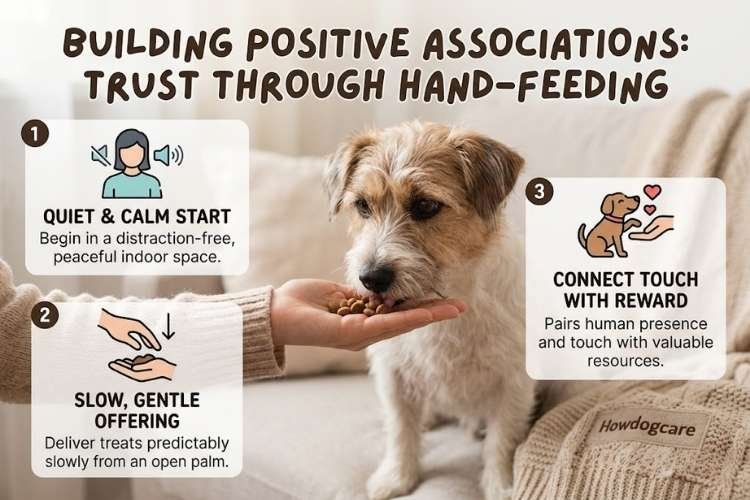
Food is the absolute ultimate currency in the canine world. Instead of simply dropping a heavy bowl of kibble on the kitchen floor, use daily mealtime to actively rewire their traumatized brain.
Hand-feeding is a profoundly effective, purely positive trust-building exercise for deeply fearful animals.
- Toss treats first: If they are too terrified to approach your body, gently toss high-value treats across the floor, slowly decreasing the distance over several days.
- Offer a flat, open palm: Present their daily kibble in a flat, open hand, allowing them to gently take the food at their own carefully chosen pace.
- Rewire the association: This highly rewarding, simple daily practice powerfully teaches a fearful dog that human hands bring valuable resources, not physical harm or harsh punishment.
6. Avoid Forced Affection and Respect Physical Boundaries
While you may desperately want to smother your new pet with love, forced affection is highly detrimental to rescue dog psychology. To a deeply anxious, newly adopted animal, a tight human hug feels exactly like terrifying physical restraint and entrapment.
Building true canine trust requires you to completely respect their physical boundaries during the early decompression phase.
- Never lean over them: Bending directly over a fearful dog’s head or back is universally perceived in the canine world as an aggressive, dominating threat.
- Skip the kisses: Putting your face directly into the face of an unpredictable, highly stressed animal creates a severe and unnecessary bite risk.
- Respect their bubble: Always invite the dog into your personal space using gentle coaxing, rather than aggressively forcing yourself into theirs.
7. Use the “Two-Second Rule” for Petting and Consent
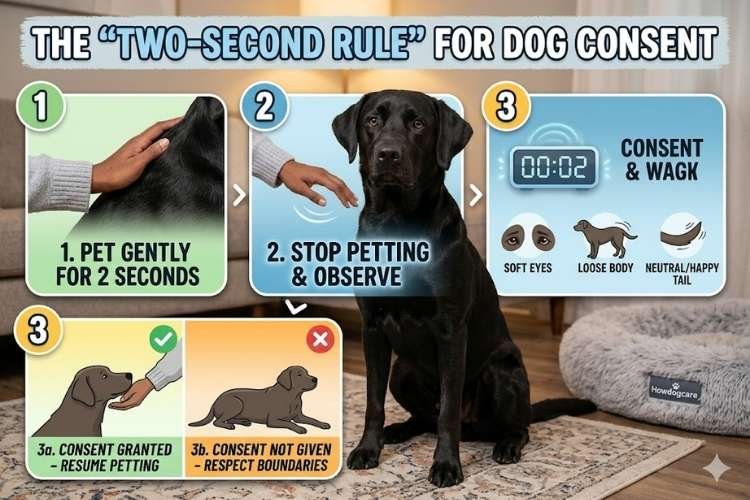
Just like humans, dogs absolutely deserve the right to dictate when and how they are physically touched. Implementing a strict “consent test” is a professional game-changer for building rapid, mutual trust with a timid animal.
The “Two-Second Rule” is an incredibly simple but powerful behavioral technique to instantly gauge their true comfort level.
- Pet for exactly two seconds: Gently stroke their chest or shoulder (avoiding the highly sensitive top of the head) for exactly two seconds, then completely pull your hand away.
- Observe the reaction: If they actively lean into your hand, nudge you with their nose, or relax their body, you have enthusiastic consent to continue.
- Respect the rejection: If they turn their head away, lick their lips, or simply freeze stiff, they are politely asking you to stop touching them immediately.
8. Introduce the Concept of “Choice” in Daily Activities
Traumatized dogs have often spent a significant portion of their lives with absolutely zero control over their chaotic environment. A core pillar of effective rescue dog psychology is actively giving that crucial agency back to the animal.
Allowing your dog to make small, safe daily choices rapidly rebuilds their shattered environmental confidence.
- Let them navigate: On quiet decompression walks, safely let them choose which direction to turn at the end of the street or which tree to investigate.
- Implement open-door policies: Never physically drag or pull a fearful dog into a new room. Simply leave the door open and allow them to cross the threshold only when they feel completely ready.
- Providing these simple, safe choices transforms a helpless, shut-down animal into a confident, active participant in their new family life.
9. Keep Environmental Stimuli and Visitors to an Absolute Minimum
It is completely natural to want to show off your newly adopted companion to all your friends, neighbors, and extended family. However, you must actively resist this social urge to successfully protect your dog’s highly fragile nervous system.
A newly rescued dog is already completely overwhelmed simply trying to process the basic smells, sounds, and layout of your household.
- Enforce a strict “no visitor” rule: Keep houseguests entirely out of your home for at least the first two to three weeks of the adoption.
- Control the environment: Keep the television volume low, avoid using loud power tools or vacuums, and create a calm, library-like atmosphere.
- Protecting their sensory processing during this critical window actively prevents dangerous instances of trigger stacking and fear-based aggression.
10. Prioritize Mental Enrichment Over Exhausting Physical Exercise
Many owners mistakenly believe that a physically exhausted dog is a calm, well-behaved dog. However, forcing a terrified rescue dog on a mandatory three-mile neighborhood walk immediately creates massive anxiety and intense sensory overload.
Instead of stressful physical exertion, you must heavily prioritize low-impact, confidence-building mental enrichment during the first few weeks. Engaging their brain safely tires them out far more effectively than forcing them to nervously navigate loud city sidewalks.
The Power of Sniffaris and Lick Mats for Anxiety Reduction
Certain natural canine behaviors actively serve as biological off-switches for a severely overactive nervous system. You can strategically use these behaviors to rapidly naturally soothe your adopted dog.
- Take them on a “Sniffari”: Allow your dog to lead a slow, completely aimless walk where the only goal is to let them intensely sniff every single blade of grass. Deep sniffing actively lowers their heart rate and heavily reduces circulating cortisol.
- Utilize soothing lick mats: Smear plain yogurt or pet-safe peanut butter on a textured silicone mat. The repetitive, rhythmic action of licking naturally releases high levels of calming endorphins directly into their brain.
Navigating Common Behavioral Challenges in Rescue Dogs

As your new companion finally begins to relax, you will inevitably encounter a few new behavioral hurdles. Understanding rescue dog psychology is absolutely essential for successfully navigating these frustrating moments.
Instead of viewing these issues as permanent personality flaws, you must treat them as temporary side effects of their ongoing decompression process. Let’s troubleshoot the most frequent challenges owners face once the dog finally starts settling in.
Recognizing and Managing “Trigger Stacking”
Sometimes, a dog will suddenly react aggressively to a seemingly minor event, leaving owners completely baffled. This intense reaction is almost always the direct result of a canine psychological phenomenon called “trigger stacking.”
- Cumulative stress: Just like a human having a terrible day at work, a dog’s internal cortisol levels slowly rise with every minor stressful event.
- The tipping point: A loud garbage truck, a dropped frying pan, and a stranger staring at them might all happen within a single afternoon. The final trigger—perhaps just reaching out to pet them—causes an unexpected behavioral explosion.
- Management strategy: Actively monitor their daily stress exposure. If they experience a scary event on a walk, immediately give them quiet, uninterrupted downtime in their crate to naturally reset their nervous system.
The “Honeymoon Period” Fake-Out: Sudden Behavioral Regressions
Many new owners are absolutely thrilled when their rescue dog is perfectly quiet and submissive during the very first week. However, experienced trainers frequently refer to this temporary peace as the “honeymoon period” fake-out.
- The initial freeze: That perfect early behavior is actually a profound fear-based “freeze” response. The dog is simply too terrified of the unknown to make a bold move.
- The three-week regression: Around the three-week mark, they finally feel comfortable enough to test boundaries, suddenly barking at the window or chewing on your shoes.
- A sign of progress: While deeply frustrating, this sudden behavioral regression is actually a massive psychological compliment. It proves your dog finally feels secure enough to express their authentic personality.
Resource Guarding: Why Survival Instincts Kick In
If your dog suddenly freezes, hard-stares, or low-growls when you approach their food bowl or a new toy, they are actively resource guarding. Through the lens of rescue dog psychology, this terrifying behavior makes perfect biological sense.
- Rooted in extreme scarcity: Shelter dogs often have to fiercely compete with other animals for every single meal. They naturally assume you are approaching simply to steal their valuable prize.
- Never punish the growl: Physically punishing a dog for guarding actively proves their worst fear: that human hands are unpredictable resource thieves.
- Play the “trade-up” game: Always toss a significantly better treat from a distance when walking past their bowl. This actively teaches them that your approach always brings better things, not theft.
Separation Anxiety: The Fear of Being Abandoned Again
It is incredibly common for shelter dogs to completely panic the exact moment you walk out the front door. This intense separation anxiety stems directly from their deep-seated trauma and the very real fear of being permanently abandoned yet again.
- The true panic response: This is never spiteful or angry behavior. It is a full-blown physiological panic attack, frequently resulting in destructive door scratching, relentless howling, or sudden indoor potty accidents.
- Avoid big emotional goodbyes: Making a massive, dramatic fuss before leaving the house heavily spikes their anxiety before you even touch the doorknob. Always leave and return completely quietly.
- Practice micro-departures: Start systematically desensitizing them by simply picking up your car keys and sitting right back down. Slowly build up to stepping outside for just five seconds to consistently prove you always return.
You might also like
When to Call a Professional Canine Behaviorist
Sometimes, DIY training is simply not enough to overcome a difficult past. Understanding basic rescue dog psychology provides an excellent foundation, but recognizing your own limitations is equally important.
When deep-rooted canine trauma manifests as highly dangerous behavior, seeking immediate professional intervention is the absolute only responsible choice.
Identifying Red Flags: Fear Aggression and Severe Bite Risks
Extreme fear frequently forces a dog into a highly defensive, aggressive state simply to protect themselves. You must accurately identify these critical behavioral red flags long before a severe bite incident ever occurs.
- Unprovoked snapping: Lunging or actively snapping when a family member simply walks past the dog’s resting area.
- Refusal to decompress: Remaining in a complete state of severe panic, constant shaking, or refusing to eat for more than two consecutive weeks.
- Dangerous resource guarding: Actively attacking other household pets or humans over daily meals, toys, or prime sleeping spaces.
The Difference Between a Standard Trainer and a Veterinary Behaviorist
If your new dog is exhibiting severe fear aggression, hiring a standard obedience trainer is frequently ineffective and potentially dangerous. You must understand the crucial difference between teaching basic commands and actively repairing a shattered nervous system.
- Standard dog trainers: These professionals are excellent for teaching basic household manners, loose leash walking, and standard obedience cues to a relatively stable dog.
- Veterinary behaviorists: These are highly specialized, board-certified veterinarians who formally diagnose and treat severe psychological disorders in animals.
- Medical intervention: Unlike a trainer, a behaviorist can legally prescribe critical anti-anxiety medications to chemically lower a dog’s panic threshold, allowing behavioral modification to actually work.
Expert Answers to Your Rescue Dog Psychology FAQs
Navigating the complex emotional landscape of an adopted pet inevitably brings up numerous questions. Here are the clear, concise, and expert-approved answers to the most common concerns regarding shelter dog behavior.
1. How long does it actually take for a rescue dog to bond with its new owner?
Following the foundational “3-3-3 Rule,” most dogs require a minimum of three full months to completely let their guard down. However, for dogs with severe past trauma, establishing a deep, unwavering bond can easily take up to a full year of consistent daily routine.
2. Why does my newly adopted dog just stare at me without moving?
This intense, unblinking staring is a classic, deep-seated fear response known as hyper-vigilance. They are highly unsure of your intentions and are simply watching your every single move to ensure you do not suddenly harm them.
3. Is it normal for a rescue dog to sleep all day during the first week?
Yes, excessive sleeping is an absolutely normal and necessary biological response. The chaotic shelter environment kept their body constantly flooded with stress hormones, and they are now finally crashing from profound physical and mental exhaustion.
4. Can you ever fully rehabilitate a severely traumatized rescue dog?
They typically enjoy the company of other dogs. Small animals may trigger their prey drive.
5. Do Siberian Huskies get along with other pets?
While you can massively transform a traumatized dog’s daily quality of life, you cannot magically erase their past. Instead of aiming for a “perfect” dog, successful rehabilitation means actively managing their triggers and providing a highly predictable, safe environment.
The Lifelong Journey: Celebrating Small Wins with Your Rescue
Navigating the deep complexities of rescue dog psychology is rarely a fast or perfectly linear journey. You will inevitably face frustrating setbacks, unexpected behavioral regressions, and days where you completely question your decision to adopt.
However, the ultimate reward is entirely worth the intense initial struggle.
Earning the deep, unwavering trust of an animal that once feared the entire world is a profoundly beautiful experience. By remaining fiercely patient, strictly respecting their physical boundaries, and actively celebrating every single small victory, you will successfully forge an incredibly loyal, lifelong companion.