Disclosure: This post may contain affiliate links. As an Amazon Associate I earn from qualifying purchases, at no extra cost to you. Learn more
Specs are compiled from manufacturer listings and verified buyer reviews and can change over time — please confirm the key details on the product page before buying.
If your dog clears the yard every time the gate opens, a wireless dog fence can hold the boundary without a single shovel of dirt. The catch most shoppers miss: these systems come in two very different designs. A radio transmitter fence creates a circle around a base unit you plug in at home. A GPS fence builds its boundary from satellite signals, so it travels with you. Pick the wrong type for your property and you will fight false warnings all day.
This guide is built by comparing the manufacturers’ published specifications and the patterns across verified customer reviews, so you get each pick’s real strengths and trade-offs instead of marketing spin.
Below you will find the practical differences that actually matter — containment range, correction modes, waterproofing, and battery endurance — laid out so you can match a system to your dog and your yard.
Every pick here is judged on the numbers a worried owner really needs from the wireless dog fences shelf: range, correction levels, and battery life.
Top Picks

How To Choose The Best Wireless Dog Fences
Start with the shape of your property, not the feature list. A transmitter fence makes a circle around one plug-in base, so it suits a typical suburban backyard where you can place the unit centrally. A GPS fence draws its circle from satellites, which means it works on acreage, at a campsite, or on a farm where there is no outlet to anchor a base unit to.
Transmitter Fence Or GPS Fence
A transmitter system sends a radio signal from a base unit, and the collar reacts when it drifts past the set distance. That signal stays steady in an ordinary yard, but metal sheds, AC units, and dense tree cover can bend it. A GPS collar reads satellite position instead, so it is not bothered by a metal fence panel — but it needs a clear view of the sky to lock on. If your dog spends most of its time under heavy canopy or inside a barn, a GPS collar will drop its fix and stop working as a boundary.
Read The Range Number In Context
Range is always quoted from open-ground testing, and every maker says so somewhere in the fine print. A 3500-foot boundary is a radius, meaning it measures from the center point out to the edge, not the width of the whole circle. Walls, terrain, and nearby electronics shrink that usable distance. Set your boundary a comfortable margin inside your actual property line so a dropped signal never puts your dog near the road.
Correction Modes And Warning Order
The gentlest systems warn before they correct. A typical sequence starts with a beep, adds vibration, and only then delivers a static correction — and many collars let you switch static off entirely. Look for adjustable levels so you can start at the lowest setting that gets your dog’s attention. A collar with a wide spread of levels lets you tune finely instead of jumping from “ignored” to “too much.”
Waterproofing And Battery Life
An IPX7 rating means the collar survives being dunked in water for a short period, which covers rain, wet grass, and a pond swim. A higher IPX9K rating covers high-pressure water spray, useful for a dog that wades through hose spray or heavy storms. Battery figures usually come as two numbers: continuous runtime in fence mode, and standby days when the collar is idle. Check the runtime, because that is what you will actually recharge.
Side-by-Side Comparison
| Model | Best For | Containment Range | Dog Weight Range | Waterproof Rating | Amazon |
|---|---|---|---|---|---|
| Htcuto X3 Fence (2-Dog Kit)★ Best Overall | All-round backyard containment | 25–3500 ft, 14 levels | 10–130 lbs | IPX7 collar | Amazon |
| PATPET GF400-BA1 GPS FenceBig Property Pick | Large properties and farms | Up to 9999 yards radius | 20–140 lbs | IP67 collar | Amazon |
| Aweec JC-B 2-in-1Budget Entry | Budget entry into containment | 990 ft radius | Not specified | IP65 collar | Amazon |
| Blingbling Petsfun App GPS (White) | Phone-controlled setup | 65–984 ft | 20–110 lbs | IPX7 collar | Amazon |
| Htcuto GT1 Oak (2 Dogs) | Step-by-step training | 25–3500 ft, 14 levels | 10–130 lbs | IPX7 collar | Amazon |
| Htcuto GT1 Camo (2 Dogs) | Bark control plus containment | 25–3500 ft, 14 levels | 10–130 lbs | IPX7 collar | Amazon |
| WIEZ D020 GPS Fence | Farms and open fields | 65–3281 ft | All breeds | Not specified | Amazon |
| Dogtra GPS Fence GF10UC | Custom-shaped boundaries | 3/4 acre or larger | 15 lbs and up | IPX9K collar | Amazon |
| PetSafe Guardian GPS | Long single-charge battery | 3/4 acre or larger | Over 25 lbs, neck 13–28 in | Waterproof collar | Amazon |
Detailed Reviews
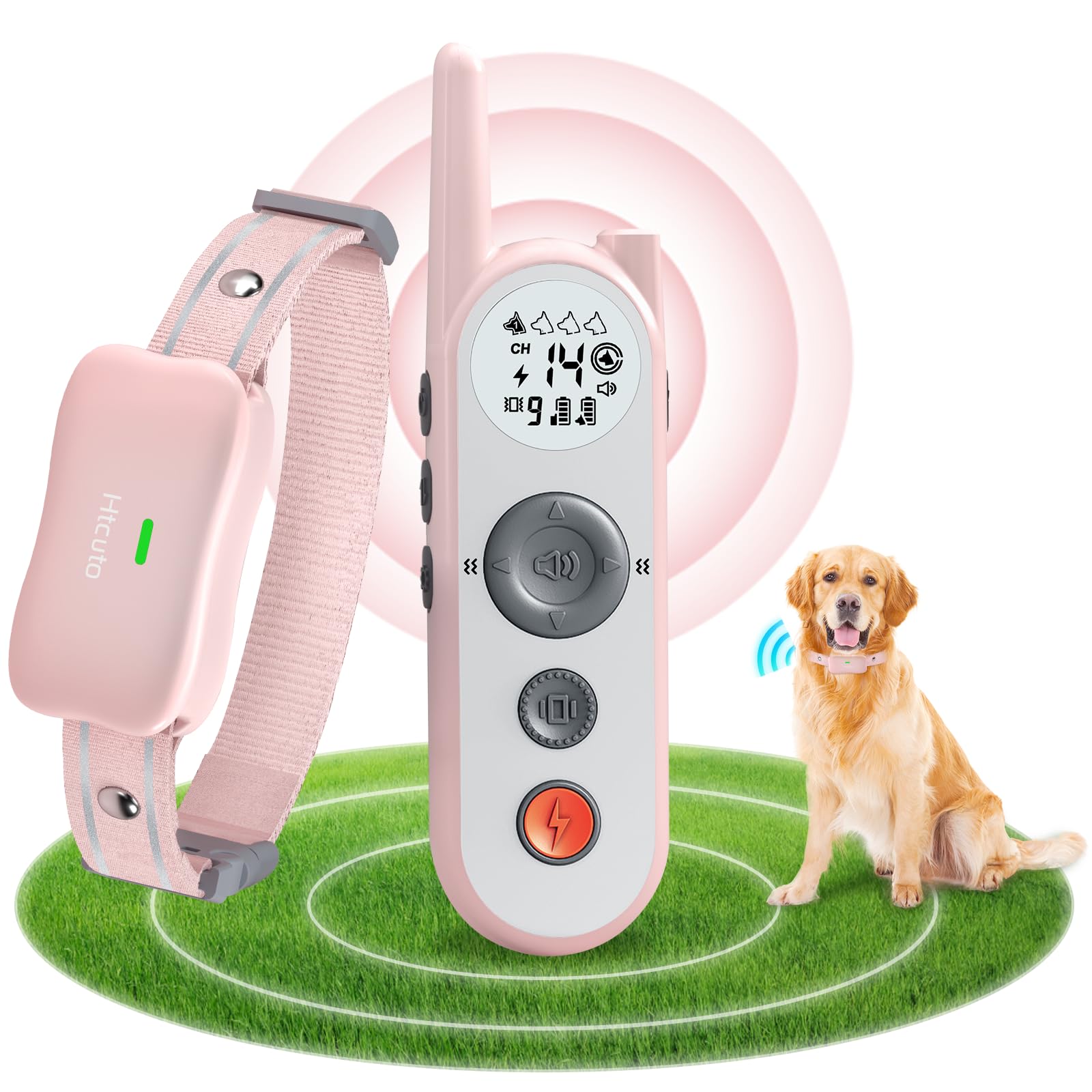
1. Htcuto Wireless Dog Fence
Our pick — 4.5+★ from 100+ verified ratings; the strongest balance of quality and price.
A 3500-foot boundary and a 6000-foot remote trainer in one kit, with no subscription.
Most containment kits make you pick a lane: a plug-in base that never leaves the house, or a GPS collar that wanders off signal. The Htcuto X3 does both jobs in one kit. It builds a circular boundary from 25 to 3500 feet using 14 distance levels, and it also carries a remote training collar with a 6000-foot reach for the trail or the park. That dual personality is why it takes the top slot — it is the one system here that follows your dog past the property line.
The boundary itself is a radius you dial in, so a wide-open half-acre and a small patio strip both work. Cross the line and the collar starts with a warning beep and vibration. This is not an automatic shock — you press to correct manually, which gives you a chance to see whether the beep alone turns your dog around. That matters if you are nervous about correction and want to lead with sound. Both the remote and the collar charge full in about 2.5 hours, and the collar manages up to 185 days on standby or around 84 hours of continuous fence use.
Weather is handled by an IPX7 collar, which is a rating meaning it survives a short dunk — so rain, sprinklers, and a quick pond dip are all fine. The strap fits dogs from 10 to 130 lbs, and the kit ships with six collar straps plus a spare USB cable and manual, which is more than most kits bother to include. There is also a keypad lock to stop accidental button presses and two flashlight modes so you can spot a dark-colored dog after sunset. As owners sum it up: “Just built a home, didn’t want to put a fence up…works amazing!”
The honest catch is the manual correction. If you want the collar to self-correct the instant your dog crosses, this is not that system — you are the trigger. The other trade-off is that a handful of long-term users report the vibration button eventually quitting while beep and shock keep working. Treat the remote as the wearable part it is and it holds up fine for most households.
What earns it the crown
- Two systems in one kit — a 25–3500 ft boundary plus a 6000 ft remote trainer
- Manual correction lets you start with beep and vibration only
- Around 84 hours of continuous fence use and 185 days standby
- IPX7 collar with 10–130 lb fit and a keypad lock
Where it asks more of you
- No automatic shock on boundary crossing — you press the button
- Vibration output has been reported to fail on a small number of units over time
Reach for this if: you want one purchase that guards the yard at home and keeps training going on hikes and camping trips.
Think twice if: you expect the collar to correct without you touching the remote.
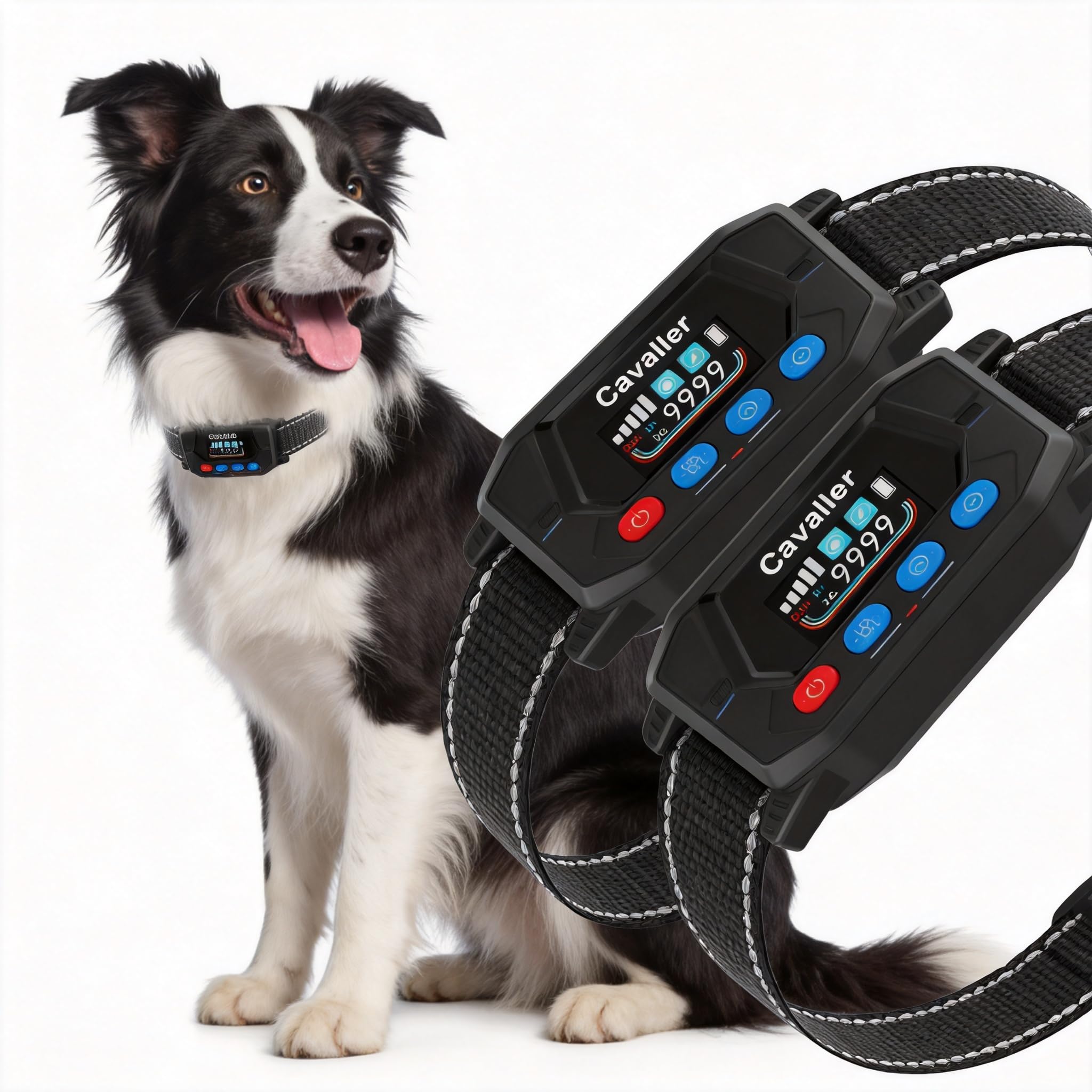
2. GPS Wireless Dog Fence Collar System 2 Dogs
A 9999-yard satellite radius for acreage where trenching a wire is out of the question.
Nine thousand nine hundred ninety-nine yards of radius is the number to sit with. That is the PATPET GF400-BA1’s headline, and it dwarfs the 3500-foot transmitter fence in the top slot — a completely different class of containment built for farms, acreage, and open fields. Satellite positioning draws the circle, so there is no base unit to plug in and no buried wire to trench. Two rechargeable collars come in the box, so two dogs get separate boundaries without buying anything extra.
Correction is where this one asks you to think. You choose from No Shock, Small Dog, and Large Dog modes, with adjustable levels sitting on top of that. At a 20–140 lb weight span, this collar fits dogs a step heavier than the Htcuto’s 130 lb ceiling, which makes it the better call for a large-breed household. The IP67 collar means it keeps working through rain, puddles, and wet grass on those long property patrols.
You leave this collar on your dog all day, so buyers care most about how it looks and how it holds up outdoors — durability and appearance run through the feedback. Tone-first training comes up again and again too: set the recall sound and plenty of dogs turn back before vibration or correction is even needed. The recurring gripe is the remote, which is small enough to slip from a pocket; a lanyard fixes that. 850+ owners have rated it 4.0+ stars, so the crowd is happy but not flawless in every case.
The big-property math: if your dog’s safe zone is measured in acres rather than a suburban lawn, this GPS radius beats every transmitter-based pick on this list for sheer coverage.
What to plan for: GPS needs sky. Heavy tree cover, a barn, or a metal-roofed outbuilding will weaken the fix, so walk the boundary yourself first.
Built for: rural and semi-rural yards where the boundary has to stretch across open ground and a plug-in transmitter has nowhere to live.
Not your pick if: your yard is heavily wooded or your dog spends long stretches indoors under a roof.
3. Wireless Dog Fence 2-in-1
A 990-foot radius and a 3.7-volt correction for a small yard on a tight budget.
Start with the number that decides everything: 990 feet of radius. That is a fraction of what the GPS fences above offer, so this Aweec system belongs in an ordinary backyard, not on ten acres. Inside that range it does two jobs. One transmitter auto-pairs with the receiver collars on power-up, so there is no manual pairing step. Switch to training mode and the same transmitter works as a handheld remote with sound, vibration, and correction.
The fence mode sends a warning tone when your dog leaves the circle, then a 3.7-volt low-voltage static pulse to prompt a return. That low voltage is note if you are correction-averse — it is a nudge, not a jolt. The kit includes four conductive posts, with two small ones for short-haired coats and two larger ones for long-haired dogs, plus silicone caps to fit over the posts once training is done. The transmitter charges in 4–5 hours and the receiver takes 1–2. That is the slowest charging on this list, so plug it in overnight.
This one earns its keep on portability and flexibility. Buyers report taking the small base unit on walks, hikes, and even horseback rides, and one early buyer said their 8-month Corgi stopped bolting within a day. The IP65 collar (rated to shrug off dust and water spray) keeps up with wet grass and splashing. But the honest limit is signal stability — a few owners mention inconsistent beeps near the edge of the circle, particularly around trees or electronics, and the maker itself warns that TVs, AC remotes, and phones should be kept away from the system. At 450+ ratings and 3.5+ stars, the picture is a split one: many happy, some frustrated.
What the lower tier buys you: a working containment and training combo for a small yard, with a transmitter light enough to travel.
The trade you make: the shortest range and slowest charging in this roundup, plus a boundary that prefers clear open ground over clutter.
Suits: a first-time fence buyer with a modest yard and a dog that already knows basic recall.
Skip if: your property is large or packed with trees, metal, and appliances that can disturb the signal.
4. Blingbling Petsfun GPS Wireless Dog Fence

Set the radius from 65 to 984 feet by dragging a circle in the Bluetooth app.
Punching in distances through tiny buttons is the part of fence setup most people dread. This Blingbling Petsfun system skips it. You connect over Bluetooth, set the center point and radius in the app, and watch a visual circle take shape — the radius runs from 20 meters up to 300 meters, roughly 65 to 984 feet. You also check collar battery right in the app, and it logs a pedometer reading for daily activity. It still relies on free GPS satellite signals with no SIM card and no monthly fee, so the app is control, not a subscription.
The collar handles the correction side with beep, vibration, and static shock at adjustable intensity, and the app can manage up to five dogs if you add collars. The strap is cuttable to fit neck sizes from 7 to 23.5 inches, aimed at medium to large dogs between 20 and 110 lbs. An IPX7 collar means rain, snow, and swimming are covered. This is the lightest review base on the list at 30+ ratings and 4.5+ stars, so it is new — but the pattern in the feedback is worth noting. People who moved off a flakier brand say this one stays switched on, with “no failures,” charging every couple of days and behaving consistently when the dogs go outside.
The one clear expectation to set: this is a Bluetooth app, so you configure and check it near the collar, not from across the county. The system is also limited to a 984-foot radius, which is smaller than the GPS giants above — right for a standard yard, not for open farmland. Everyone in a multi-dog house also needs to agree who holds the phone that runs the setup.
The setup win: a visual app boundary is faster to learn and easier to adjust than on-device button sequences.
Set expectations: Bluetooth control and a 984-foot ceiling mean this is a home-yard system, not an acreage solution.
Made for: the owner who wants to see and tune the boundary on a screen rather than decode button codes.
Not for: large properties where the safe zone needs to run well past a thousand feet.
5. Blingbling Petsfun GPS Wireless Dog Fence System 2 Dogs
A five-stage warning that builds from beep to 1-, 2-, and 3-second static.
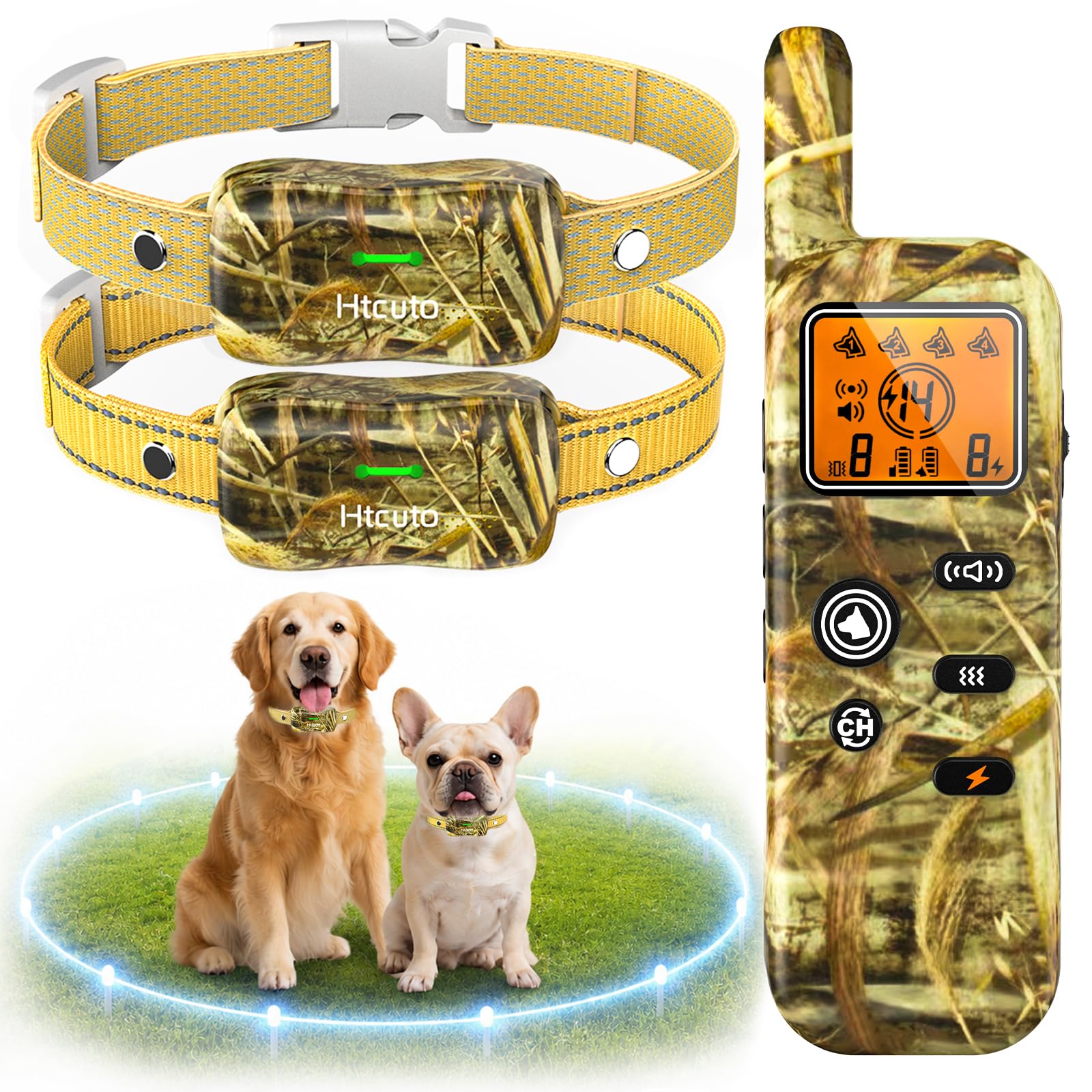
The detail worth starting with is the warning ladder. When a dog steps past this Htcuto GT1’s boundary, the collar works through five stages. In no-static mode, each stage is a beep with a rising number of vibrations. In static-enabled mode, the first two stages stay beep-and-vibration, and then three more stages add preset static output lasting 1, 2, and 3 seconds. That gradual build is the difference between a dog that learns the line and a dog that panics at a single jolt.
Boundary range runs 25 to 3500 feet across 14 distance levels, so a small suburban lot and a roomy property both fit. Two receiver collars come included for two dogs, and each dog saves its own vibration and static level before you enter fence mode. The remote training side reaches 6000 feet in open areas and offers four options: beep, ultrasonic sound, 0–9 vibration, and 0–9 static. Held commands stop on their own after up to 8 seconds. Recharging takes about 2 hours for roughly 84 hours of fence-mode running and up to 365 days on standby.
Wet grass and rain are handled, because the 10–130 lb collar is IPX7 waterproof (rated to survive a dunk in water). One setting quirk to know: levels cannot be adjusted while fence mode is active, so set them beforehand. The remote itself is not waterproof. The reliability thread in the feedback runs against the grain of the cheaper gear on this list — people who tried a pricier GPS collar from a bigger brand say they reach for this one more, because the boundary does what it says. As one puts it: “the more expensive gps collar has been so unreliable where as this one may require more attention, I like that it has setting for setting a boundary, and it’s actually reliable.”
What sets it above the pack
- Five-stage warning with 1, 2, and 3-second static stages
- Separate saved levels per dog in a two-collar kit
- 6000 ft remote training with an ultrasonic option
- Up to 84 hours fence runtime and 365 days standby
Small print to read first
- Levels lock out while fence mode is running
- The handheld remote is not waterproof
- An occasional kit ships with mismatched collars, so check the box on arrival
Best matched to: a two-dog house that wants a patient warning sequence and a long-range trainer in the same kit.
Look elsewhere if: you want to tweak levels on the fly while the fence is live.
6. Htcuto Wireless Dog Fence System for 2 Dogs (Camo)

A 3500-foot boundary plus a 25–30kHz ultrasonic mode for the porch barker.
Barking at the mail carrier is a separate problem from wandering, and this Htcuto GT1 tackles both. Its remote training side includes an ultrasonic mode that emits 25–30kHz high-frequency sound, pitched above most human hearing, to interrupt excessive barking. That shares a kit with the containment side: a 25–3500-foot boundary on 14 levels and two receiver collars for two dogs. One system covers the yard line and the noise.
Training reach runs up to 6000 feet in open areas across four modes — ultrasonic, beep, vibration, and static correction — with vibration and static able to hold for up to 8 seconds. The collars recharge in about 2 hours and run around 84 hours in fence mode with up to 365 days standby. Fit covers 10–130 lbs, and the IPX7 collar shrugs off rain, wet grass, muddy trails, and poolside splashes. The remote is not waterproof. There is also a slide safety lock against accidental presses and a lost-dog alert while fence mode is on.
Users keep raising how little the manual asks of them — it uses real photos for each step, each button, assembly, and maintenance, with a troubleshooting section at the back, which helps when English is not your first language. The honest caveat is steepness on the front end: programming takes a patient read before it clicks. Once it does, the boundary holds — one Blue Heeler owner says the collar keeps their herding dog out of the pasture and calls it “well built.”
The feature you will not find on the others: that 25–30kHz ultrasonic cue gives you a bark interruption with no contact at all.
Plan an hour with the manual: setup is more involved than the button-light systems, and power adapters should stay below 5V.
Right choice for: a two-dog yard where noise is as much a nuisance as wandering.
Wrong choice for: someone who wants to unbox and go — the programming asks for your attention first.
7. WIEZ GPS Wireless Dog Fence (2 Collars)

Satellite boundaries with an automatic timeout that stops warning after three tries.
The safety behavior is the reason to read this one closely. When a dog crosses the WIEZ line, the warning runs nonstop for 16 seconds, pauses for 30 seconds, and repeats. After three full rounds, if the dog still has not come back, the system shuts off entirely until it returns to the safe zone. That built-in cutoff is designed to prevent a dog from being nagged endlessly while it is lost or stuck — a thoughtful touch you will not find spelled out on most collars.
The GPS radius is adjustable from 65 feet up to 3281 feet, and the warning strength is tunable to match your dog. The system uses satellite positioning rather than a base transmitter, which makes it far less vulnerable to metal and electronics interference, and it stores the last setup so you are not re-plotting the circle every time. There is only a collar receiver — no extra cables or transmitters to buy — and the kit includes two collars. As one owner sums it up: “I am able to set it up for my dog to be able to roam freely around the property and also swim in our pond.”
Farm and field owners are the clear balance, and the manufacturer states plainly that it suits open fields, not houses ringed with trees. The compact build makes it easy to carry, which helps when the safe zone moves. Most reviewers who train their dog without a physical fence call it the best they have tried. This is the highest-scoring pick in the whole roundup at 4.5+ stars, and it does not pretend to be a home-yard unit — it is built for space.
The clever bit: that three-round timeout means a wandering dog is warned firmly, then left alone instead of corrected indefinitely.
Stay in open ground: the maker recommends fields and farms, so treat tree-dense yards as the wrong environment for this collar.
Belongs with: a farm, acreage, or field dog that needs broad, tunable GPS coverage and a humane timeout.
Not your fit if: your dog’s world is a tree-lined suburban lot.
8. Dogtra GPS Fence

Draw a fence around the shape of your land, not just a lopsided circle.
Every other pick here draws a circle. The Dogtra GPS Fence draws whatever you sketch in its free app — circular or custom-shaped — so it can trace an odd L-shaped lot or wrap around a house. It supports up to 30 unique fences, layered as a warning zone, a primary fence, and two backup fences. Dual-band GPS and a 100-level correction range underpin the whole thing. Set it up once in the app and the collar runs on its own with no phone connection needed thereafter.
The come-home sequence is the humane touch. A continuous beeping tone gently steers your dog back, and smart detection turns off correction whenever the dog is already returning. Each boundary can be set to tone, vibration, or stimulation. The IPX9K waterproof rating is the toughest on this list — a class that covers high-pressure water spray, so a soaked, muddy, or storm-caught dog is no problem. The collar weighs 8 ounces and fits 15 lbs and up with neck sizes from 10 to 30 inches. Up to three dogs can share one fence profile.
With 450+ owners rating it 3.5+ stars, the picture is candid. The setup is praised as easy and the app-guided mapping is a genuine draw, and dogs learn the boundary in days with a few flag walks. The recurring complaint is battery life — it runs closer to a day than a week, so plan a nightly charge. A few owners also mention the collar sliding when the GPS box sits off-balance, so check the fit. If you need a custom perimeter in a tough environment and accept a daily charge, it works.
Where it is unique: custom-shaped, layered fences plus the highest waterproof class in this roundup.
The daily chore: battery endurance is short — this is a charge-it-every-night collar, not a leave-it-for-a-week one.
For the owner who: needs a fence to follow an irregular property line rather than a plain circle.
Not ideal for: someone who wants to low-maintenance for days between charges.
9. PetSafe Guardian GPS Dog Fence, 3/4 Acre+
Five days on a charge, but this is the pick where the collar behavior asks for patience.
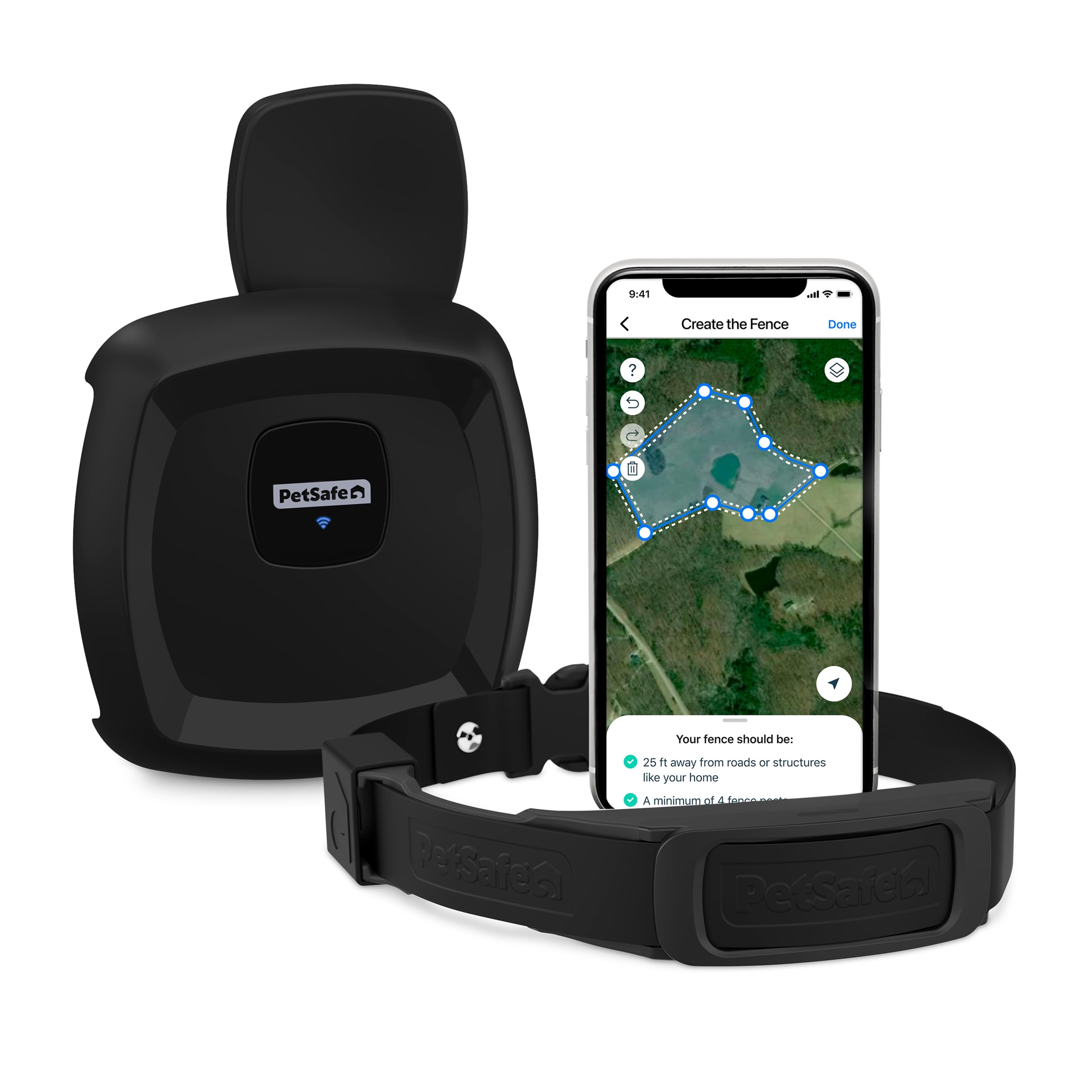
The battery figure is the standout. A redesigned, slim collar holds up to 5 days of life on one charge — the longest interval on this list — with a rechargeable, waterproof build that lets you choose tone-and-vibration or 10 levels of static. It uses AccuGuard tech, which the maker describes as blending GPS satellite data, real-time motion detection, and AI. There is no subscription and no tracking. It is designed for properties of 3/4 acre or larger and for dogs over 25 lbs with 13 to 28-inch necks, with add-a-dog collars available separately.
The My PetSafe app handles the setup and daily monitoring: you draw the boundary, then check battery and adjust collar settings, and you get notifications on your phone. That app-guided approach is convenient, and the range and clean indicator-light design get fair praise. Where it gets complicated is reliability. At 250+ ratings and 3.0+ stars, the split is honest — plenty of reviewers point out the fence working exactly as intended, while others describe the collar only working some of the time and inconsistent alerts. The app is also frequently called clunky for geofence creation, and the battery bar is vague about remaining power.
One safety detail deserves a close read: contact-point fit matters, and the collar should be checked on the neck regularly. The maker’s guidance and owner experience both point to matching the prong length to coat and inspecting the neck. Get that right, and this fence rewards you with the best battery endurance of any pick — get it wrong and you will be troubleshooting. It is the premium option here, and it earns that label on battery and brand support rather than a spotless record.
The reason to consider it: up to 5 days per charge is a real convenience no other collar on this list matches.
The honest friction: collar consistency and a clunky app put it below the higher-rated picks for most buyers.
Choose it if: long battery life and app-controlled monitoring matter more to you than a spotless reliability record.
Look elsewhere if: you want the most consistent, proven collar behavior in this roundup.
Know the Specs
Containment Range and Radius
Range describes the distance from the center of the boundary out to the edge — a radius, not the full width of the circle. A 3500-foot radius reaches far in every direction from one point. GPS fences quote range in feet, meters, or even yards, so read the unit carefully before assuming two systems are close. All of these figures come from open-ground testing, and walls, trees, metal, and terrain shrink the usable distance. Set your boundary inside your real property line to leave a margin.
Correction Levels and Warning Modes
Levels let you fine-tune how strong a correction feels. A system with 10 levels jumps in bigger steps than one with 99 or 100 levels, so more levels means gentler tuning. Warning order matters just as much: the dog-friendliest designs start with a beep, then vibration, and only then static — and many let you disable static entirely. Some collars correct automatically at the boundary, while others wait for you to press the remote. Know which behavior you want before you buy.
Waterproof Ratings
An IP rating’s second number tells you how much water the collar tolerates. IP67 means it survives a short dunk, covering rain, wet grass, and a splash. IPX7 means the same short-dunk protection and is the most common rating here. IP65 handles splashes but not immersion. IPX9K is the toughest class in this roundup, covering high-pressure spray. The handheld remote on most kits is not waterproof, so keep it dry even when the collar is fine.
Battery Runtime and Standby
Makers publish two battery numbers: continuous runtime in fence mode and standby days when idle. Runtime is the one you live by, because that is how long the collar actually works while on your dog. Standby numbers can look huge — up to 365 days on some kits — but they only apply when the collar is powered down or sleeping. Recharge time matters too: a couple of hours is common, while a few kits take closer to four or five. Plan a nightly or every-few-days charge based on the runtime.
Common Questions
Will a wireless dog fence work if my yard has a lot of trees?
Do I need a WiFi connection or monthly subscription for these fences?
How many dogs can one wireless fence system contain?
Can a wireless fence correct my dog even when it returns to safety?
How long does the collar battery actually last per charge?
Is a GPS dog fence better than a transmitter fence?
What dog weight range does each collar fit?
Can I take a wireless fence collar with me when I travel or camp?
Will the static correction hurt my dog?
How big a property do I need for a GPS fence to work well?
The Bottom Line
For most dog owners, the right pick among the wireless dog fences is the Htcuto X3 Fence 2-Dog Kit — it fences a 25–3500-foot yard and doubles as a 6000-foot remote trainer, so one purchase covers home and trail. If your property spreads across open ground, the PATPET GF400-BA1 GPS Fence gives you a 9999-yard satellite radius that no transmitter fence here can approach. And for a farm or field where you want the highest-scoring collar in this roundup, the WIEZ GPS Fence earns its 4.5+ star standing with a humane three-round timeout. Match the system to your sky and your yard, and the boundary will hold.
How we choose
We do not accept paid placement. Every pick is matched to a real buyer and a real use-case; we do not hands-on test units.
Sources
Specifications: manufacturer listings and product documentation. Review insights: verified customer reviews, as of October 2026. Pricing: not shown on this page (it changes often); check the current price via the retailer link.
As an Amazon Associate, How Dog Care earns from qualifying purchases. This does not affect which products we feature.