Disclosure: This post may contain affiliate links. As an Amazon Associate I earn from qualifying purchases, at no extra cost to you. Learn more
Specs are compiled from manufacturer listings and verified buyer reviews and can change over time — please confirm the key details on the product page before buying.
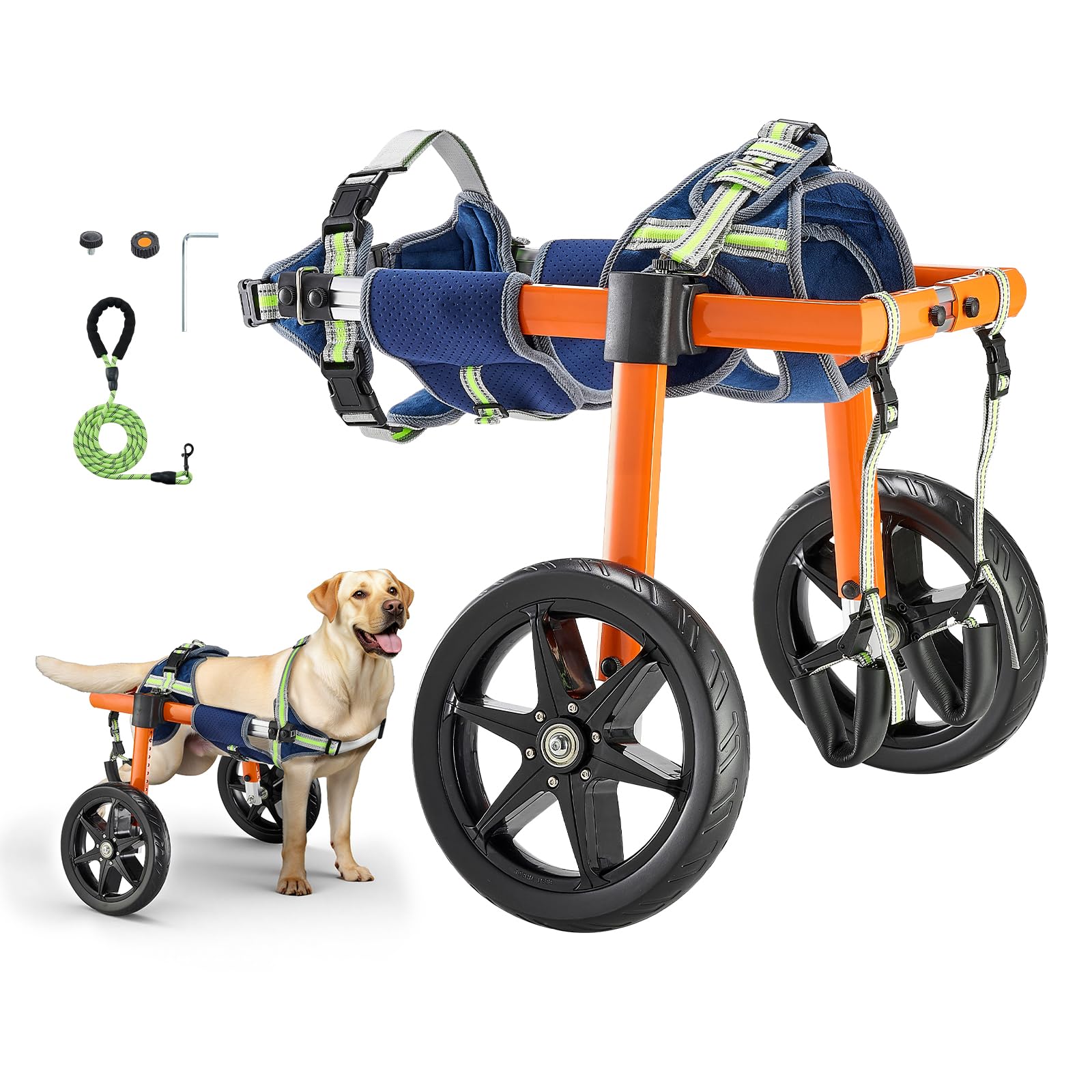
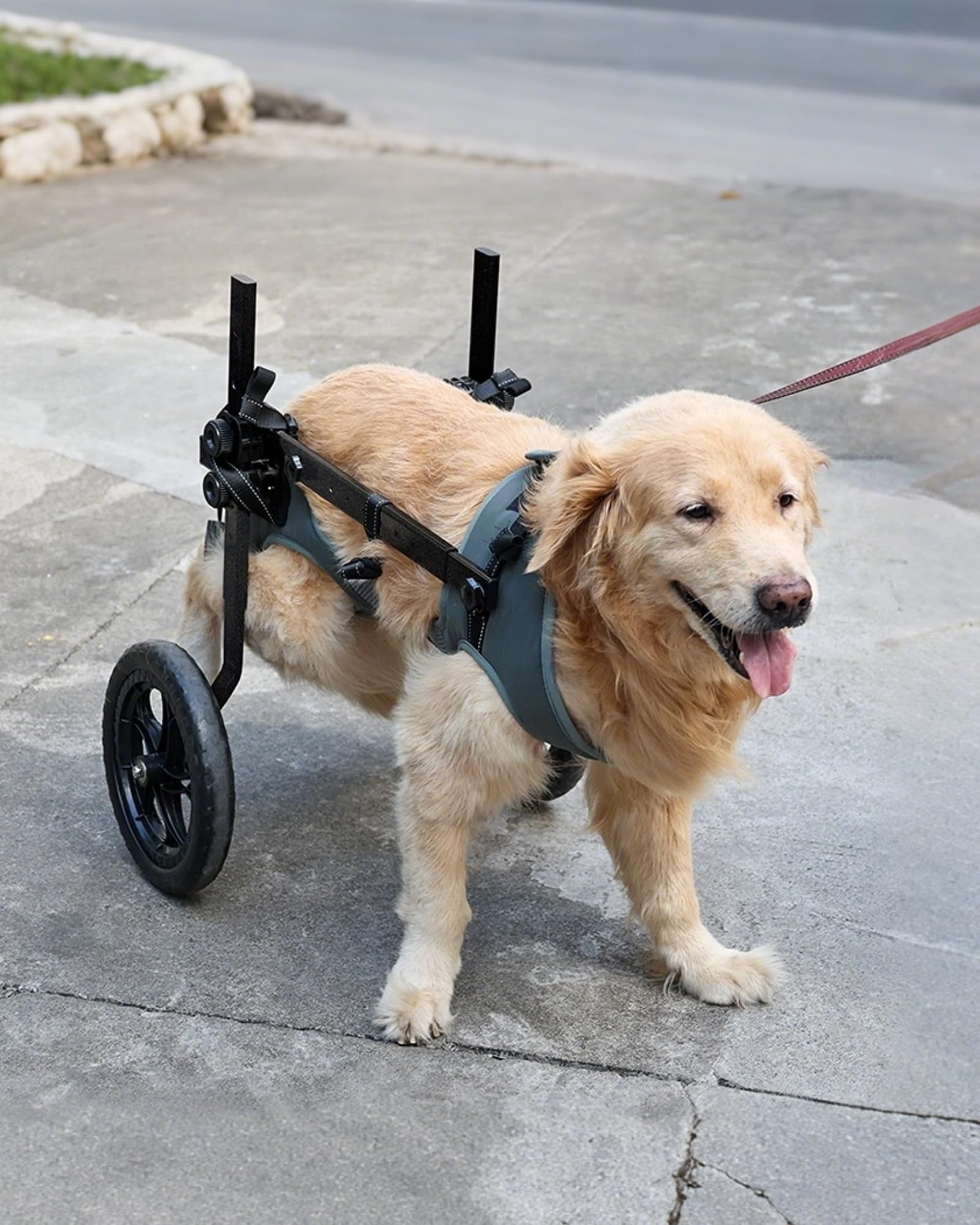
A rear-leg dog wheelchair only works if it fits your dog’s body — the width, the leg height, and the belly sling all have to line up, or your dog will refuse to move in it. That is why the right pick here depends on your three measurements, not the logo on the frame. Get the measurements right and a dog that has been dragging its back paws can be trotting down the driveway within a week. Get them wrong and you are boxing up a cart while your dog waits.
This guide is built by comparing the manufacturers’ published specifications and the patterns across verified customer reviews, so you get each pick’s real strengths and trade-offs instead of marketing spin.
Nine carts are sorted by what each one does best, with leg-height and weight ranges spelled out so you can match your dog before you buy. Every pick here is a rear-support cart for dogs with strong front legs and weak or paralyzed hind legs. The single question that decides your shortlist is whether your dog can still power itself forward on its front paws — that is what the best dog wheelchairs are built around.
Top Picks

How To Choose The Best Dog Wheelchairs
Start with three tape measurements, not with a brand name. You need your dog’s chest circumference, the gap between the front legs and the rear legs, and the floor-to-belly leg height. Those three numbers decide which cart you can actually use, and every maker on this list sizes its carts off them.
Measure the leg height first
The leg height is the distance from the floor to the top of your dog’s hind leg where the sling sits. A cart built for a 7-9″ leg will not work on a dog with a 13-14″ leg, no matter how the weight range reads. If your dog is between two sizes, size up on the frame and tighten the adjustable bars down — every cart here adjusts in height, length, and width.
Run the towel test before you order
Loop a towel under your dog’s hips and lift gently so the back stays level. If your dog steps forward on its own front legs, a rear-support cart is the right tool. If the front legs buckle or splay out wide, you are looking at the wrong class of cart and should talk to your vet before ordering. This is the single check that prevents most returns.
Decide how the cart will be stored and moved
A cart your dog wears twice a day needs to live somewhere convenient. Fold-flat frames slip behind a car seat for park trips; a fixed stainless steel frame is happiest set up in the garage. If you plan to load the cart into a sedan weekly, pay attention to the folded footprint as closely as the weight range.
Think about the surface your dog walks on
Foam wheels with rubber treads roll on grass, gravel, and pavement without puncturing. Solid rubber wheels are the tougher, quieter option for sidewalks and indoor floors. If most of your walks happen on dry loose sand, no two-wheel cart is going to feel easy — plan your routes around packed surfaces instead.
Side-by-Side Comparison
| Model | Best For | Weight Range | Cart Weight | Wheel Type | Amazon |
|---|---|---|---|---|---|
| Walkin’ Wheels Large (70-180 lb)★ Best Overall | Big dogs who need a proven, adjustable frame | 70-180 lbs, 20-22″ leg | 21 lbs | Dense foam with rubber treads | Amazon |
| VEVOR Lightweight 2-WheelLightest Option | Medium dogs and owners who travel with the cart | 35-48 lbs | 6.4 lbs | Shock-absorbing EVA treads | Amazon |
| TianfuSpanda XL AdjustableBest Big-Dog Value | Large dogs on grass and mixed ground | XL, chest 28.3-33.9″ | 7.13 lbs | Upgraded large wheels | Amazon |
| Whisker Bark Stainless Steel (L) | Easy on-and-off in a busy household | L, 60+ lb | — | Solid rubber | Amazon |
| Walkin’ Wheels Dachshund | Long-bodied small dogs with short legs | 11-14 lbs, 7-9″ leg | 8 lbs | Dense foam with rubber treads | Amazon |
| Walkin’ Wheels Small (15-25 lb) | Small breeds who need a long-life frame | 15-25 lbs, 12-15″ leg | 10 lbs | Foam with rubber treads | Amazon |
| All-Terrain XL (55.1-88.1 lb) | Big dogs on pavement, grass, and indoor floors | 55.1-88.1 lbs (XL) | 10.28 lbs | 11.8″ all-terrain with bearings | Amazon |
| K9 Carts Custom Made in USA | Owners who want a measured, hand-built cart | 21-35 lbs | 5.5 lbs | EVA foam with ABEC bearings | Amazon |
Detailed Reviews
1. Walkin’ Wheels Dog Wheelchair for Large Dogs, 70-180 Pounds
Our pick — 4.0+★ from 600+ verified ratings; the strongest balance of quality and price.
A 21-pound aluminum cart built to carry a 70-180 pound dog through its changing health.
The frame adjusts in three directions — height, length, and width — so the cart grows with your dog instead of being outgrown by it. That matters with a progressive condition, because the same cart that fits this month can be re-tuned next season without a second purchase. The aluminum build weighs 21 pounds, which is heavy to lift into a car but reassuring under a dog that size.
The build itself wins people over. The cart is steady enough that a dog with hip and leg weakness steps straight into it. One 12-year-old 80-pound German Shepherd that was 95% paralyzed after a stair slip was back to roughly 75% walking ability after about a year in it — buyers report exactly that kind of slow recovery. Set aside about two hours for assembly plus an hour of dialing in the fit, and build the cart in front of your dog so the noise does not scare it.
The honest catch is the wear parts. Harness stitching has let go on some carts, the foam wheel treads wear with hard use, and a D-ring has snapped at the six-month mark on one cart, though the company replaced the hardware. Also check doorway widths before you commit — a wider stance on a big dog can be awkward indoors. The cart is outright heavy, which is the trade-off you accept for the 70-180 pound support range.
Where this cart earns its keep
- Adjusts in height, length, and width, so it follows a changing condition instead of needing replacing.
- Dense foam wheels with rubber treads hold up on grass, gravel, and pavement without puncturing.
- Folds flat for the car and every part is washable, including the wheels.
- The 70-180 pound range covers genuinely big dogs that most carts skip past.
What you should plan for
- At 21 pounds it is the heaviest cart here by a wide margin, so lifting it into a trunk takes two hands and some intent.
- Two hours of assembly and an hour of adjustment before the first walk.
- Small wear parts — stitching, wheel treads, a D-ring — are the recurring weak points over months of use.
- Measure the chest width against your doorways before ordering for a very broad dog.
Reach for this if: you have a big dog with weak or paralyzed hind legs and you want one cart that can be re-sized as the condition changes.
Think hard first if: you live alone with a 150-pound dog, since the 21-pound cart plus a big dog is a two-person lift.
2. VEVOR Dog Wheelchair for Back Legs, Lightweight 2-Wheel
The cart that swings over your shoulder and disappears into the back of the car.
Six point four pounds is the headline. That is roughly a third of the 21 pounds the Walkin’ Wheels large cart weighs, so this is the one you can carry with the leash in the other hand. The aluminum frame is 1.5 mm thick rather than the standard 1 mm, which the maker says keeps it stiff enough not to sag under a mid-size dog.
The fit range is 35-48 pounds, with 18 length settings, 12 width settings, and 12 height settings, so you can dial in a mid-size body without guessing. The mesh is breathable and washable, and the shock-absorbing wheels run quiet on gravel, grass, dirt, and asphalt. A 2-meter leash ships in the box, and the spring buckles mean you are not hunting for a wrench every time you adjust it.
Here is where you need to be honest with yourself: this cart is a two-person job to strap on. Owners mention that plainly — “It takes 2 persons to put it on the dog” — and the parts count during assembly is high enough to discourage a first-timer. If you handle your dog alone, expect a learning curve, or plan on a helper for the first couple of weeks. It also tops out at 48 pounds, so it is not the cart for a big shepherd.
The travel argument: at 6.4 pounds it is the cart you will actually pack, and the shock-absorbing EVA treads keep it quiet on pavement and compact gravel where firmer wheels chatter.
The real trade-off: the many-part harness is fussy to get on and off, and the 48-pound ceiling rules out large dogs entirely.
It beats the pack on portability: 6.4 pounds against 21 pounds for the large Walkin’ Wheels is a different category of cart to carry.
It loses on ease of strapping: plan for two pairs of hands during the fitting phase.
3. TianfuSpanda Adjustable Large Dog Wheelchair, XL
Seven pounds of cart holding up a large dog, with bigger wheels for the backyard.
The XL size is built around a chest circumference of 28.3-33.9 inches, and the cart itself weighs 7.13 pounds. That combination — a large-dog size that still carries light — is the reason this one earns a spot. Height and length adjust, so you can level out the frame under a dog that stands tall.
The upgraded wheels are the part that changes daily life. They steer more smoothly and stay steadier in grass than small cart wheels, and the frame is built to move over uneven backyard ground rather than only smooth floors. The company also asks you to send your dog’s six measurements and a photo before ordering if the sizing is unclear, which is a real safety net on a frame this size.
Two caveats to weigh. The instructions ask you to measure chest circumference and the gaps between the front and rear legs and between the two front legs — skip that and you will get a poor fit. And getting a 60-pound dog into the harness is not a one-handed task; reviewers describe lifting and guiding as the hard part, not the cart itself. The frame materials have drawn some durability questions, so treat the cart kindly and check the joints monthly.
Why the XL frame holds up
- 7.13 pounds carries a large-dog frame without the heft of a 20-pound cart.
- Larger wheels roll over grass and mixed ground with better balance than small wheels.
- Height and length adjust for a taller dog’s stance.
- The maker will size-check your dog’s six measurements before you commit.
Worth a second look
- Loading a 60-pound dog into the harness takes real effort and a steady second hand.
- Construction durability has drawn some skepticism, so inspect joints regularly.
- Chest measurement is the sizing key — order on a guess and you will get a poor fit.
Your move: send the maker your dog’s six measurements and let them confirm the XL before you buy.
Where it strains: the harness-up moment on a heavy dog is a two-person job in practice.
4. Whisker Bark Adjustable Dog Wheelchair

The cart people describe as a minute of setup, not an hour of wrestling.
What surfaces again and again in the feedback is how quickly this cart goes on and comes off. That is the whole pitch: getting it on and off is super easy, and a worn-out owner with a stiff-backed dog notices that every single morning. The stainless steel frame adjusts in height, width, and length, and the belly support and harness areas are padded and breathable so the dog is not fighting the straps.
Daily practicality is baked in. Solid rubber wheels roll across grass, sidewalks, and pavement, and the open design is deliberate — it lets your dog relieve itself naturally rather than making you pull the whole cart apart. It sanitizes easily and the portable frame travels. That combination makes it the cart for a household where the routine is three short walks a day and one clean-up.
Know what it is not. It is a large size rated for 60+ pound dogs, but the harness shape is not universal — a 10-pound dachshund in the XXS came back as a completely wrong fit on the front harness, and that is a body-shape mismatch, not a fault in the cart. Long, low dogs should look at the dachshund-specific cart instead. Owners of standard-bodied dogs describe the fit as spot on.
What the routine feels like: on in a minute, padded where it touches the belly, and built so bathroom breaks do not mean stripping the harness off.
Pick this one if: you are handling the cart alone every day and want the fastest on-and-off in the group.
Look to the dachshund cart instead if: your dog is long and low, because the front harness is shaped for standard bodies.
5. Walkin’ Wheels Dachshund Wheelchair, 2-30+ Pounds

Built for the long body and short legs that standard carts get wrong.
This is the cart for a dog sized 11-14 pounds with a 7-9 inch leg, which is the shape a doxie actually has. The aluminum frame weighs 8 pounds and adjusts in height, length, and width, so the long-back geometry can be balanced rather than forced. Stirrups and a belly band come in the box, which matters for a dog whose hind feet tend to knuckle under.
Where a standard harness pinches the chest on a long-bodied dog, this one is cut for it. Dense foam wheels with rubber treads take grass, gravel, and pavement without puncturing, and the parts wash clean. The cart folds down and slips into a car for vet trips.
Set your expectations honestly on two points. Assembly instructions have been called somewhat vague — manageable, but plan on a patient hour. And a 17-year-old dachshund refused to move in it even for treats, which is a dog thing, not a cart thing; with a younger dog, the adjustment period is worth pushing through. The cart is also a bit heavy for a very small doxie, so expect a short adaptation window while the dog builds up.
Why the shape matters
- Sized for 7-9″ legs and 11-14 pounds, so the long back is properly supported.
- Stirrups and a belly band included for hind feet that scrape.
- Patented adjustable design re-sizes as the dog’s condition changes.
- Folds and travels, with every part washable.
Set aside patience for
- The written instructions are vague enough that assembly takes longer than it should.
- An 8-pound cart is noticeable on a very small dog until they strengthen up.
- A senior dog that has given up on walking may simply refuse, regardless of fit.
Right cart, right dog: if you have a doxie-shaped dog with weak hind legs, this is the geometry that fits.
Wrong tool if: your dog is a senior who has already stopped trying to move — no cart fixes that reluctance.
6. Walkin’ Wheels Small Dog Wheelchair, 15-25 lbs

Ten pounds of extruded aluminum that a small dog can lean on for years.
The fit spec is what to check first: 15-25 pounds with a 12-15 inch leg. Inside that window, the extruded aluminum frame adjusts in height, length, and width, and the maker builds it chew-proof, which is a real consideration for a young dog that mouths everything. Foldable struts let the cart collapse into a small footprint for the car.
This is the cart that gets described in the language of resurrection. A 10-year-old Pomeranian with IVDD (a spinal-disc disease that can paralyze the hind legs) was running on grass within about 15 minutes of the first fitting. That adaptation speed depends on the harness design and the belly support strap, which lets a small dog feel the ground again.
Budget roughly 45 minutes to an hour for assembly and adjustment, and expect some fiddling with the leg lifters — raising the legs is described as one of the harder bits. Front wheels have needed service on at least one cart, which the company sorted out. And if your small dog has unusually short hind legs, the standard frame may never sit right; that is the moment to look at the dachshund model.
The honest read on durability: aluminum construction and a chew-proof build suggest a cart meant to last, and the foldable struts make it a genuine travel companion for a small breed.
Best matched to: a small dog with a 12-15 inch leg who needs a cart for the long haul.
Not the answer for: a dog whose hind legs are shorter than the frame assumes — check leg height before anything else.
7. All-Terrain Dog Wheelchair, 11.8″ Wheels, XL (55.1-88.1 lbs)

Eleven-point-eight-inch wheels and real bearings for a 55-88 pound dog on rough ground.
Wheel diameter is the spec that decides how a cart feels under a big dog, and 11.8 inches with quality bearings means this one rolls quiet and steady on grass, pavement, and indoor floors. The XL frame covers 55.1-88.1 pounds and weighs 10.28 pounds, built from aircraft-grade aluminum so the dog carries support rather than dead weight.
The harness detail is the smart part. A reinforced abdominal strap redistributes weight off the spine and hips, and the fabric is chosen to reduce rubbing during long wear. Front harness attachment is designed to be quick, which shortens the morning routine. The maker even publishes a towel test: lift your dog’s hips with a towel, and if the front legs can push forward, this rear cart is the right class — if the front legs wobble, a four-wheel chair is the honest answer.
The mixed part is the harness sizing. Some dogs fit perfectly and some find the harness too big, and a mid-size dog with hind-leg weakness has been described as uncomfortable in the rear harness while the owner wrestles to hold the dog up. There is also a single report of a main wheel separating from the frame and the cart tipping with the dog inside — check the retention clips before every walk, and stop using the cart immediately if anything feels loose.
Where the money goes: big bearings and 11.8″ wheels make this the smoothest-rolling cart for a heavy dog on mixed ground.
The safety conversation: retention clips and wheel mounts deserve a pre-walk check, because one cart was reported tipping with a dog inside.
Go here for ground clearance: 11.8″ wheels are a size up from a typical cart and it shows on grass and gravel.
Double-check the harness size: a body that lands between sizes can end up uncomfortable in the rear harness.
8. K9 Carts Dog Wheelchair Back Legs

Hand-built to your dog’s measurements in the USA, at 5.5 pounds.
Five and a half pounds makes this the lightest cart in this group, and it is built one at a time rather than picked off a shelf. The frame is designed by veterinary orthopedic surgeons and refined over 50 years by the company that originated pet mobility carts. Every cart adjusts fully in height, length, and width, and ships within 1-5 business days.
The design detail that earns the custom price is the leg rings: contoured, dense foam padding covers the cable rings to prevent pressure sores and give pelvic support. You can run it as a walking cart with the rear paws on the ground or as a suspension cart with the legs held up in protective slings, which means the same cart follows a dog from partial mobility into full hind-limb support. The EVA foam wheels (a lightweight, shock-absorbing foam) use high-end 3-ABEC bearings (a precision rating for smooth rolling), and the cart is rated for lakes and oceans as well as grass and trails.
What you pay for beyond the build is the sizing conversation. The maker contacts you for measurements, and people describe that process as the reason the cart arrives fitting correctly. It arrives pre-adjusted, with a DVD and written instructions, and most owners are moving in under an hour. Expect the dog to need a patient week or two; a Corgi losing strength in both rear and front legs got there in the end. One practical gap: no expedited shipping through Amazon, so order before a surgery date rather than after.
Why the custom build earns it
- Built to your dog’s measurements, so it arrives fitting rather than needing a return.
- 5.5 pounds — the lightest cart here, and the least burden on a weak dog.
- Foam-padded leg rings guard against pressure sores on the pelvis.
- Walks as a ground cart or suspends the legs in slings as needs change.
- The maker walks you through sizing and ships in 1-5 business days.
Plan around this
- No expedited shipping option through Amazon, which matters if surgery is scheduled.
- The custom sizing conversation takes time — do not buy the week of an operation.
- A dog losing front-leg strength too will need a different, full-support cart.
This is the one for a specific dog: 21-35 pounds, strong on the front legs, and about to have surgery.
Start the order early: custom building plus standard shipping is not a same-week purchase.
Know the Specs
Weight Range vs. Leg Height
The weight range is the number everyone reads first, but the leg height — the floor-to-sling distance — is what actually decides fit. A cart sized for a 7-9″ leg will sit too low on a 13-14″ dog even if the pounds match. Measure both, and size on leg height first.
Cart Weight and Frame Material
The cart’s own weight is what your dog drags forward. Aluminum frames keep that down — 5.5 to 10.28 pounds across this group — while stainless steel trades some weight for a sturdier feel. If your dog has weak front legs, go lighter, because the front legs do all the pushing.
Wheel Diameter and Tread
Bigger wheels roll over grass and gravel with less shove from the dog; 11.8″ with bearings feels smoother than a small solid wheel. Foam and rubber treads will not puncture on gravel. Expect loose dry sand to be a slog no matter the wheel size.
Harness and Belly Support
The harness carries your dog’s rear weight and touches the body all day. Padded, breathable fabrics reduce rubbing. A reinforced abdominal strap shifts weight off the spine and hips, which matters for dogs with IVDD or degenerative myelopathy. A belly band or sling setup also helps with bathroom breaks.
Common Questions
How do I know if my dog needs a wheelchair for the back legs or all four legs?
Will a dog wheelchair work for a dog with IVDD or degenerative myelopathy?
How long does a dog wheelchair last?
Can my dog urinate and poop while wearing the wheelchair?
What size dog wheelchair do I need if my dog is between two sizes?
Is it hard to get a dog into a wheelchair?
How long does it take a dog to adjust to a wheelchair?
Can a dog wheelchair be used on grass and trails?
Can I use the wheelchair indoors on my floors?
Can I return a dog wheelchair if it does not fit?
The Bottom Line
For most dogs within its size range, the Walkin’ Wheels large cart is the answer because it adjusts in three directions and carries 70-180 pounds on a frame that folds flat. If your dog is a small, long-bodied breed like a doxie, the Walkin’ Wheels Dachshund cart fits the geometry that standard carts miss. And if you want a hand-built cart sized to your own dog’s measurements, the K9 Carts custom build is worth the fitting call. Take the threemeasurements and run the towel test before you order — it is the single step that decides whether your dog wheelchairs purchase ends in a trotting dog instead of a boxed cart.
How we choose
We do not accept paid placement. Every pick is matched to a real buyer and a real use-case; we do not hands-on test units.
Sources
Specifications: manufacturer listings and product documentation. Review insights: verified customer reviews, as of October 2026. Pricing: not shown on this page (it changes often); check the current price via the retailer link.
As an Amazon Associate, How Dog Care earns from qualifying purchases. This does not affect which products we feature.