Disclosure: This post may contain affiliate links. As an Amazon Associate I earn from qualifying purchases, at no extra cost to you. Learn more
Specs are compiled from manufacturer listings and verified buyer reviews and can change over time — please confirm the key details on the product page before buying.
If your dog has more energy than your schedule can absorb, a dog treadmill solves the problem without a single rainy walk. The real decision is not which machine looks toughest, but who sets the pace. It is if you want a motorized belt that sets the pace or a dog-powered slatmill where your dog controls every step. This guide breaks down eight machines built for dogs, sized from a 15-pound Yorkie up to a 100-pound German Shepherd.
This guide is built by comparing the manufacturers’ published specifications and the patterns across verified customer reviews, so you get each pick’s real strengths and trade-offs instead of marketing spin.
You will see the exact deck sizes, weight limits, and speed ranges that decide whether a machine actually fits your breed. Every pick below is a canine treadmill, not a human one, so the belt length and paw safety are built for four legs. Here is the honest breakdown of the dog treadmills for exercise worth your floor space. And one of these has earned the crowd’s trust at 4.0+ stars across 200+ owners.
Top Picks

How To Choose The Best Dog Treadmills for Exercise
Before you compare a single model, decide what kind of machine your dog will actually use. A motorized treadmill has a belt that runs at a set speed, which you control with a remote or a program. A slatmill is motorless: your dog’s own paws drive the running surface forward, and your dog sets the pace. That single choice changes everything else — the price tier, the assembly, the safety gear, and how fast your dog adapts.
Slatmill or motorized belt: pick the temperament first
A nervous dog that flinches at motor hum usually settles faster on a motorless slatmill, where its own paws drive the belt and nothing forces the pace. An energetic dog that needs structured intervals often does better with a motorized belt, where you can dial a speed range and follow preset programs. Think honestly about your dog. A dog that already panics at the vacuum is not a candidate for a loud motor.
Measure withers height and chest width, not just weight
The weight capacity tells you how much load the frame holds, but it does not tell you whether your dog fits. Withers height is the distance from the floor to the top of the shoulders — the highest point of the back before the neck. Chest width is the widest part of the ribcage. If your dog’s gait is long, a short deck forces the hind legs off the back of the belt, and that happens even when your dog is well under the weight limit.
Brakes, safety keys, and harness guides
A brake lets you slow or lock the track when the session ends, so the belt does not slide while you unclip a harness. A safety key is a magnet fob that cuts the motor if it detaches. A harness guide or overhead bar keeps a dog aligned on the deck. These are the features that separate a safe daily tool from a machine you have to watch with both hands full.
Where the machine will live
These are heavy machines. Several of the picks here weigh over 100 pounds, and the lightest is still close to 90. Measure the floor space before you buy, and think about if you need transport wheels to roll it between a garage and a patio. If you live upstairs, noise matters too, so look for a model with cushioning or quiet rollers.
Side-by-Side Comparison
| Model | Best For | Drive Type | Weight Limit | Deck Size | Amazon |
|---|---|---|---|---|---|
| PawPaw’s Dog Treadmill★ Best Overall | Large and medium dogs | Non-electric slatmill | 330 lbs | 16.5 in wide | Amazon |
| Lifepro PawRunnerMost Programmable | Small and medium dogs | Motorized | 130 lbs | 38.6″ x 14.2″ | Amazon |
| FYC Treadmill with RemoteBest Value | Small and medium dogs | Motorized, 2.5 HP | 265 lbs | 41.3 in x 15.8 in | Amazon |
| HotFeed Dog Slat Mill | Medium breeds | Non-motorized slatmill | 320 lbs | 66″ x 20″ frame | Amazon |
| BowWowTread | High-energy large breeds | Self-powered | 220 lbs | 69 in x 21 in | Amazon |
| Simulated Nature Trotter | Large and medium dogs | Self-propelled | 220 lbs | 16.5 in wide | Amazon |
| Kolmmeo Non-Motorized | Large dogs, multi-dog homes | Dog-powered slatmill | — | 67 in x 24 in | Amazon |
Detailed Reviews
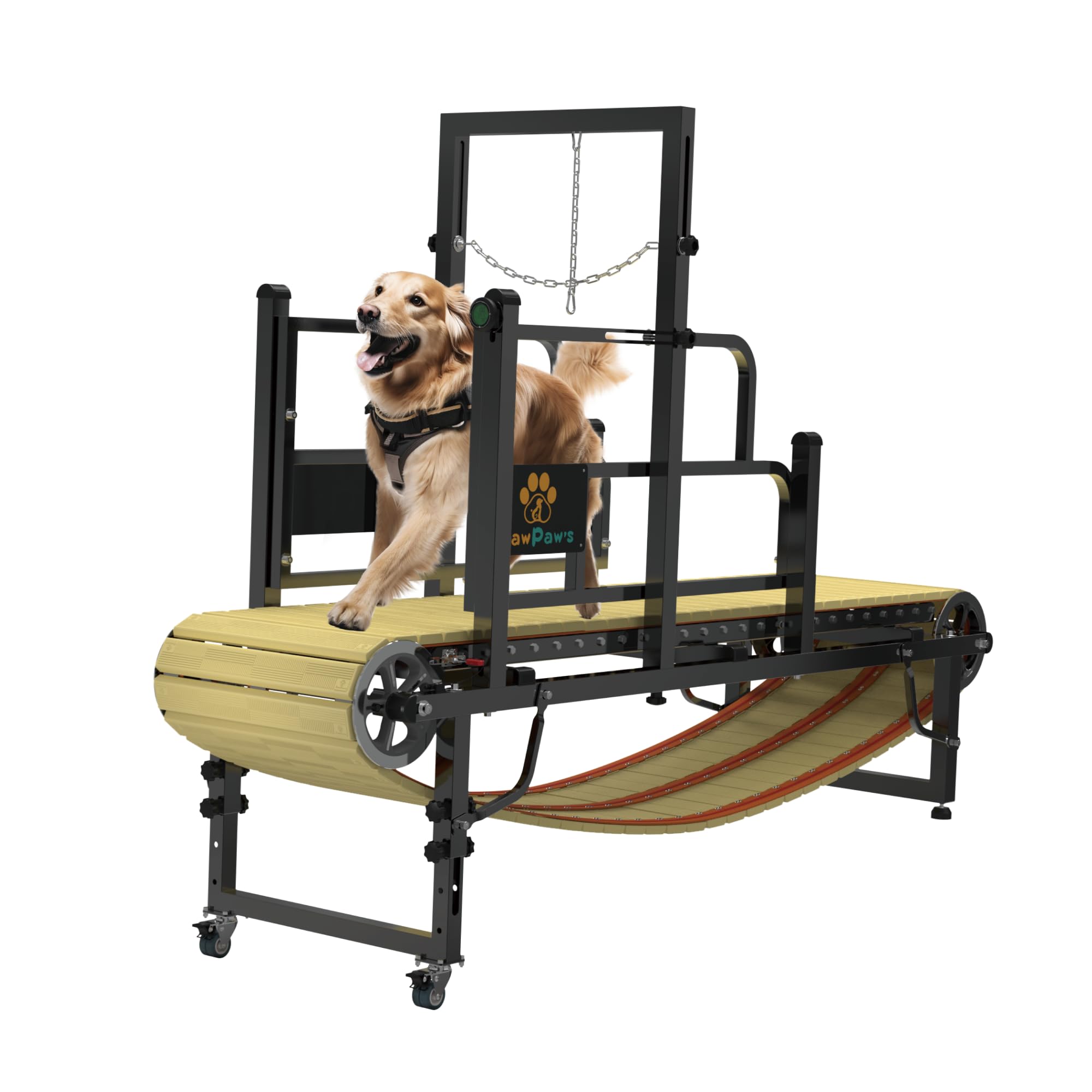
1. PawPaw’s Dog Treadmill
Our pick — 4.0+★ from 90+ verified ratings; the strongest balance of quality and price.
A no-motor slatmill that lets a big dog run on its own terms, indoors or out.
One number defines this machine’s range: 330 lbs of capacity. That is the highest weight limit on this list, and it sits over a solid carbon steel frame with wooden slats and aluminum rollers. For a large breed, that means the deck holds up through repeated sprint sessions rather than sagging under a heavy dog. The Large model fits breeds with a withers height up to 29.5 inches and a chest width under 20.5 inches. The Medium model fits a withers height up to 23.6 inches and a chest width under 16.5 inches.
Because it is non-electric, there is no motor sound and no forced pace. Your dog starts, slows, and stops on its own — a real advantage for a dog that fears the hum of a motorized belt. You can walk alongside with treats to lead the first few sessions. The 20-minute assembly is quick, and adjustable heights let you match different dogs on the same frame. Buyers report that even a cautious 80lb GSD that started apprehensive now loves it.
The catch is the brake question. The listing title mentions a brake, but the reviews are split on whether a brake mechanism is actually included. If a lockable brake is a must-have for you, budget for a model that states it plainly. Also note the footprint: at 69″D x 22″W x 59″H it is a substantial piece of equipment, and it weighs 110 pounds. For context, the FYC deck below is 35% smaller in overall dimensions, which makes that one the easier fit in a tight room.
What the slatmill gets right
- 330 lbs capacity — the strongest weight limit here, suited to a heavy large breed
- Non-electric and dog-paced, so a nervous dog is never dragged along by a motor
- Solid carbon steel frame with wooden slats and aluminum rollers
- Adjustable height across different pets, plus a 20-minute setup
What to weigh before buying
- Brake availability is unclear in the listing and mixed in reviews
- 110 pounds and 69 inches deep — measure the room first
- Wooden slats may need sanding for splinters, per owner notes
Reach for this if: you have a large or medium breed that needs a tough, motorless deck and you want the highest weight limit on this list.
Look elsewhere if: a lockable brake is non-negotiable — this one does not clearly state one.
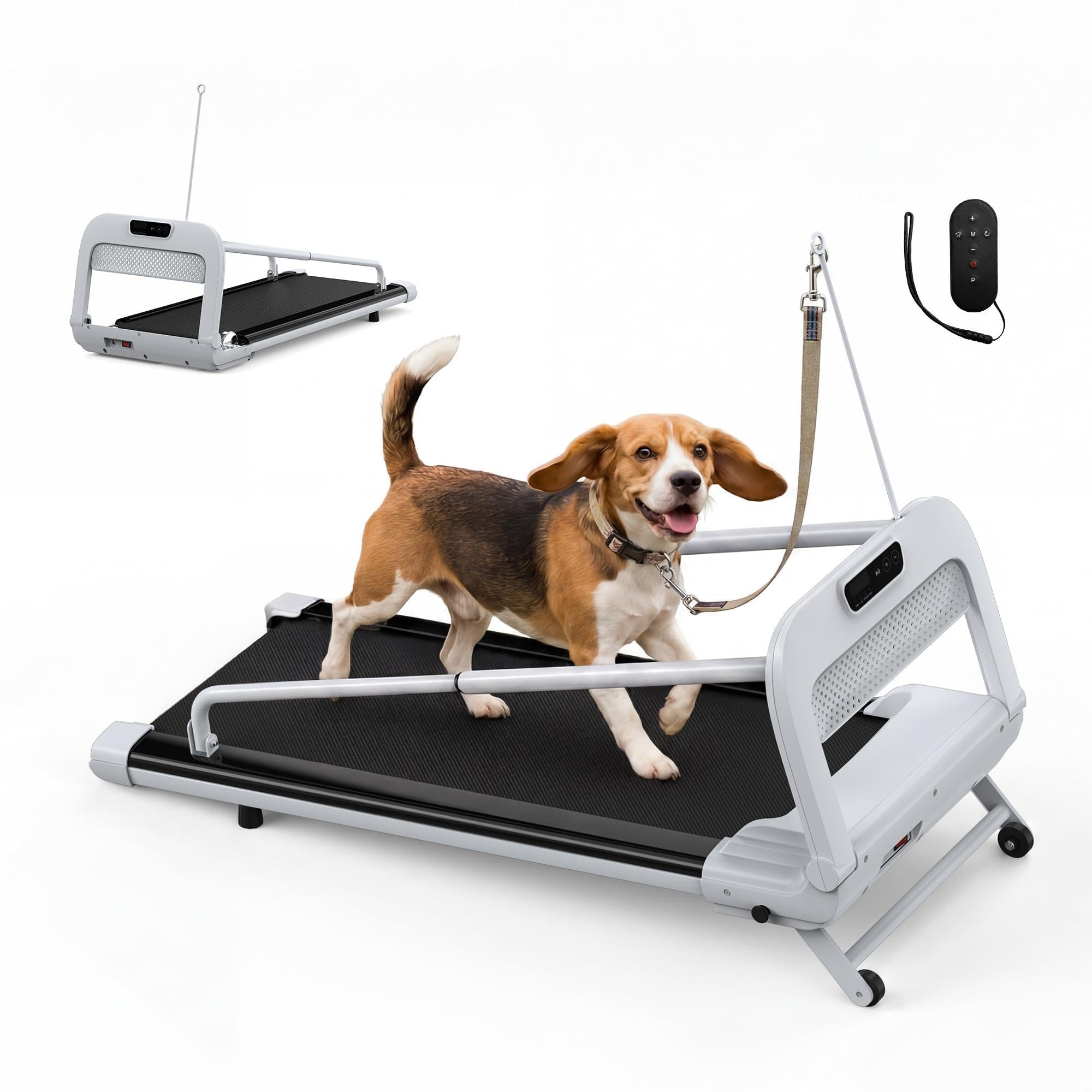
2. Lifepro PawRunner Dog Treadmill for Small & Medium Dogs
The 1,000-watt motorized pick with a remote and a safety key built for skittish small dogs.
This is the machine for a dog under 130 lbs that needs you to set the pace. A 1,000-watt motor drives a 38.6″ x 14.2″ running surface at a 0.5–7.5 MPH speed range — fast enough for a brisk jog, slow enough for a recovery walk. The remote lets you adjust speed from across the room, so you can stand beside your dog with a treat rather than bending over the console. An LCD display shows the session readout, and a safety key plus an emergency stop button give you two ways to cut power fast.
The quiet motor is the point for sound-sensitive dogs. It is designed as an in-home unit, and it runs at a low hum rather than a roar. Setup takes about 10 minutes according to the maker, and the deck folds to 28 inches for storage. What wins people over is the mix of a genuinely quiet motor and simple controls — the older and smaller dogs take to it especially well, and it earns a 4.0+ star rating across 200+ owners.
Know the size ceiling. This is not a large-breed machine — it tops out at 130 lbs and a 35.4″ tall, 29.5″ long frame. One Belgian Malinois owner found the gait too long and the hind legs slipping off the belt above 1.5 MPH despite the dog being under the weight limit. Measure your dog’s length before you buy, and remember the “Err” message many new owners hit simply means the red safety key is not seated on the panel.
Where it shines: the quiet 1,000-watt motor and remote pairing make it a gentle first treadmill for a puppy or an older small dog.
Real limit: the 38.6-inch deck is short for a long-strided breed, so a large or leggy dog will outrun the belt.
Best matched to: small and medium dogs that need a quiet, remote-controlled session.
Think twice for: large breeds or long gaits that need more deck than the 38.6-inch belt provides.
3. FYC Treadmill for Small & Medium Dog with Remote & Incline
A 2.5 HP motor over a wide 41.3-inch deck, built to carry a surprising amount of dog for the price.
Here is the value story in two numbers: a 2.5 HP motor and 265 lbs of capacity. Where the FYC pulls ahead of the small-dog machines is deck width. Its 41.3″ x 15.8″ running surface is wider than the PawRunner’s 15.8 versus 14.2 inches, so a medium dog gets room to stretch out. A 0.5–6.0 MPH range covers a slow recovery walk up to a sprint, and 12 preset programs plus an LCD and remote let you set a routine without dialing it in by hand each time.
The two-level manual slope is the feature to know: it simulates a gentle uphill walk for an aging or recuperating dog, easing joint load compared with flat running. Owners describe the setup as quick and the profile as small, and many note it runs quietly. At 51.22″D x 22.06″W x 27.58″H it is 35% more compact than the PawPaw’s footprint — the easiest of the big-deck picks to tuck into a corner.
Understand the trade-off before you commit. Some units arrive with an E08 error from shipping damage, and dealing with that can mean a slow round of support emails. A few find it heavier than expected to move, and the handlebar does wobble slightly, though it holds balance fine. It is a light-duty machine overall — best treated as a family dog’s daily supplement rather than a heavy-duty workhorse for a 90-pound dog.
The value read: a 2.5 HP motor, a wide 41.3-inch deck, and 12 preset programs at a mid-range price tier — strong kit for a medium-breed household.
Honest caveat: light-duty build quality, and a shipping-damaged unit can mean a slow support cycle.
Settle on this when: you want a powered belt with incline and room to move for a medium dog.
Keep looking if: your dog is heavy enough to need a slatmill-grade frame.
4. HotFeed Dog Slat Mill for Medium Dogs with Brake
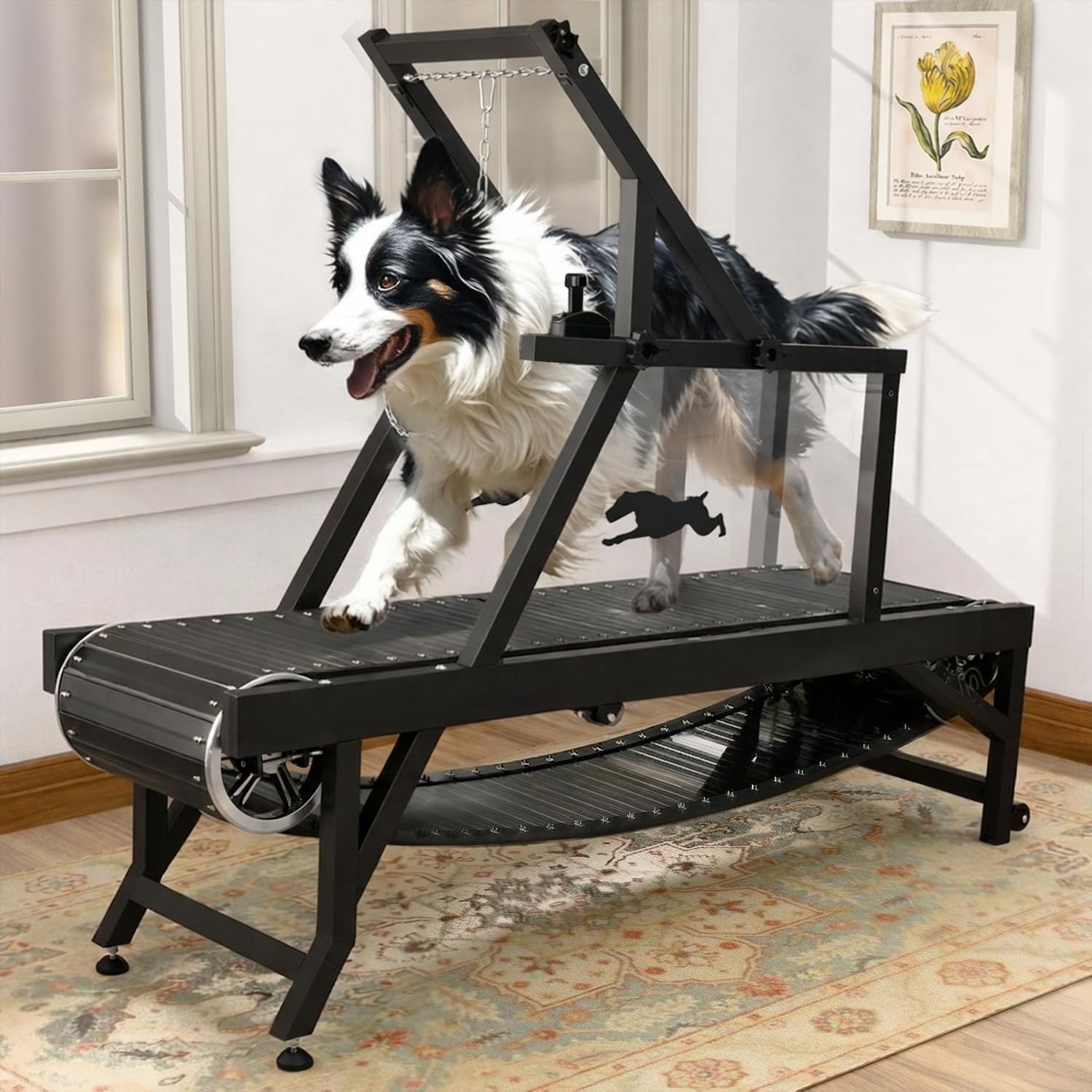
A three-level braking slatmill with a fiberglass belt that skips the splinter problem entirely.
The standout spec here is the belt material: fiberglass rather than wood. That means no splinters and no sanding maintenance, which is the exact complaint that follows wooden slatmills. On top of that sits a 3-level adjustable braking system that lets you set resistance and stop the track instantly. That brake is the differentiator against the PawPaw’s, where brake inclusion is unclear. A 320 lbs weight recommendation and a carbon steel frame carry medium breeds like Pit Bulls, Belgian Malinois, and Australian Shepherds.
Because it is non-motorized, your dog walks, jogs, or sprints at its own pace and can pause whenever it needs. The adjustable forward-tilt frame and customizable incline let you tailor resistance to the dog on deck. An owner of a 90lb German Shepherd calls it a well-made slat mill with quality that surprised them for the price. Assembly is straightforward for two people — one alone can wrestle with the second set of screws on the belt.
What keeps this honest is the durability report. The plastic side panels are the weak point for a few owners, and one brake from a two-unit purchase did not work from the start. The brake pad also may not hold up for a powerful dog that wants more resistance. Noise is another factor: it is a slatmill, not a silent wheel, so skip it if you have downstairs neighbors who complain about footfall.
The real draws
- Fiberglass belt — no splinters, no sanding
- 3-level brake for instant stopping and set resistance
- 320 lbs recommendation across a carbon steel frame
- Two-person assembly is quick and the hardware is labeled
Where it asks patience
- Plastic side panels are the most-cited wear point
- Brake reliability is inconsistent — a few units fail early
- Not a quiet machine at full tilt
Made for: a multi-dog household where different dogs need different resistance levels from one slatmill.
The trade-off: the brake is your main control, so if it fails the slatmill coasts free.
5. BowWowTread Dog Treadmill
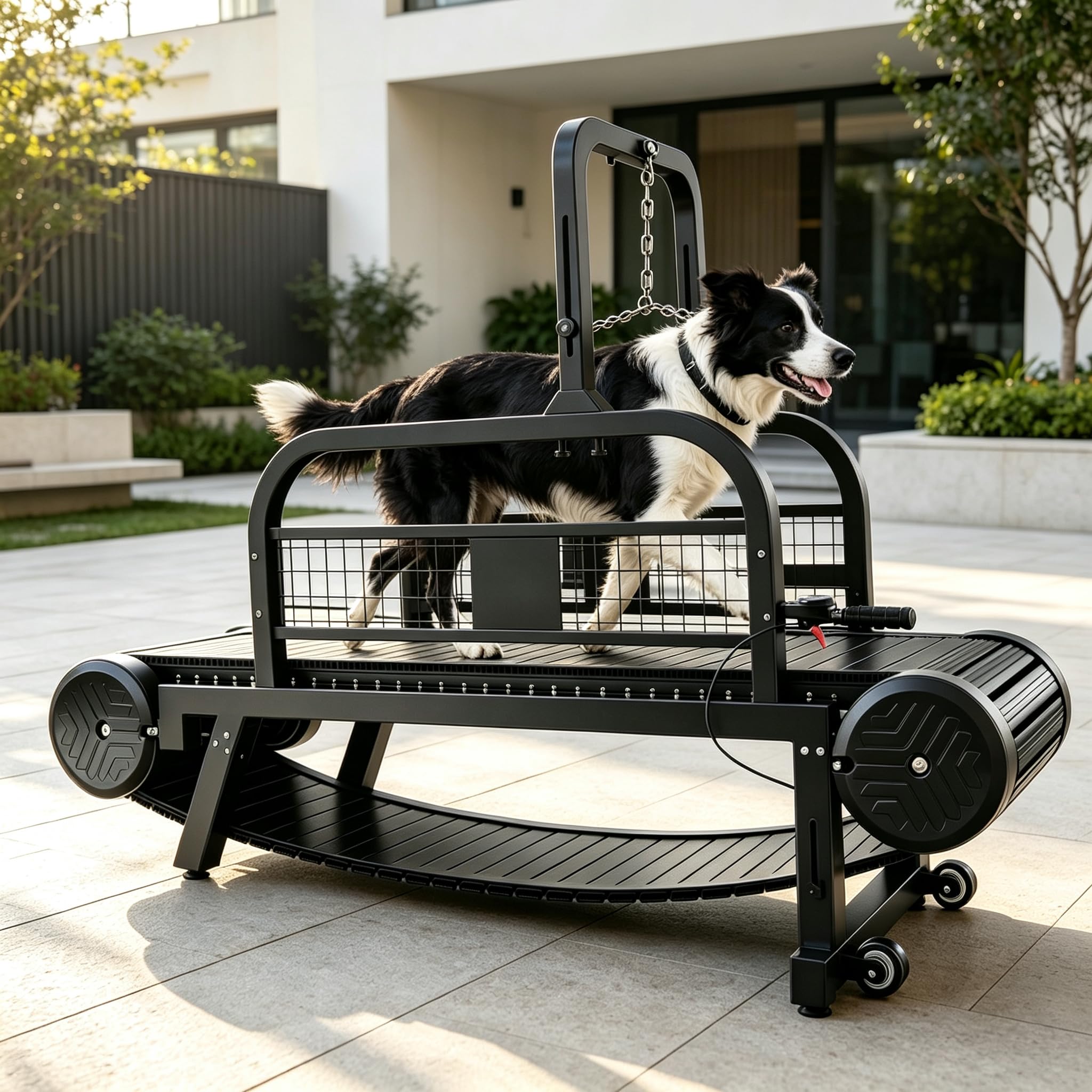
A self-powered sprint machine for a dog that wants to run flat out, with a paw-friendly pedal.
Look at the 220 lbs weight recommendation and the 20 kilometers per hour maximum speed — this is a big-dog machine built for real speed. The pedal is the upgraded eco-friendly material: wear-resistant, wipe-clean, and cushioned under the paw. On a hot or cold day, that surface shields your dog’s paws from the harsh ground outside. The adjustable incline lets you tailor resistance to your dog’s weight and stamina, and a brake system keeps stops controlled and safe.
With no motor, the dog drives the pace. Silent smooth rollers keep the operation quiet enough for indoor use, and the wipe-clean pedal makes daily maintenance simple. The calorie counter, distance, speed, and time readouts give you a session record to follow. A solid pick for a high-energy large breed that tears around the house when the walk did not burn enough.
Two things to weigh. The assembly instructions are described as vague and the build needs some handiness, so a person comfortable with tools will have an easier time. And the wooden slat finish is one area to inspect on arrival — a poorly cut slat sends splinters, which is a reason some owners seal the planks for a custom look and longer life. Go over the deck with your hand before your dog’s first step.
Best for: high-energy large breeds that need a sprint-capable, motorless deck.
Check on arrival: inspect the slats for splinters before the first session.
Suit yourself to this: if your dog needs to run hard and you want a paw-friendly pedal with a brake and incline.
Go a different way if: you need clear step-by-step instructions to build it.
6. Simulated Nature Dog Trotter Running Machine
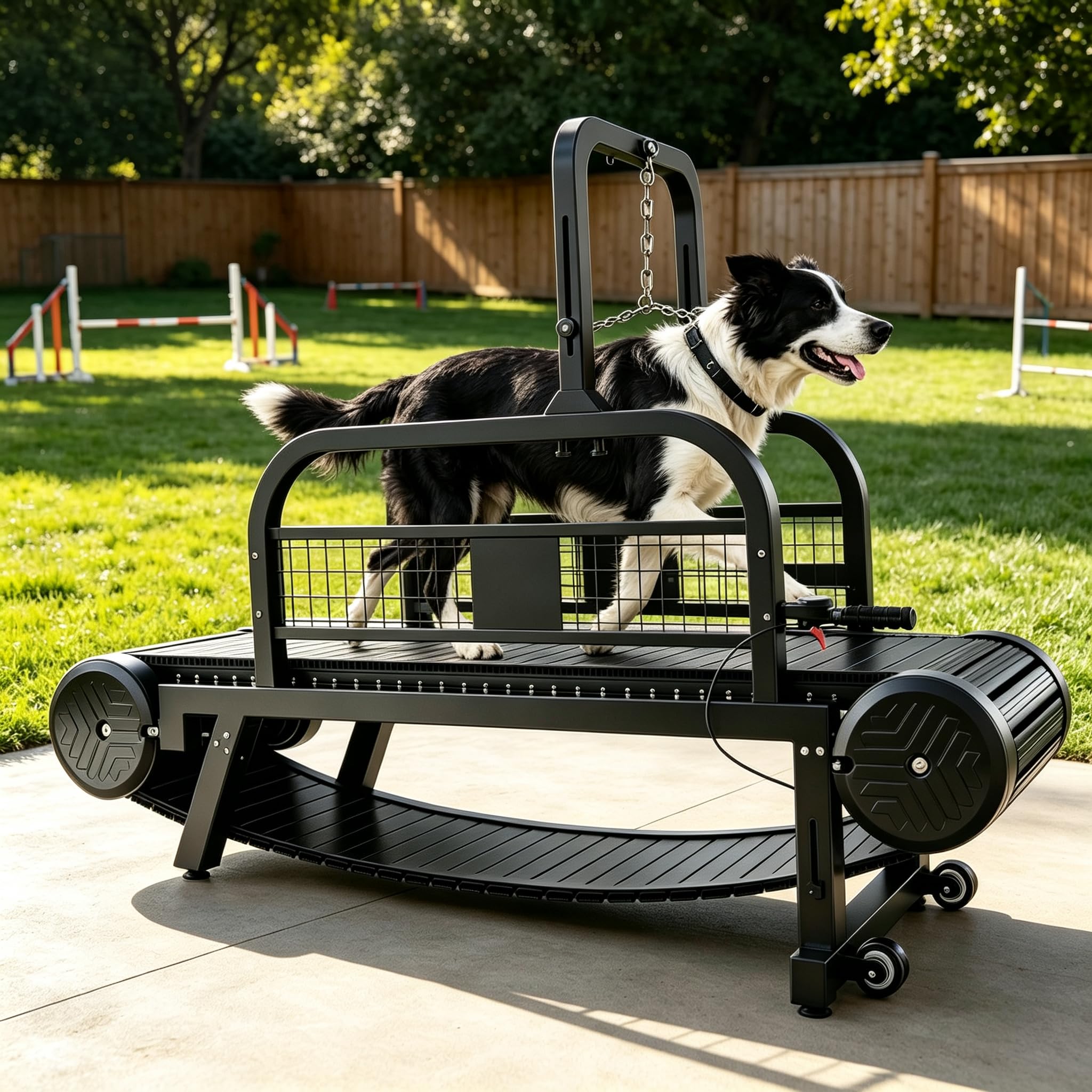
The floor-space saver of the group, with a 16.5-inch deck and a manual brake you set yourself.
If your spare corner is tight, start with the footprint: 68.89″D x 20.47″W x 53.14″H and 220 lbs of weight capacity. That narrower 20.47-inch width is the practical reason this one tucks into an apartment living room or a pet activity area better than the wider frames. It is self-propelled, so the track speed is fully controlled by your dog’s own paws — no power cord, no motor to fail. Silent rollers keep the noise low during home use.
A manual brake system lets you stable the track quickly to help your dog stop safely, and the adjustable incline matches the workout to your dog’s weight and stamina. The running pedal is a tough, flexible material with a wipe-clean surface — useful when a muddy-pawed dog finishes a session. A broad range of dogs can use it: the manufacturer lists small, medium, and large breeds, and one owner runs a 45lb Belgian Malinois, a 20lb Cattle Dog, and a 17lb Chihuahua mix on theirs.
Be realistic about the build. Assembly is the most-split verdict in the reviews. With a good install video it goes together easily for one person, but some owners found holes that did not align and took hours to build. The included instructions are not detailed. Greasing the track helps with startup smoothness, and rubber feet covers protect your floors. If you have never assembled a slatmill, recruit a second set of hands.
Why it earns a spot
- Narrow 20.47-inch width fits tight apartment corners
- Self-propelled with silent rollers and no power cord
- Manual brake for controlled stops, plus adjustable incline
- One owner runs three dogs of 45lb, 20lb, and 17lb on it
What to plan for
- Assembly instructions are thin and some holes misalign
- Track may need greasing for an easy startup
- Manual brake only — no lock buckle
Great fit if: floor space is tight and you want a budget-friendly motorless deck for a multi-dog home.
Not ideal if: you would rather not assemble a track yourself.
7. Kolmmeo Non-Motorized Dog Treadmill for Large Dogs
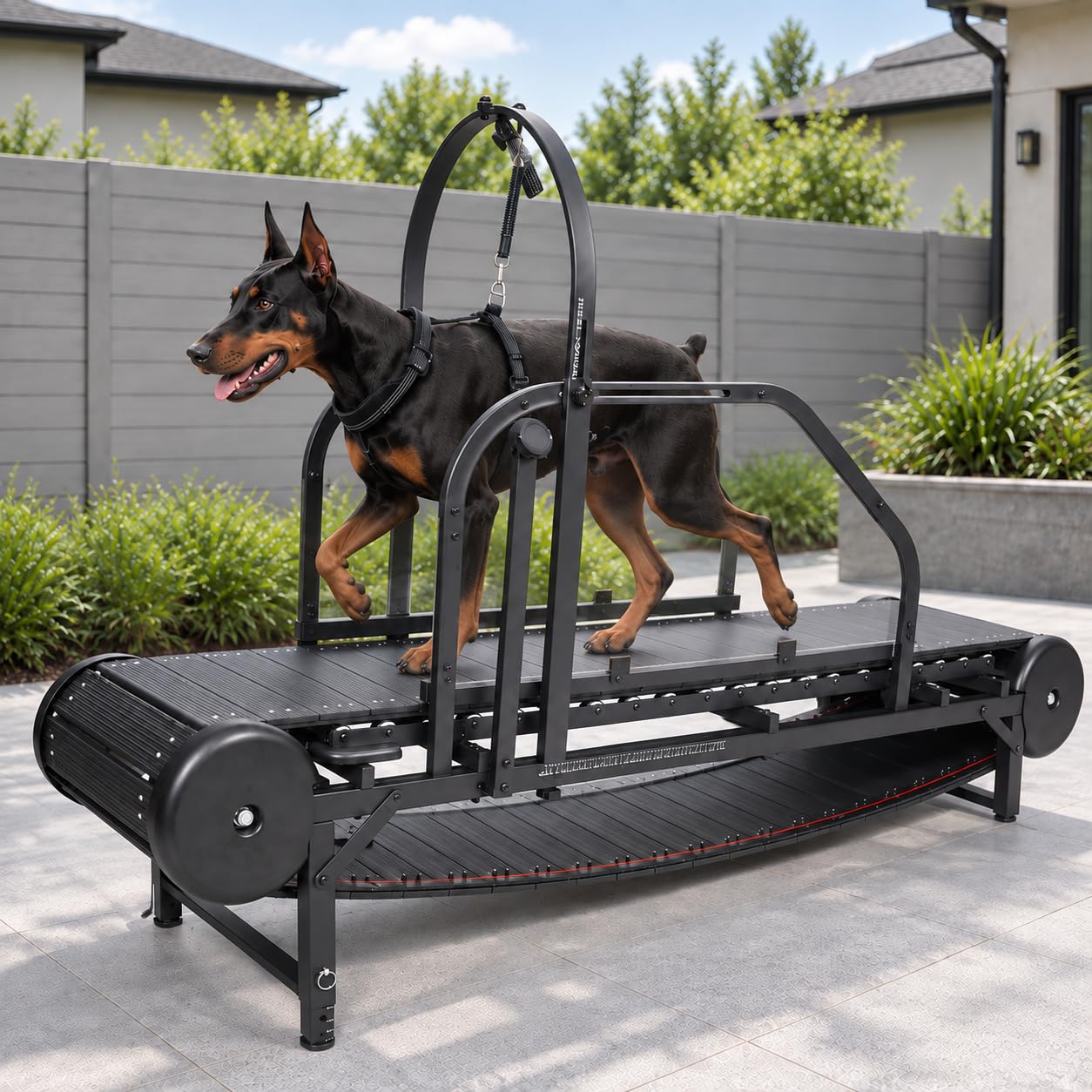
An 18-inch wide, 69.5-inch long usable deck built for large dogs that need room to place their paws.
The defining number is usable width: 18 inches, with a 69.5-inch usable length. That extra margin gives a big dog room for natural side-to-side paw placement and rear-paw follow-through. This machine is explicitly designed for walking and a controlled trot, not full-speed sprinting. You get an overhead guide that adjusts to your dog’s shoulder and harness position, plus a choice of a 3.35° or 7° manual deck angle. A fitted harness guide helps maintain alignment, a timer tracks elapsed session time, and a real low-position manual brake lets you slow the track as you observe.
The deck is a connected ABS slat system with a textured contact surface and dual connecting supports, all running over a fixed steel base. Choose size by body length and shoulder height first, and use weight as a secondary reference. That is the correct order of operations for a large breed, and here it is stated plainly. A 112-pound weight means it stays put on the floor during a session.
Two honest points. First, the timer does not track speed, distance, or calories — so if you want session metrics, this is not the machine. Second, this is the lowest-rated pick here, and the split shows in the reviews: assembly is praised, but wheel durability and noise divide owners. A few report wheels loosening near the paw area, and a couple find the belt rough. It is a specialist fit for a large dog that walks and trots rather than sprints.
The specialist angle: an 18-inch usable width with a height-adjustable guide and 5-level incline for large breeds.
The honest caveat: no speed or distance tracking, and wheel durability is a recurring weak spot.
Choose this when: you have a large dog that needs the widest deck for controlled walking and trotting.
pass on it if: you want speed and distance data, or your dog sprints rather than trots.
Know the Specs
Weight capacity
This is the load the frame and deck are rated to hold. A higher number like 330 lbs suits a heavy large breed, while 130 lbs is the ceiling for a small-dog machine. Remember that capacity is about the frame, not the fit — a long-strided dog under the limit can still slip off a short belt.
Deck size and usable width
The running surface is where your dog actually plants its paws. Usable width and length tell you how much room there is for a natural gait. A large dog needs a longer deck so the hind legs do not fall off the back at speed. A 41-inch deck suits a medium dog better than a small one.
Motorized versus motorless
A motorized belt runs at a set speed you control with a remote or program. A motorless slatmill runs on your dog’s own effort with no forced pace. Motorless suits a dog that spooks at motor hum; motorized suits timed intervals and slow rehab walks.
Brake and safety features
A brake slows or locks the track so the belt stays put while you unclip a harness. A safety key is a magnet fob that cuts the motor if it detaches. A harness guide or overhead bar keeps a dog aligned on the deck. These features decide how safe your session is when your hands are busy.
Common Questions
Is a slatmill or a motorized treadmill better for my dog?
How do I measure my dog for a treadmill?
Can a large dog use a treadmill built for small dogs?
Do I need to supervise my dog on a treadmill?
How do I train a dog that is afraid of the treadmill?
Does a motorless treadmill need electricity?
Why does my treadmill show an error code on the display?
How long should a treadmill session last?
Are wooden slats on a slatmill safe for paws?
Will a treadmill fit in a small apartment?
The Bottom Line
For most dogs, the strongest overall pick is the PawPaw’s Dog Treadmill. It brings the highest weight limit on this list at 330 lbs, a solid carbon steel frame, and a non-electric design that lets your dog set its own pace. If you want a motorized belt with incline and a remote, the FYC Treadmill delivers a 2.5 HP motor and 12 preset programs in a more compact footprint. And if you have a multi-dog household where different dogs need different resistance, the HotFeed Slat Mill with its three-level brake is the one to reach for.
How we choose
We do not accept paid placement. Every pick is matched to a real buyer and a real use-case; we do not hands-on test units.
Sources
Specifications: manufacturer listings and product documentation. Review insights: verified customer reviews, as of October 2026. Pricing: not shown on this page (it changes often); check the current price via the retailer link.
As an Amazon Associate, How Dog Care earns from qualifying purchases. This does not affect which products we feature.