Disclosure: This post may contain affiliate links. As an Amazon Associate I earn from qualifying purchases, at no extra cost to you. Learn more
Specs are compiled from manufacturer listings and verified buyer reviews and can change over time — please confirm the key details on the product page before buying.
Most people buy a training collar for one reason: the recall that works perfectly in the kitchen stops working the second the gate opens. The right collar closes that gap with a tone or a vibration long before anything stronger is needed, and the picks below are ranked by how reliably they deliver that signal. If you want the short answer: the Garmin Pro 70 is the one most owners end up trusting with a dog’s safety, and the PaiPaitek vibration-only collar is the gentlest way in.
This guide is built by comparing the manufacturers’ published specifications and the patterns across verified customer reviews, so you get each pick’s real strengths and trade-offs instead of marketing spin.
Range, stimulation levels, and waterproof ratings vary wildly between models, and a collar that suits a 10 lb terrier can hang loose on nothing at all. Below you’ll find the fit, the honest limits, and the right match for your dog among these dog training collars.
Top Picks


How To Choose The Best Dog Training Collars
Start with the recall distance you actually need, then work backwards. A suburban backyard needs maybe 100 feet of reliable signal; a farm or a hunting field with a dog that ranges wide needs far more. Extra range costs little; too little range is the mistake that sends you back to the listings.
Match the correction to the dog, not to the marketing
Tone and vibration are the first two tools you should reach for. Many owners never go past them, and several of the collars here let you lock out the stimulation entirely. A dog that responds to a beep at level 2 does not need a 99-level dial, but a strong-willed working breed may need a wider band to find its own lowest effective level.
Check the neck range before anything else
A collar listed for “all breeds” still has a hard neck-size range, and that is what decides fit. Measure your dog’s neck with a soft tape before you buy. Collars that run down to small necks will not cinch tight enough on a slender terrier, and collars built for large dogs can hang loose with slack strap doubled over.
Waterproof matters more than you think
Look at the receiver and the remote separately. A receiver rated IPX7 survives a swim; a remote rated IPX3 only shrugs off light rain. If your dog finds every puddle, check the receiver’s IP rating first and the handheld’s second.
Side-by-Side Comparison
| Model | Best For | Range | Stimulation Levels | Waterproof | Amazon |
|---|---|---|---|---|---|
| Garmin Pro 70★ Best Overall | Serious field training | 1 mile | 6 continuous | Floats | Amazon |
| PaiPaitek Vibration CollarGentlest Option | Gentle, no-shock training | 3300 ft | 9 vibration + 9 combo | IPX7 receiver | Amazon |
| HapTop 4500FTLongest Range Value | Long-range on a budget | 4500 ft | 0–99 shock | IPX8 receiver | Amazon |
| PATPET 640 | Blind-operation simplicity | — | 1–16 static | IPX7 receiver / IPX5 remote | Amazon |
| Blackdog OT9 Military | Two dogs, rugged use | 4200 ft | 1–99 shock | IP67 | Amazon |
| Educator ME-300 Micro | Small dogs, fine control | 1/3 mile | 100 | Waterproof | Amazon |
| Mini Educator ET-300 | Small to medium dogs | — | 100 + boost 1–60 | — | Amazon |
| SportDOG SportTrainer 875 | Hunting and field work | 1/2 mile | 10 continuous + momentary | Submersible to 25 ft | Amazon |
| Dogtra 280X | Stubborn dogs, precise dial | 1/2 mile | 100 + BOOST | Fully waterproof | Amazon |
Detailed Reviews
1. Garmin 010-01201-00 Pro 70 Dog Training System
Our pick — 4.5+★ from 300+ verified ratings; the strongest balance of quality and price.
The collar that brings a dog back from a mile out, then finds it in the dark.
This is the pick for the owner whose dog disappears into a treeline and comes back on its own schedule. It reaches a full mile over 27MHz radio frequency (a long-wave signal band that holds up better than Bluetooth-style links at distance), so a dog ranging across a field stays in contact. A handheld that measures 7.68 ounces sits in your palm without feeling like a brick, and the top-mounted dial lets your thumb roll through correction levels instead of hunting for buttons.
What wins people over is the bark limiter built into the collar, with Advanced Bark Correction Technology that flags detections with red and green flashes. The LED beacon on the dog device is the second thing owners bring up — it stays visible up to 100 yards, which is exactly what you want when a black dog stands in a black yard. Battery runs 80 hours, so daily wear over a couple of weeks is realistic. The stimulation dial holds 6 levels of continuous correction, and a stubborn German Shorthaired Pointer settled at level 2 on this unit where another collar needed level 7.
The honest trade-off is scope. You cannot run the bark limiter and the regular collar function at the same time, so pick which job you need before you head out. One dog is also all this box trains — you buy additional dog devices to reach the 6-dog ceiling, which is the reason a single-dog household may find it more collar than it needs. A button press also needs a beat longer than you would expect, so quick taps are not its style.
What earns the top spot
- One mile of range on 27MHz radio, so a dog in the far field still hears you
- Built-in bark limiter with Advanced Bark Correction Technology, plus red and green detection flashes
- LED beacon visible up to 100 yards — the night-time locator owners lean on most after the bark limiter
- 80-hour battery life, so it survives daily wear between charges
- 6 continuous stimulation levels on a thumb dial, with tone and vibration one click away
Where it asks more of you
- Bark mode and collar mode cannot run at the same time
- Additional dog devices are a separate purchase to reach 6 dogs
- Buttons need a longer press than a quick tap
- More capability than a one-dog backyard owner will ever use
Built for: hunters, farm owners, and anyone with a dog that works at real distance and needs a locator light after dark.
Think twice if: you have one dog and a fenced half-acre — the bark limiter’s conflict with collar mode and the extra-dog cost will both frustrate you.
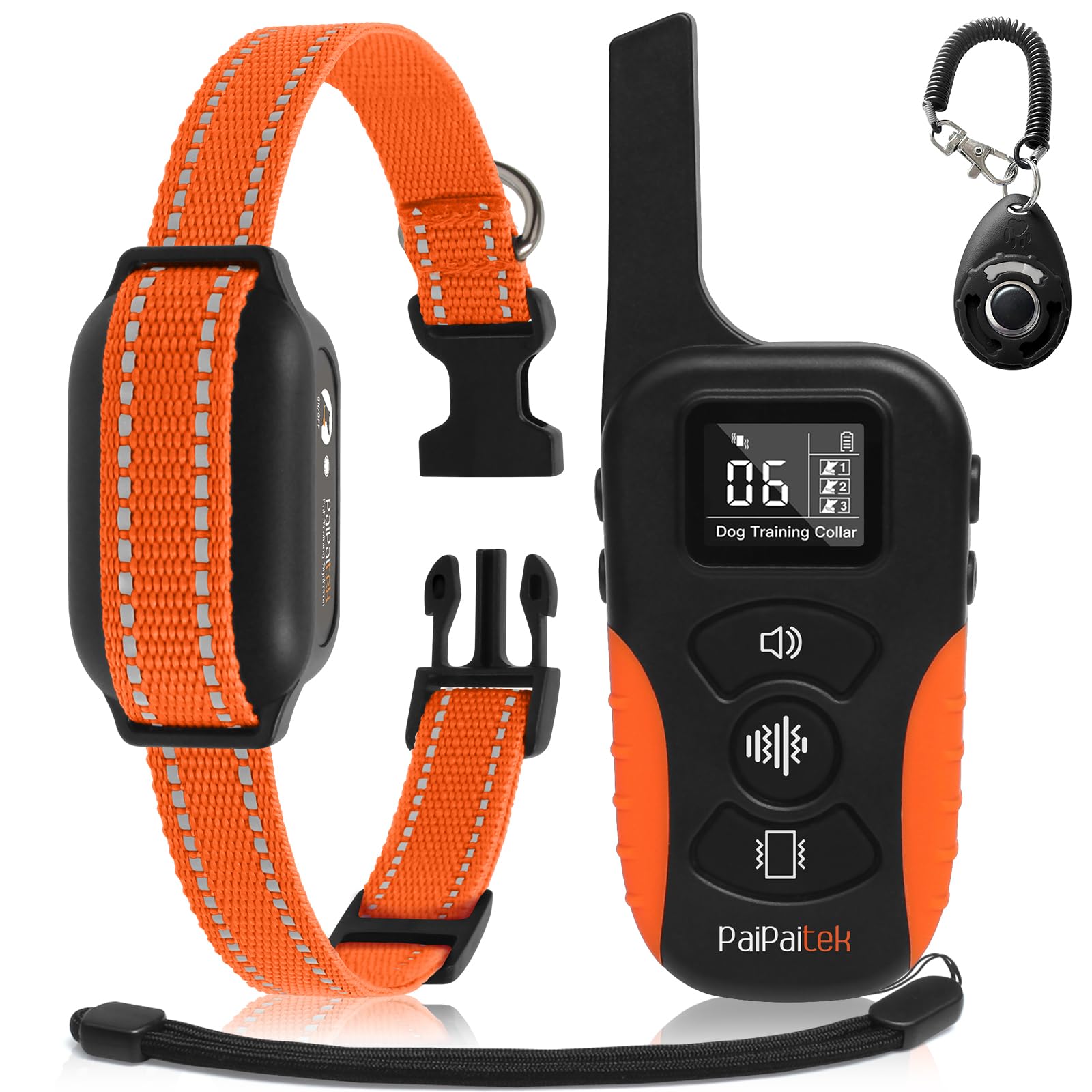
2. Dog Vibration Collar with Controller
A beep-and-buzz collar for the owner who never wanted to press a shock button.
There is no shock and there are no metal prongs here — only a beep, a vibration, and a combination of the two, each running 9 levels. At 1.7 ounces the receiver is the lightest thing on this list by a wide margin, and that matters on a small dog’s neck. It reaches 3300ft, which is a shorter leash than the 4500FT HapTop but plenty for a large yard or an open park. The strap adjusts from 8 to 27 inches and fits dogs from 5 to 120 lbs, so one collar genuinely covers a Chihuahua and a Labrador.
The receiver is rated IPX7, meaning it survives being dunked, while the remote is IPX3 — light rain only, so keep the handheld out of the lake. Both halves recharge in about 2 hours through a dual cable and then run up to 20 days, which removes the nightly charging chore entirely. A reflective strip on the strap catches headlights on evening walks. One remote can also hold 3 dogs on separate channels with each dog’s settings saved.
Two things to know before you commit. The strap runs long, so a small neck will have slack doubled over — adjust it before the first session or the receiver slides. And the durability picture is genuinely mixed: some units keep working for months on a deaf dog that reads vibration beautifully, while others stop drawing a reaction after 2-3 months and a replacement ends up being the fix. That is worth knowing, not a reason to walk away — the support side is responsive when a unit does go quiet.
Why it earns its place: The reframe most buyers need — roughly 3300ft of range and 9 vibration steps with zero shock on the table means a nervous dog, a deaf dog, or a rescue with a bad history of neck pressure can all be trained on the same collar.
The realistic limit: Budget tier rarely survives a hard life. If your dog swims weekly, the IPX3 remote will be the weak link before the receiver ever is.
Reach for this if: you rule out shock outright, or your dog is deaf, anxious, or small enough that prongs are a non-starter.
Look elsewhere if: you need the remote to survive a downpour or a swim — IPX3 protection covers light rain and nothing more.
3. Dog Shock Collar 4500FT
The longest reach on this list, and it costs less than most of the short-range competition.
Pull this one out when the dog has room to run. At 4500ft it out-reaches everything here including the Garmin’s mile on paper terms — 4500 feet against the PaiPaitek’s 3300 feet is a meaningful stretch of open field, and it is the sort of reach you want at a beach or on a hiking trail. Four modes cover the whole spectrum: beep at 1-8 levels, vibration at 1-16, shock at 0-99, and a Shock Boost that adds 10% higher stimulation when you need one decisive moment. The shock can be switched off entirely, so this doubles as a no-shock collar if you decide the prongs are not for you.
The receiver is IPX8 rated — the deepest waterproofing on this list, which means a swim in the lake does not stop training. Neck sizing runs 7.8 to 24.4 inches for dogs 10-120 lbs, and the maker recommends limiting wear to 12 hours a day. Battery figures are generous: up to 35 days on standby for the receiver and up to 45 days for the remote, topped up by USB-C. A security lock prevents a pocket press from sending an accidental correction. Two dogs share the dual-channel remote with each dog’s settings remembered separately.
What the review pages reflect back is a collar that sets up fast and makes sense on the first read of the manual. Owners describe the controls as simple enough to use without looking down, and the adjustable intensity lets you find the lowest level that registers instead of guessing. The screens and the beep do a lot of the work for most dogs.
Best-fit buyer: Someone with a big yard, a beach house, or a trail-happy dog who wants maximum distance without paying premium money for it.
Worth noting: Deep waterproofing and a 35-day receiver standby are the headline numbers — if your dog never leaves a fenced yard, you are paying for range you will not use.
Suits you when: distance is the whole point and you want IPX8-level water protection alongside it.
Not for you when: you prefer a single dial over a multi-button remote — this one carries more controls than a backyard collar needs.
4. PATPET Dog Training Collar
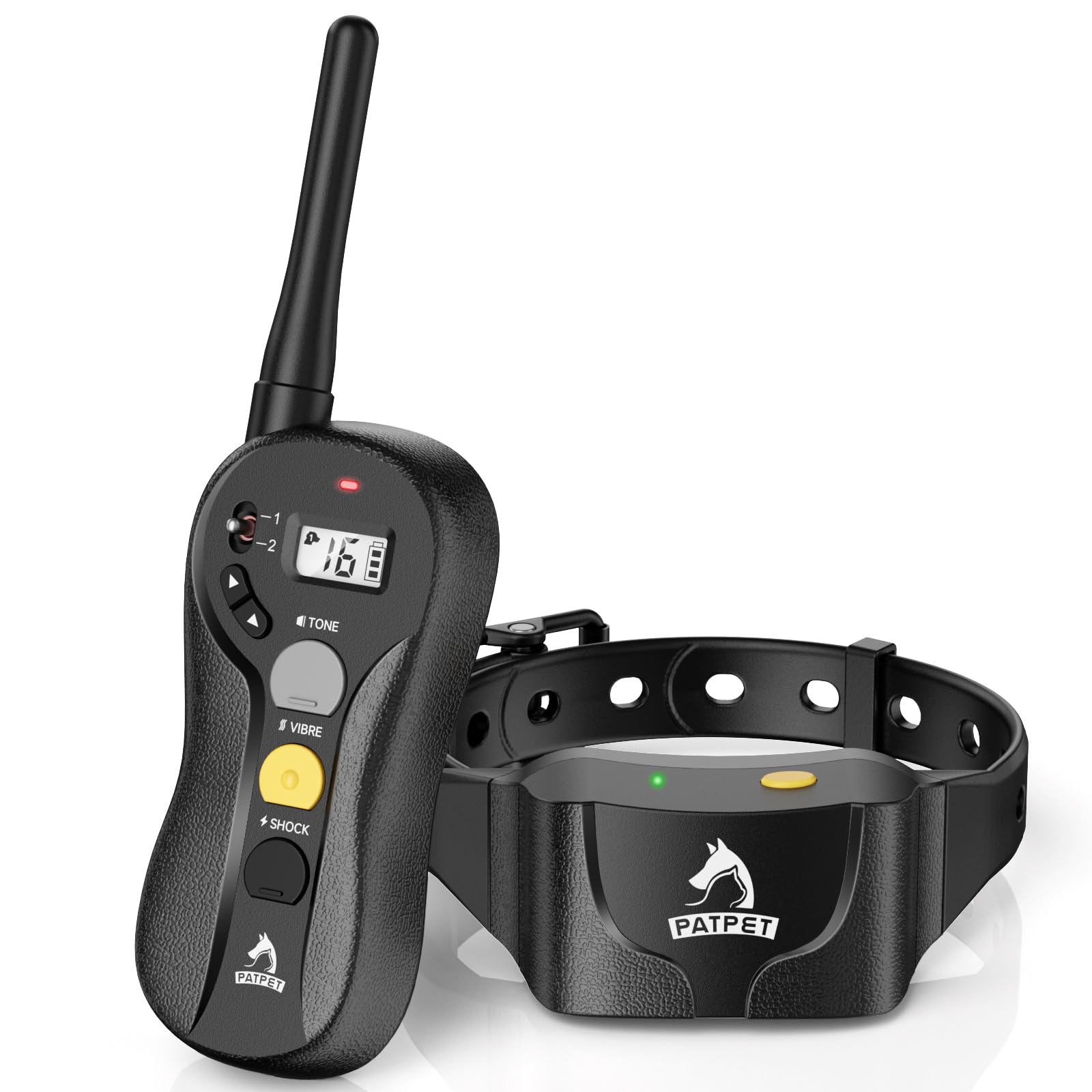
Three modes, buttons you can tell apart by touch, and a receiver that shrugs off the lake.
Some remotes force you to look down at the moment your dog is already forty feet into the wrong direction. This one is built for blind operation, meaning each button carries a different feel so your thumb knows where it is without your eyes. Three modes sit underneath: beep, vibration, and static at 1 to 16 levels. That 16-level band is narrower than the 99-level dials elsewhere here, which is actually the point — fewer steps mean faster decisions under pressure.
The receiver is IPX7 waterproof, so a wet dog coming out of the pool keeps training without a pause, and the remote is IPX5 rainproof. The strap is adjustable across different dogs, and the battery recharges rather than swapping out. Owners use these for running, hiking, and camping on doodles, and the water rating gets tested in backyard pools.
The honest catch is consistency between units. Functional performance is what most owners come back to praise — the remote pair and the corrections land the way they expect. But battery life and durability divide opinion. Some collars keep a charge for weeks and outlast premium units; others arrive unable to hold a charge at all and get swapped through support. Tighten the contact screw posts with a thread locker if they start to back out. Buy knowing you may need to use the replacement path, and the odds of a happy outcome go up.
The real advantage: Touch-distinct buttons and 16 static levels form a fast, low-distraction control set — a trainer’s tool for on-the-move correction.
The realistic caution: Unit-to-unit battery consistency is the recurring gripe; the wrist strap is also a short-lived part.
Right choice for: owners who want to correct without looking down at the remote, and whose dogs swim.
Wrong choice for: anyone who wants a guaranteed long-lived battery on the first try — plan on the support path being part of the experience.
5. BLACKDOG Military Dog Shock Collar 2 Dogs
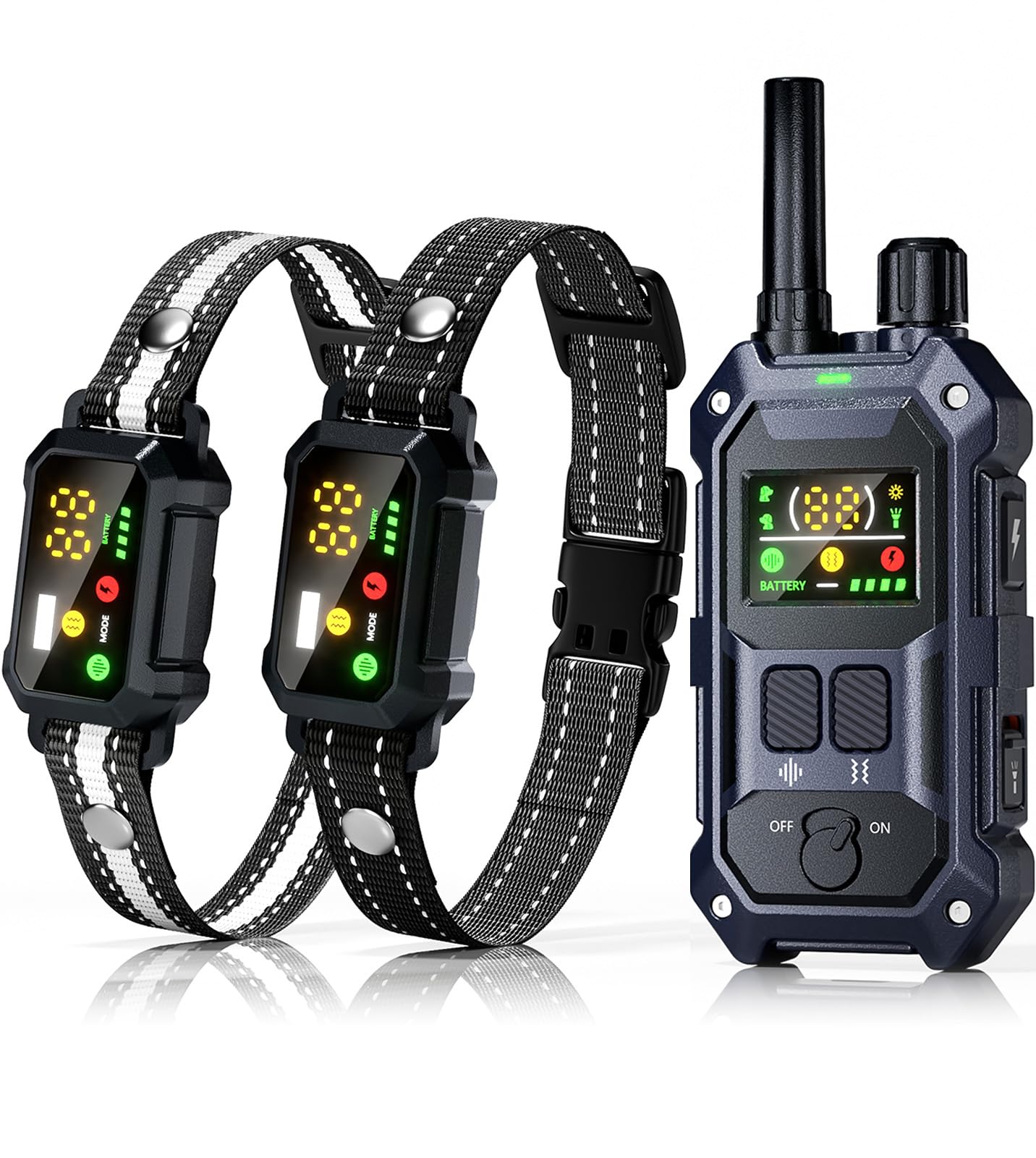
Two receivers in the box, a 90-day battery, and a build that survives the truck bed.
Buy this if you have two dogs and you are done buying collars one at a time. The kit ships with 2 receivers and one remote, and you switch between Dog #1 and Dog #2 with a tactile toggle rather than a menu. Range runs 4200ft, which clears any yard, park, or hiking trail you will realistically train on. The nylon strap adjusts from 8 to 25 inches and covers dogs from 5 to 150 lbs.
The build is what separates it. The reinforced casing is tested against 500lbs of crush force and 100K+ bite cycles, and the IP67 rating means it survives 1m of water for 30 minutes. The night-lighting system is a two-part setup: a flashlight on the remote to sweep the trail, and a strobe on the collar to spot the dog. Owners get the most out of the collar light — the strobe at distance on a dark night gets mentioned again and again. Four modes include beep (1-8), vibration (1-16), safe shock (1-99), and the strobe, with an LCD screen showing battery level. A built-in hex tool lets you pull the prongs for no-shock mode on a puppy or senior. USB-C charging gets it back to full in 2 hours, and the maker rates battery at 90 days on an hour of daily use.
The honest catch is the strap. The nylon runs firm and takes effort to adjust, and after a few days of wear some owners find it slipping and swap over to a standard 1-inch collar. Battery also drains faster than 90 days under heavy daily use — treat the 90-day figure as a best case for light use, and consider charging after every session if the collar runs long days.
Where it holds up under pressure
- Two receivers included — no second purchase to train both dogs
- IP67 rated to 1m of water for 30 minutes, so mud and storms do not stop training
- 4200ft range with a tactile up/down switch for quick dog switching
- Remote flashlight plus collar strobe for tracking at night
- Built-in hex tool for switching to no-shock mode without extra tools
- 2-hour USB-C charging
Worth knowing before you order
- The nylon strap is stiff to adjust and loosens over the first days
- 90-day battery is a light-use figure — heavy daily use needs frequent charging
- If you only have one dog, the second receiver is dead weight
Made for: two-dog households with a muddy, stormy outdoor routine, and owners who want one remote to rule both collars.
The one caveat: budget a little time on strap fit at first — you will want a proper snug cinch before the first off-leash run.
6. Educator ME-300 Micro E Collar for Dog Training with Remote
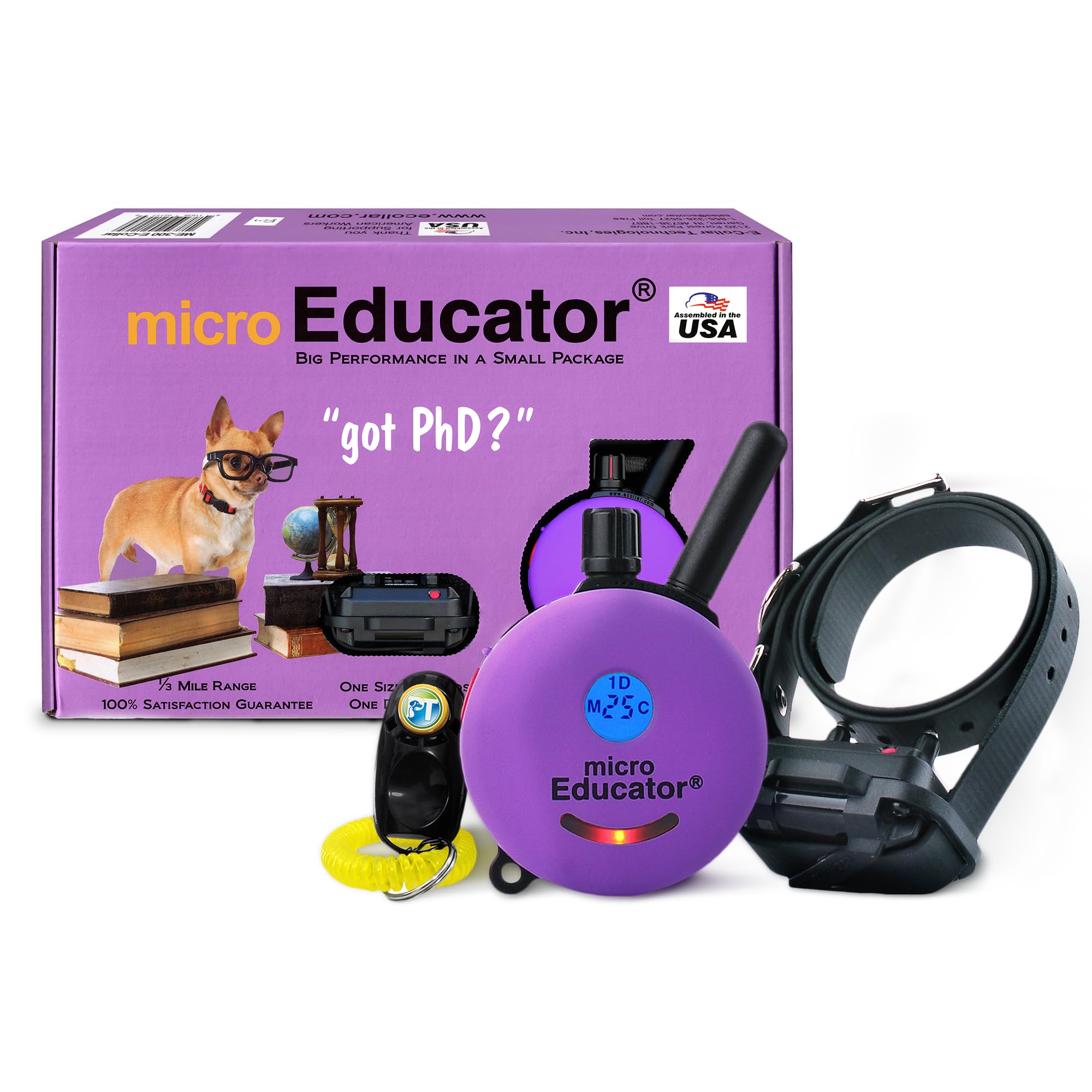
A hundred levels of adjustment squeezed into a receiver made for thin necks.
If your dog weighs 9 lbs and has a neck thinner than a wrist, this is the collar the list has been building toward. It is designed for dogs from 5 lbs with 10 to 26 inch necks, and the receiver is sized to sit quietly rather than hang heavy. That fine-grained sizing is why owners of Yorkipoos and elderly terriers come back to it after trying a looser one-size unit that slid around the neck.
What wins people over is consistency — the response is the same press after press, which is exactly what you want when the difference between a tone and a level-5 correction matters to a sensitive dog. There are 100 stimulation levels plus tone and vibration, so the working range for a small dog sits comfortably inside the band. Range runs 1/3 mile, more than enough for parks and neighborhood blocks, and both the remote and receiver are waterproof. The Biothane strap handles mud and water without stiffening. Recharge time is about 2 hours.
Two things are less flattering. The price sits at the premium end despite the compact size, and value for money is the part that divides opinion: this is a buy for a buyer who wants refinement, not the cheapest way to correct a recall. The box also looks bigger than the sensitive-neck dog it is intended for — the receiver is compact but the presentation suggests otherwise, which is a cosmetic quirk, not a functional one.
Why small-dog owners stick with it: 100 stimulation levels and a 10–26 inch neck range mean a 9 lb dog can be trained at the very lowest correction that registers — no overshoot, no guesswork.
The premium you pay: a 1/3 mile range and a straightforward mode set, both of which cost more than competing collars with wider range do.
Match it with: small breeds, thin necks, sensitive dogs, and trainers who want the correction dialed in to a single level.
Skip the premium if: you have a 90 lb dog that needs maximum distance — you are paying for refinement a big dog’s training will never test.
7. E-Collar Mini Educator ET-300

A hundred-level dial, an adjustable boost, and a tracking light for the walk home.
The ET-300 is a one-dog system: one handheld transmitter, one RX-090 receiver, and a yellow Biothane collar. It carries 100 adjustable levels of electronic stimulation with a pulsing or tapping sensation, plus vibration, tone, an adjustable boost dial running 1 to 60, and an LED tracking light. If your dog responds better to a continuous dial than a menu, this is the control style you have been waiting for — the boost function alone is the difference between a dog that comes back on a busy street and one that hesitates.
Owners describe the sensation in a consistent way: it reads as a pulse, more like a muscle jolt than a stiff zap, which is why it works on soft dogs and large ones in the same household. Lightweight remote, responsive triggering, solid range, and a secure collar fit are the recurring notes. It reinforces commands and holds a dog’s focus calmly when the correction is consistent.
The catch is that the system wants you to be a participant. The manufacturer’s own guidance is clear about charging both halves fully and verifying the transmitter talks to the receiver before the first session, and about troubleshooting inconsistent operation through battery charge, collar fit, and contact-point placement. Read the manual before you clip it on — a collar like this rewards a careful first setup and punishes a rushed one.
Why owners like the dial: 100 levels plus a boost running 1–60 means you can correct at a whisper level and escalate in small steps, which keeps the working correction low.
The thing to expect: one receiver in the box — a second dog needs a second purchase, and the setup routine takes patience up front.
Best suited to: small and medium dogs, and trainers who like a single dial and a boost button instead of a button cluster.
Consider another pick if: you want a quick plug-and-go pair — this one is built for a careful setup first.
8. SportDOG SportTrainer 875 Remote Dog Trainer, 1/2 Mile Range

Dives to 25 feet, reads its own screen, and takes the whole duck pond in stride.
Built for the close-working hunting dog, the 875 reaches 1/2 mile and holds up to 3 dogs on one handheld if you add collars later. The OLED screen shows which dog is selected, the static level, and the battery state in one glance, so nothing is a guess mid-field. Ten levels of continuous and momentary static, plus vibration and tone, cover the day-to-day training scenarios without asking you to carry a manual.
Waterproofing is the standout: DryTek technology keeps the unit submersible to 25 feet, and owners who have run it in lakes and ponds confirm it comes back working. Lithium-ion batteries charge in 2 hours and last 50 to 70 hours per charge, with low battery indicators on the system. Collar size runs from 5 to 22 inches for dogs 8 lbs and up. Color-coded straps make a three-dog setup easy to keep straight, and the orange collar stays visible in long grass.
Two honest limits: the collar battery drains much faster than the remote, so charge discipline matters and there is no collar battery indicator if you forget. The other is at the strap end — belt-style punched holes and no quick snap clip take longer to put on than a buckle-and-clip design would.
The reliable part: submersible to 25 feet and a readable OLED screen make this the pick for anyone training near or in water.
The trade-off: battery consistency divides opinion — the remote holds up well, the collar drains faster than its companion and can go flat without warning.
For the hunter: it is the pick if duck ponds and wet dogs are on the schedule and a screen you can read at a glance matters.
Read this first: set a charging routine for the collar — no battery indicator means a flat unit is easy to miss until you need it.
9. Dogtra 280X E-Collar with Remote, 1/2 Mile Range, 100 Levels
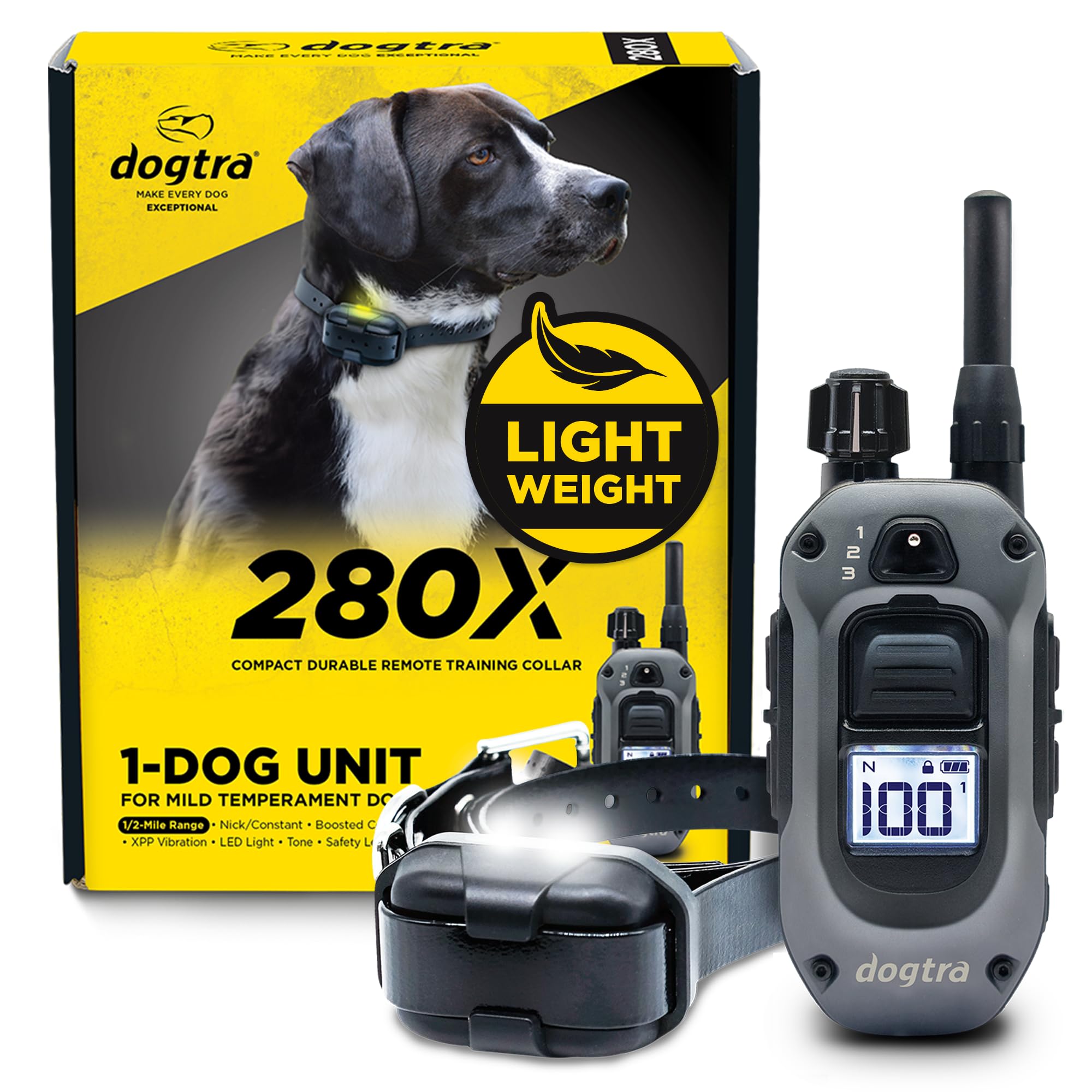
The dial a trainer’s thumb learns in an afternoon and trusts for years.
The 280X puts the main button front and center and hands the correction over to a rheostat dial — a rotating dial rather than a button that steps through levels. That dial pairs with 100 precise levels and a large screen, so a stubborn dog with a specific correction point can be dialed into a single number and left there. Range runs 1/2 mile, and tone, vibration, and BOOST are all available for a fast recall when a dog is already moving.
Water protection is complete — this unit is fully waterproof and virtually drop-proof, so rain, splashes, and full submersion are all fine. A 1000-lux LED light (lux is a brightness measure, and 1000 is bright enough to actually see) helps at night, and the level lock prevents an accidental turn of the dial. The Biothane collar strap and removable contact points keep the fit comfortable, and sizing covers dogs 10 lbs and up. A USB-C charging splitter cable in the box handles both halves at once.
What owners notice is small refinements: removable contact points, a dedicated brighter strobing light button, and a dial with a lock. What is fair to mention is that the weight sits on the heavier side for a dog at the low end of the size range, and that the light is one-sided and close to the fur. A trainer running a serious program will still find the fit and finish worth it.
Where it shines: a rheostat dial plus a level lock equals precision training at the lowest correction that reaches a strong-willed dog.
Worth weighing: full waterproofing and a 1000-lux night light are the standout specs, but the receiver weight and one-sided light are the small costs of a rugged build.
Choose it for: strong-willed dogs, trainer-led households, and anyone who wants a correction dial locked at the right number.
Leave it if: your dog is near the bottom of the 10 lb range — the receiver’s weight is a real consideration at that size.
Know the Specs
Remote Range in Feet and Miles
Range is the maximum distance at which the remote still reaches the collar, and it is usually measured line of sight in open ground. A 3300ft collar covers a big yard, a park, and most trails; 4500ft buys you extra margin in open fields. A mile or a half mile is a different tier — the Garmin Pro 70 reaches a mile, and the SportDOG and Dogtra both clear half a mile. Trees, buildings, and hills cut real-world range below the published figure, so size up from your typical training distance.
Stimulation Levels and Dial Style
More levels give you finer steps to find the lowest correction your dog actually registers. Six or ten levels are plenty for a dog that responds fast; 99 or 100 levels suit a dog whose threshold sits between two wide steps. The control style matters just as much: a dial is faster to nudge up in small increments, while buttons with discrete levels are easier to confirm without looking.
Waterproof Ratings Explained
IPX7 means the receiver survives being submerged for a short period; IPX8 goes deeper, IP67 adds dust protection on top, and IPX3 only shrugs off light rain. Check the remote separately — several collars pair a fully waterproof receiver with a rain-resistant handheld, so keep the remote out of the water even on models rated for swimming.
Battery Life and Charging
Battery figures vary from 20 days to 90 days on this list, and most are quoted under light daily use. Heavy sessions drain faster. USB-C charging is simpler than a proprietary cable because you probably already have one, and a 2-hour charge time is common. A low battery indicator on the system saves you from discovering a dead collar mid-training session.
Common Questions
Will a dog training collar work on a dog that ignores every command at home?
How do I know which stimulation level is right for my dog?
Can these collars be used on a puppy?
How long does a training collar receiver last on one charge?
Is a 3300ft collar enough for a farm, or should I go longer?
What does IP67 mean on a training collar?
Can one remote control two dogs or more?
What is a boost or rheostat dial and why does it matter?
Are prongs uncomfortable for my dog?
The Bottom Line
If a dog’s safety is the deciding factor, the Garmin Pro 70 is the one to buy — a mile of range, an 80-hour battery, and a collar light that stays visible at 100 yards are the combination that makes a dog findable and recallable in the dark. For a household that rules out shock and wants the gentlest path, the PaiPaitek vibration collar is the one to reach for, with no prongs inside the box. And if you are training two dogs on a budget, the Blackdog OT9 delivers two receivers and IP67 protection in one order.
How we choose
We do not accept paid placement. Every pick is matched to a real buyer and a real use-case; we do not hands-on test units.
Sources
Specifications: manufacturer listings and product documentation. Review insights: verified customer reviews, as of October 2026. Pricing: not shown on this page (it changes often); check the current price via the retailer link.
As an Amazon Associate, How Dog Care earns from qualifying purchases. This does not affect which products we feature.