Disclosure: This post may contain affiliate links. As an Amazon Associate I earn from qualifying purchases, at no extra cost to you. Learn more
Specs are compiled from manufacturer listings and verified buyer reviews and can change over time — please confirm the key details on the product page before buying.
Most dog training books fail for the same reason: they promise a magic fix and deliver a wall of theory you never actually use. The books below all earn their shelf space because they stay short, stay practical, and stay positive. Which one is right for you depends on the dog in your house — a bird dog, a rescue who reacts to the mail carrier, or a wriggling eight-week-old puppy.
This guide is built by comparing the manufacturers’ published specifications and the patterns across verified customer reviews, so you get each pick’s real strengths and trade-offs instead of marketing spin.
Some books here are decades-old classics still sold fresh; others are modern manuals aimed at reactivity, service work, or passing a test. That range matters more than page count, because choosing the right book for your dog’s specific behavior problem can save months of frustrating trial and error. Here are the nine dog training books that survived that comparison.
Top Picks


How To Choose The Best Dog Training Books
You will not train a dog better by reading a bigger book. You will train better by reading the right book once, then doing the same exercise ten times a day for a few weeks. Reading the right book once beats skimming a bigger one.
The skill is matching the book to your dog’s current behavior, not to your own reading stamina. A puppy book that starts at potty training is useless for a twelve-month-old rescue already lunging at bikes.
Match the method to your dog’s actual problem
Start by naming what you need help with: house-training, leash manners, recall, bird work, reactivity, or a specific certification. Many training manuals carve out a specialty and cover the basics thinly. The best fit has a chapter on the exact behavior you are wrestling with daily.
Check the training philosophy before you buy
Positive-reinforcement methods reward the behavior you want rather than correcting the behavior you don’t. Force-based methods can work too, but they risk damaging trust. If you believe in treat-and-praise training, look for books that say so on the cover or in the publisher’s description.
Page count tells you how deep the book goes
A shorter book often focuses on one thing well: task training, bird dog field work, or getting through a certification test. A longer book often does reference duty, with an index to look up specific problems rather than a weekend read. Neither is wrong — pick the focused manual if you have one problem, the reference if you have several.
Check the publication date for outdated advice
Older classics still sell for good reason, but some contain training methods the field has since moved away from. A modern title carries advice aligned with current behavioral science, while a decades-old guide earns its place through tested results. Read the publisher’s summary and the title for clues.
Side-by-Side Comparison
| Model | Best For | Print Length | Method Focus | Publication Year | Amazon |
|---|---|---|---|---|---|
| Gun Dog: Revolutionary Rapid Training Method★ Best Overall | Bird-dog owners wanting a proven field method | 160 pages | Bird-dog field work | 1961 | Amazon |
| Canine Good Citizen: The Official AKC Guide, 2nd EditionMost Official | Anyone working toward the CGC certification test | 192 pages | Obedience and AKC test prep | 2020 | Amazon |
| Ultimate Guide to Dog TrainingThe All-Rounder | Beginners wanting the total training picture | 224 pages | Positive reinforcement, all levels | 2020 | Amazon |
| Reactive Dogs: Positive Training Strategies | Owners of reactive dogs whose calm walk feels impossible | 174 pages | Reactivity and fear management | 2025 | Amazon |
| The Only Positive Puppy Training Book You’ll Ever Need | First-time puppy raisers from day one | 137 pages | Puppy basics, potty training, socialization | 2025 | Amazon |
| Positive Training for Aggressive and Reactive Dogs | Serious reactivity or aggression cases | 256 pages | Behavior modification, rehabilitative | 2023 | Amazon |
| Service Dog Training Manual for Beginners | Handlers training a service dog on their own | 99 pages | Task training and public-access preparation | 2026 | Amazon |
| Tom Dokken’s Retriever Training | Retriever owners wanting a full curriculum | 256 pages | Retriever field training | 2009 | Amazon |
| The Do No Harm Dog Training and Behavior Handbook | Owners tackling behavior problems without any force | 346 pages | Force-free behavior modification | 2022 | Amazon |
Detailed Reviews
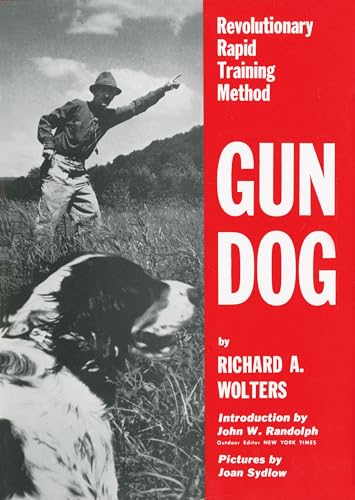
1. Gun Dog: Revolutionary Rapid Training Method
Our pick — 4.5+★ from 800+ verified ratings; the strongest balance of quality and price.
The field guide that turns a pointer pup into a working bird dog in months, not years.
If you own a pointer, setter, or retriever and want it steady on wings by autumn, this is the reference that has held its ground since 1961. It packs a complete bird-dog program into 160 pages — short enough to finish in a weekend, dense enough to run a full season on. Given that owner response is 4.5+ stars across 800+ ratings, it’s the crowd favorite by a wide margin among field trainers.
The content is what wins people over. The method uses no dominance and no force training, and owners who run it with real dogs report pups that learn to love the work. It is the classic weekend-hunter playbook. One reviewer reports using it with a pointer pup: “solid ‘whoa,’ statue point on live birds by September, retrieving planted chukars by October, hunting wild pheasants by November.” The daily routine is modest — around 15–20 minutes a day, starting at 8 weeks — so it fits around a job. That same reviewer reports come, stay, sit, whoa, and heel by week 12 with two Llewellin setters.
It is notably tighter than the Canine Good Citizen guide: 160 pages vs 192 pages, and it is the slimmer physical book at 6.65 x 0.63 x 9.29 inches. The catch is that it assumes a sporting dog and a bird season. A city-dwelling household with a reactive rescue will find little for its day-to-day problems here — those belong with the reactive-focused books lower down.
Why hunters keep coming back
- A complete field program squeezed into 160 pages — finishable in a weekend
- Daily routine of roughly 15–20 minutes fits around a job
- Methods grounded in Seeing Eye Dog Foundation principles, still applied today
- Works on stubborn breeds, not just biddable pointers
- Holds up as a classic — still selling fresh decades after it first printed
Where it asks more of you
- Assumes a bird dog and a season — little coverage of city-dog problems
- The daily routine requires discipline; miss days and the timeline stretches
- Written in 1961 and aimed at hunting-dog tradition, so some wording reads dated
Best fit: A bird-dog owner with a pup and a hunting season on the calendar who wants one guidebook and no argument.
Worth knowing: It is not a general dog-training book. Pick up a reactive or service-dog title alongside it if your dog has to live in a city.
2. Canine Good Citizen: The Official AKC Guide, 2nd Edition
Ten test items, one official guide, and a calmer dog at the front door.
Some people want a dog that behaves. Some people need their dog to prove it — at a testing event, a residential building, or a daycare that asks for paperwork. The AKC’s official guide is the one written by the group that actually runs the Canine Good Citizen test.
You get the ten skills laid out as a step-by-step curriculum, from accepting a friendly stranger and sitting politely for petting through loose-leash walking, coming when called, and supervised separation. What makes the book work is the clarity of that sequence — you are never guessing which skill comes next. It runs 192 pages, forty percent longer than the Gun Dog guide above, which is what you want when ten distinct test items each need their own chapter.
Owners find it genuinely useful beyond the test. A single run at an evaluation is not the last thing it does — the training content holds up after the certificate, and the book is small enough to carry in a training bag at 15.2 ounces. There is one honest caveat worth knowing: the value question divides people. Some owners feel they paid for a booklet when they expected a manual. The honest read is that you are buying the official curriculum and the test details, not a thick reference book.
What carries it: The 10-item structure is the point. Follow it in order and you build the exact skills the evaluation asks for, including the loose-leash walk and the supervised separation — the two the test most often fails people on.
Where it stings: That exact AKC step-by-step layout is comprehensive, so readers hoping for something more substantial often feel the price is stiff for 192 pages. A reactive or aggression case needs a different book entirely.
Reach for it if: You or your dog’s daycare, landlord, or club asks for the CGC certification and you want the source material rather than a blog post.
Think twice if: Your dog has reactivity or aggression issues — this lays out the test skills, not behavior rehabilitation.
3. Ultimate Guide to Dog Training
One thick manual that runs from house-training all the way to balancing a bone on a nose.
Teoti Anderson’s manual answers the question most first-time owners ask: where do I even start? It rolls puppy training, basic cues, advanced skills, tricks, and behavior fixes into a single 224-page book, which is more total coverage than any other title in this lineup. The training approach is positive reinforcement throughout.
The breakdown is where the real value sits. There are 25 solutions to problem behaviors, 24 tricks to teach, and a full program that starts at house-training and socialization and moves up through sit-stay, down-stay, leave it, heel, and working past distractions. That structure suits a household where one person is training the dog while someone else reads along — the instructions are step-by-step and designed for novices.
The one real drawback shows up in the digital edition. The Kindle version has been dragged by repeat editorial errors and a topic order that sometimes jumps to advanced cues before the basics. Paper readers bypass much of that, and one pattern does emerge in the print reviews: some of the harder behavior problems get routed to “seek a professional” rather than a home fix. That is honest guidance, but it means the book is strongest on everyday manners and weaker on serious aggression cases.
The reason it earns a spot: Fewer books try to do everything and actually deliver it — puppy up through advanced, 25 behavior fixes, 24 tricks, all with a positive approach.
What to watch: Grab the print copy. The digital version reported repeated typos and topical jumps, and you want the page layout in front of you while you work a 10-year-old through a down-stay.
Go for this one if: You are raising a first puppy and want one manual that covers the whole first year and beyond, not a stack.
Look elsewhere if: Your dog has an aggression problem — this guides you to a professional rather than walking you through a home protocol.
4. Reactive Dogs: Positive Training Strategies
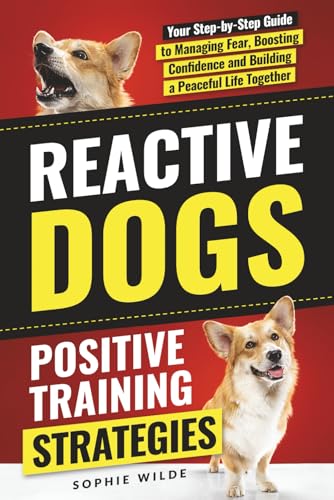
For the dog that turns every passing cyclist into a full-body explosion.
Leash lunging, frantic barking at the mail carrier, stiff-body staring at other dogs — if that describes your daily walk, this is the book that most closely matches your problem. It runs 174 pages and is newer than most of the lineup, publishing in 2025, so you are getting modern behavioral science rather than decades-old advice.
What carries the book is its tone. The approach is compassionate and nonjudgmental rather than scolding, walking you through reactivity, canine body language, and trigger management in plain language. There are hands-on techniques inside — TTouch and LAT among them — and the book is not shy about the fact that it starts with understanding your dog rather than correcting it. One reading experience that comes up often is the dog getting noticeably calmer after the owner starts applying the trigger work; the change is different from dog to dog, but the direction is right.
It is more specialized than the Ultimate Guide above and less dense than Positive Training for Aggressive and Reactive Dogs. A 174-page, 8.2-ounce paperback is thin enough to slip into a training bag, and it fits the bill for owners who want the reactive-dog equivalent of a field guide, not a textbook.
What makes it comfortable to read
- Nonjudgmental tone — no shaming about your dog’s reactions
- Plain-language explanation of canine body language and triggers
- Practical techniques you can start on the next walk
Where it stops short
- Aimed at already-trained reactive dogs — not a puppy basics book
- Not a cure; most owners see progress, not an overnight fix
- Does not go as deep on aggression as the CompanionHouse book below
Pick this if: Your dog already knows sit and stay, and the missing piece is staying calm when the world gets loud.
Not the right book if: You have a fresh puppy with no leash skills yet — start with a basics book and come back to this once the foundational cues are in place.
5. The Only Positive Puppy Training Book You’ll Ever Need
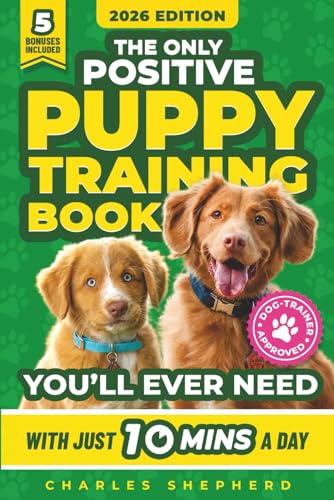
The 137-page plan for the eight-week-old chaos currently chewing your shoe.
New puppy, zero experience, and absolutely no time to read a reference manual. That is the exact buyer this book was written for. It runs 137 pages and structures the training around roughly 10 minutes a day, which is the realistic number most first-time owners can actually commit to.
The scope covers the whole early stretch: potty training, housebreaking, socialization, and basic cues. The content is what does the heavy lifting here — one reviewer describes the book’s value as helping the reader understand how puppies learn, not just being told what to do. It is written simply, laid out clearly, and pitched at a puppy that is fresh from the breeder rather than a dog with years of habits.
The one thing to go in knowing is the bonus-material mess. The QR codes inside link to downloadable extras, and at least some of those links have surfaced human or senior exercise content rather than puppy-training assets. The publisher is aware of this, but it is real friction for the readers who bought the book expecting downloadable training logs and checklists. The core chapters are not affected.
What you actually get: A 10-minutes-a-day training plan that fits in before work, aimed at a brand-new puppy and a brand-new owner.
Know before you buy: The book’s QR-code bonuses have reportedly pointed at the wrong content — human exercise, not puppy logs. Skip the bonus and run the chapters as printed.
Best for: A first puppy and a first-time owner who wants a clear plan without a thick manual.
Skip the QR codes: Treat the printed chapters as the whole book and you sidestep the broken bonus links entirely.
6. Positive Training for Aggressive and Reactive Dogs

The heavy manual for a dog whose problem has outgrown a treat-and-praise weekend.
A dog that bites, guards, or shuts down when guests arrive is past the puppy-basics stage, and this is the book that treats it as a serious case. Annie Phenix is a Certified Behaviorist and Fear Free Professional, and the 256-page guide is built around the kind of detailed behavior modification most books only nod at.
The depth is the whole draw. There are chapters on distinct types of aggression — fear-related, canine-to-canine, resource, territorial, maternal, arousal, pain, and predatory — plus a “what not to do” section that walks through exactly how good intentions can cause harm. Each chapter carries an “Ask an Expert” section with interview-style input from trainers, veterinarians, and behaviorists, and the writing is clean enough that a non-professional can follow the protocols.
The honest question a reader should ask is whether they need all of this. The practical-advice feedback is split: some readers find the information thorough and the writing clear, while others step away wanting more direct “do this” instruction and less routing to a professional. That is fair criticism of a book designed for serious cases, not a defect — you do not want a book promising simple fixes for aggression. The reading is calm and well-documented; you do have to be prepared to be told that a trainer or veterinarian in the room is often the right move.
What sets it above the basics: It names the difference between aggression types rather than treating all snapping dogs the same, and it does not pretend a book can replace a professional for a bite history.
The honest catch: If you want a step-by-step home protocol you can run alone, this book often points you toward a qualified professional instead. That is good advice, but it is not the quick-fix manual some shoppers want.
Worth having if: You are living with a genuinely aggressive or reactive dog and want the vocabulary and protocols to work well with a behaviorist.
Consider waiting if: Your dog has ordinary leash-pulling or manners problems — the Reactive Dogs book above matches that profile more closely and costs less struggle to work through.
7. Service Dog Training Manual for Beginners
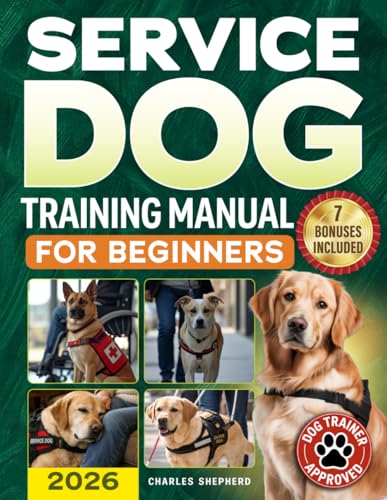
A lean, focused plan for turning a prospect into a working service dog.
Training your own service dog is a long road, and most beginners start with a hazy picture of what tasks the dog will actually perform. This 99-page guide is the shortest book in the lineup, and that is deliberate — it is structured for a first-time handler who needs a roadmap, not a reference volume.
What it covers is specific. The core is task training, tailored to the handler’s needs, plus public-access preparation and a quick study of service dog laws and ADA protections. The writing stays short and precise, with lessons sized to be manageable for a beginner. The format — 8.5 x 11 inches — means full-size pages, so each task is laid out on a page you can actually prop open while you work the dog.
There is a real-world trade-off to know about. A 99-page manual cannot cover every possible service task, so this book gives you the framework and a chunk of the details, not the whole thing. If your service path requires highly specific tasks — medical alert work, mobility assistance — expect to supplement. For the basics plus the legal picture, it earns the shelf space.
What it gets right
- A real roadmap for first-time service dog handlers
- Includes ADA and service dog law basics most books skip
- Short, precise lessons at roughly 99 pages — finishable, not a project
What it does not cover
- Cannot fit every service task at this length
- Newer title with a smaller track record than the classics
- Not a general manners book — this is specialty training
The right book if: You are training a service dog prospect yourself and want a starting framework plus the legal basics.
Not the right book if: You want a general family-dog manners guide or you have a dog with serious aggression — different problem, different book.
8. Tom Dokken’s Retriever Training

A working retriever expert’s full curriculum, from first sit to blind retrieves.
Tom Dokken has spent decades training retrievers professionally, and this 256-page book delivers that experience stage by stage. It is longer and more detailed than the Gun Dog guide above, with a full progression from foundational obedience through field-level work and the pictures and step-by-step breakdowns that beginners rely on.
The strength is the reasoning. Each stage explains not only the method but the reason behind it and the likely mistakes along the way — so you understand the why, not just the drill. The Place command gets a solid chapter of its own. That kind of explanation is why retriever owners come to trust this book as a reference rather than a one-time read.
It is not only for hunters. The reviewer feedback is candid on this point, and more than one voice on the review pages points out this works as a general training aid for dogs of all kinds. If your retriever has a drive and you want to channel it into a real curriculum rather than an afternoon of fetch, this is where to start. The book itself is 1.2 pounds and does have a printing quirk — some copies are printed in China — including a reviewer who flags it. That does not affect the content.
The case for it: Every training stage is explained at three levels: what to do, why, and what goes wrong. That layered teaching is what turns a novice retriever handler into a competent one.
One reading quirk: A few practical tips that belong in the first few chapters appear later, so read the opening chapters before you buy gear or pick the dog. A light gripe about print location does not touch the training content.
Buy this if: You have a retriever with a working drive and want a full stage-by-stage curriculum that goes beyond basic obedience.
Skip this if: Your dog is a reactive rescue or a small breed — the retriever-specific focus is not a fit.
9. The Do No Harm Dog Training and Behavior Handbook

The 346-page reference that treats dog training as a question of needs, not commands.
Linda Michaels takes a different angle than everyone else on this list. Instead of a drill-based program, the book is built around the Hierarchy of Dog Needs — a dog-shaped adaptation of Maslow’s hierarchy of human needs — and uses it as the foundation for every behavior solution. At 346 pages, it is the longest guide here by a clear margin.
The structure is what makes that length useful rather than intimidating. It is designed as a reference: read it cover to cover or look up a specific issue by index. There are treatment plans for leash reactivity, separation anxiety, barking, resource guarding, and sibling rivalry, plus a Doggy Enrichment Land concept built around a step-by-step desensitization plan. The force-free stance is firm throughout — punishment, pain, and fear are excluded by design. The book also carries a Publishers Weekly Editor’s Pick Booklife Review, which described it as a “thorough, illuminating guide to force-free dog training.”
The book is not going to be for everyone. It leans academic in places, and readers who want a quick fix will find it slower going than the shorter books above. The payoff is a reference that holds up across a dog’s life — the kind of book you pull off the shelf when a new problem appears.
What it does better than most: It connects a dog’s unmet needs to specific behavior problems, so a barking dog and a chewed door are treated as communication, not just nuisance.
What to expect going in: At 346 pages it reads more like a manual than a paperback. Plan to spend time with a chapter, not breeze through it.
The right pick if: You have a dog with recurring behavior issues and you want a long-term force-free reference to consult over the years.
Look elsewhere if: You want a quick-start puppy plan in a weekend — the shorter puppy and beginner manuals above will serve you better.
Know the Specs
Print Length (Pages)
Page count is the clearest signal of how much a training guide covers. A book around 99–174 pages is usually focused on one thing — service tasks, reactive behavior, or puppy basics — and expects you to work through it in order. A book around 224–346 pages tends to function as a reference: you look up a problem in the index, or you read a chapter on a specific issue. Neither is better; the match to your dog’s problem is what counts. A 346-page encyclopedia will not help a first-time owner house-train a puppy as well as a tight 137-page plan.
Training Method (Positive vs. Force-Based)
Positive-reinforcement training rewards the behavior you want with treats, praise, or play. Force-based or correction-heavy training uses aversives — leash jerks, shouting, or shock collars — to stop behavior. All the books in this guide lean positive or force-free, though some are more explicit about it. If you want to train without correction, look for “positive” or “force-free” in the title. The Do No Harm and Positive Training for Aggressive and Reactive Dogs books take the firmest ethical stance on this point.
Scale and Audience Fit (Puppy, Reactive, Working Dog)
Training books are written for a specific dog in mind. A puppy book assumes a dog fresh from the breeder, so it starts at house-training and socialization. A reactive-dog book assumes a dog that already knows its cues and needs help staying calm. A working-dog book — bird dogs or service dogs — assumes a specific drive and job. Buy for the dog you have today — its age, its triggers, its job. Matching the book to your dog’s age and problem saves more frustration than any other choice here.
Publication Year and the Longevity Trade-Off
An older classic earns its place because its program has been run with real dogs for a generation — the 1961 Gun Dog guide and the 2009 Retriever Training book are both proof. A newer title brings modern behavioral science, updated legal information for service dogs, and a gentler ethical stance. If you are working through bird-dog field work, an old master’s book still teaches what works. If you are dealing with reactivity, aggression, or a recent rescue, put more weight on the newer titles where current behavioral thinking shows up.
Common Questions
Are dog training books actually effective compared to professional trainers?
Which training method is better for a dog — positive reinforcement or correction-based training?
I have a reactive dog. Which book should I start with?
How long does it take to train a puppy using one of these books?
Does the Canine Good Citizen book guarantee my dog passes the AKC test?
Is a newer training book always better than an older classic like Gun Dog?
What is the difference between a puppy training book and a general dog training book?
Do I need a special book if I am training my own service dog?
Can a book help with dog aggression, or do I need to see a professional?
Do any of these books include online bonuses or downloadable resources?
The Bottom Line
For most readers looking for the best dog training books, the Gun Dog: Revolutionary Rapid Training Method is the one to grab first — it holds the highest rating of the lineup at 4.5+ stars and delivers a full field program in 160 pages. That rating comes on 800+ owners. The Canine Good Citizen guide has more reviews at 700+ and sits slightly lower on the scoreboard, but on the strength of the program itself, Gun Dog remains the winner. If you want the official AKC curriculum for certification, the Canine Good Citizen: The Official AKC Guide, 2nd Edition is the one to reach for. And for a dog that turns every walk into a battle, the Reactive Dogs: Positive Training Strategies guide is the most direct place to start. Pick the book that matches the dog in front of you, not the one you planned to get.
How we choose
We do not accept paid placement. Every pick is matched to a real buyer and a real use-case; we do not hands-on test units.
Sources
Specifications: manufacturer listings and product documentation. Review insights: verified customer reviews, as of October 2026. Pricing: not shown on this page (it changes often); check the current price via the retailer link.
As an Amazon Associate, How Dog Care earns from qualifying purchases. This does not affect which products we feature.