Disclosure: This post may contain affiliate links. As an Amazon Associate I earn from qualifying purchases, at no extra cost to you. Learn more
Specs are compiled from manufacturer listings and verified buyer reviews and can change over time — please confirm the key details on the product page before buying.
If your dog treats the yard like a snack bar, the fix is simpler than you think: a poop-eating deterrent works by making stool taste unpleasant after it passes through your dog. The picks below are the ones dog owners actually stick with, and the top of the list is a dual-action chew that pairs stool deterrence with probiotics so the stool itself becomes less appealing.
This guide is built by comparing the manufacturers’ published specifications and the patterns across verified customer reviews, so you get each pick’s real strengths and trade-offs instead of marketing spin.
A poop-eating dog usually needs two weeks of daily dosing before you see a change, so the format your dog will actually swallow matters as much as the ingredients. A chew you can hand over like a treat gets eaten every day; a powder you mix into a bowl does too, if your dog finishes the bowl. Below are the specs side by side and full reviews of the dog supplements for poop eaters that fit different feeding routines.
Top Picks

How To Choose The Best Dog Supplements for Poop Eaters
Coprophagia — the habit of eating stool — is not a nutrition problem in most cases, and that is exactly why a deterrent needs a delivery system your dog will actually swallow every single day. The products below fall into three camps: soft chews, flavored tablets, and sprinkle powder. Each works on the same principle. Once digested, the formula changes how the stool smells and tastes so your dog loses interest.
Match the format to your feeding routine
A soft chew gets eaten like a treat, which is why so many buyers report their dogs take it without a fight. A powder gets mixed into kibble and disappears. A tablet sits somewhere in between and can be crushed if your dog is suspicious of anything new in the bowl. If your dog is a picky eater or a bolter, the chew format removes the daily negotiation entirely. If your dog inhales food without chewing, the powder blends in more reliably.
Check the dose schedule before you commit
Deterrents are dosed by weight, and a small dog needs far less than a large one. A chew bottle that lists weight bands — up to 40 lbs takes one chew, 41 to 80 lbs takes two — lets you plan how long a container will actually last. The wrong assumption beginners make is buying a large-breed bottle for a small dog and then overfeeding, or buying a small bottle for a big dog and running dry mid-behavior. Read the dosing line before you read the price.
Understand what the probiotic add-on actually does
Many of these products pair the deterrent with probiotics and digestive enzymes. The reason is practical: if stool is less digestible, it carries more undigested food value, and a dog is more likely to revisit it. Improving digestion can make stool less attractive at the source, and it also supports firmer output. Probiotics do not replace the deterrent — they complement it. If your dog also has loose stool or gas, a dual-action chew is often the better first purchase than a standalone deterrent.
Side-by-Side Comparison
| Model | Best For | Format | Count / Size | Flavor | Amazon |
|---|---|---|---|---|---|
| No Poo Coprophagia Chews 200 ct★ Best Overall | Dual-action deterrence plus gut support | Soft chew | 200 count | Chicken | Amazon |
| No Poo Chews for Dogs (Pawsential)Best Everyday Chew | Large-breed daily routine | Chew | 120 count | Beef Liver | Amazon |
| No Poop Eating for Dogs (Nature’s Pure Edge)Best for Multi-Dog Homes | Multi-dog households | Powder | 230 scoops | Chicken | Amazon |
| STRELLALAB No Poo Chews | Soft-chew texture for picky dogs | Soft chew | 120 count | Poultry Liver | Amazon |
| FOR-BID Coprophagia Deterrent | Sprinkle-and-go simplicity | Powder packets | 12 packets | — | Amazon |
| PAWFECTCHEW No Poo Chews | Flavor-first chew acceptance | Chew | 120 count | — | Amazon |
| PRN CoproBan Soft Chews | Litter-box raiding and stool eating | Soft chew | 40 count | Roast Beef | Amazon |
| Zesty Paws Chew No Poo | Gum and gut support in one chew | Soft chew | 90 count | Bison | Amazon |
Detailed Reviews
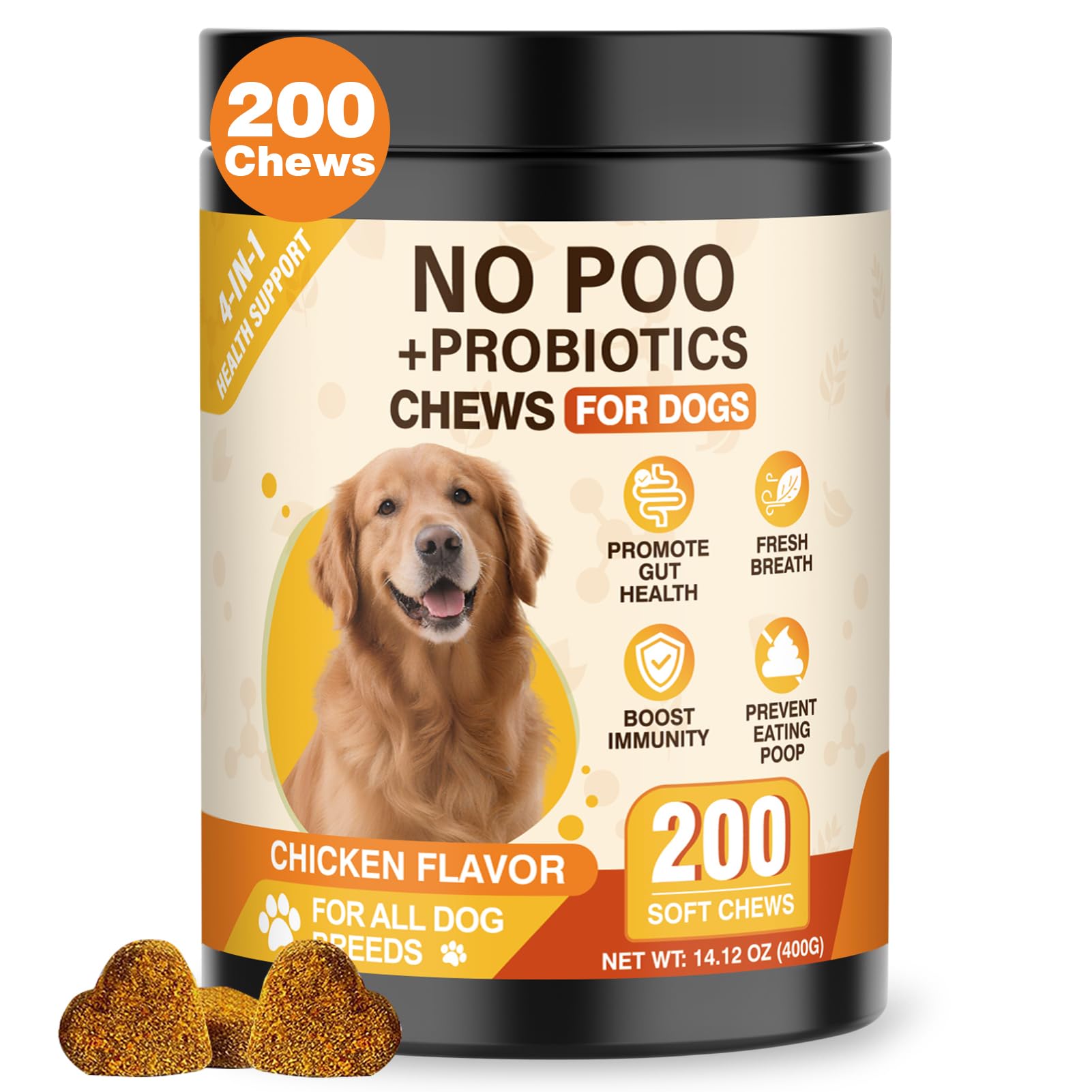
1. No Poo Coprophagia Chews for Dogs 200 ct
Our pick — 4.5+★ from 100+ verified ratings; the strongest balance of quality and price.
Two jobs in one chicken chew: kill the stool habit and settle the gut that started it.
The first thing to know is volume. This bottle holds 200 chews, and because dosing runs by weight, that works out to roughly 50 full doses for a dog on a four-chew schedule. That is the practical reason it wins the top slot over bottles half its size — you are not reordering in the middle of a behavior change that needs consistency to stick.
The formula itself is a 2-in-1: a stool deterrent plus a probiotic and prebiotic blend, with bromelain, pumpkin powder, and glutamic acid in the mix. The deterrent side gently shifts how stool smells and tastes. The probiotic side maintains a balanced gut microbiome, and the thinking is that better digestion means stool carries less appeal to begin with. Owners consistently report the chews disappear fast and that their dogs treat them as a treat rather than a tablet to hide. Reviewers also mention itchy feet, paw licking, and head shaking clearing up alongside the stool habit.
The catch is the chew count versus the dose count. If your dog sits at the top of the weight chart, 200 chews do not last as long as the number suggests, so plan the reorder before the bottle gets light. One buyer’s summary still stands as the best value note here: “200 chews = 50 doses for, good value.”
What earns it the top slot
- 200 chews deliver roughly 50 weight-based doses, so a full behavior cycle stays covered
- Deterrent and probiotic in one chew means one daily step instead of two
- Bromelain, pumpkin powder, and glutamic acid, with no artificial preservatives or synthetic colors
- Soft chew texture gets eaten like a treat, so no pill-hiding routine
Where it asks a little more of you
- Large dogs burn through the bottle faster than the 200-chew count implies
- Daily consistency is required — the deterrent fades when you stop
- Weight-based dosing means you need an accurate read on your dog’s size
Reach for this if: you want the stool habit and the gut addressed in one chicken chew, and you have a small-to-medium dog that makes the 200 count stretch.
Look elsewhere if: your dog is at the heavy end of the weight scale — the dose count drops and a powder format may stretch further.
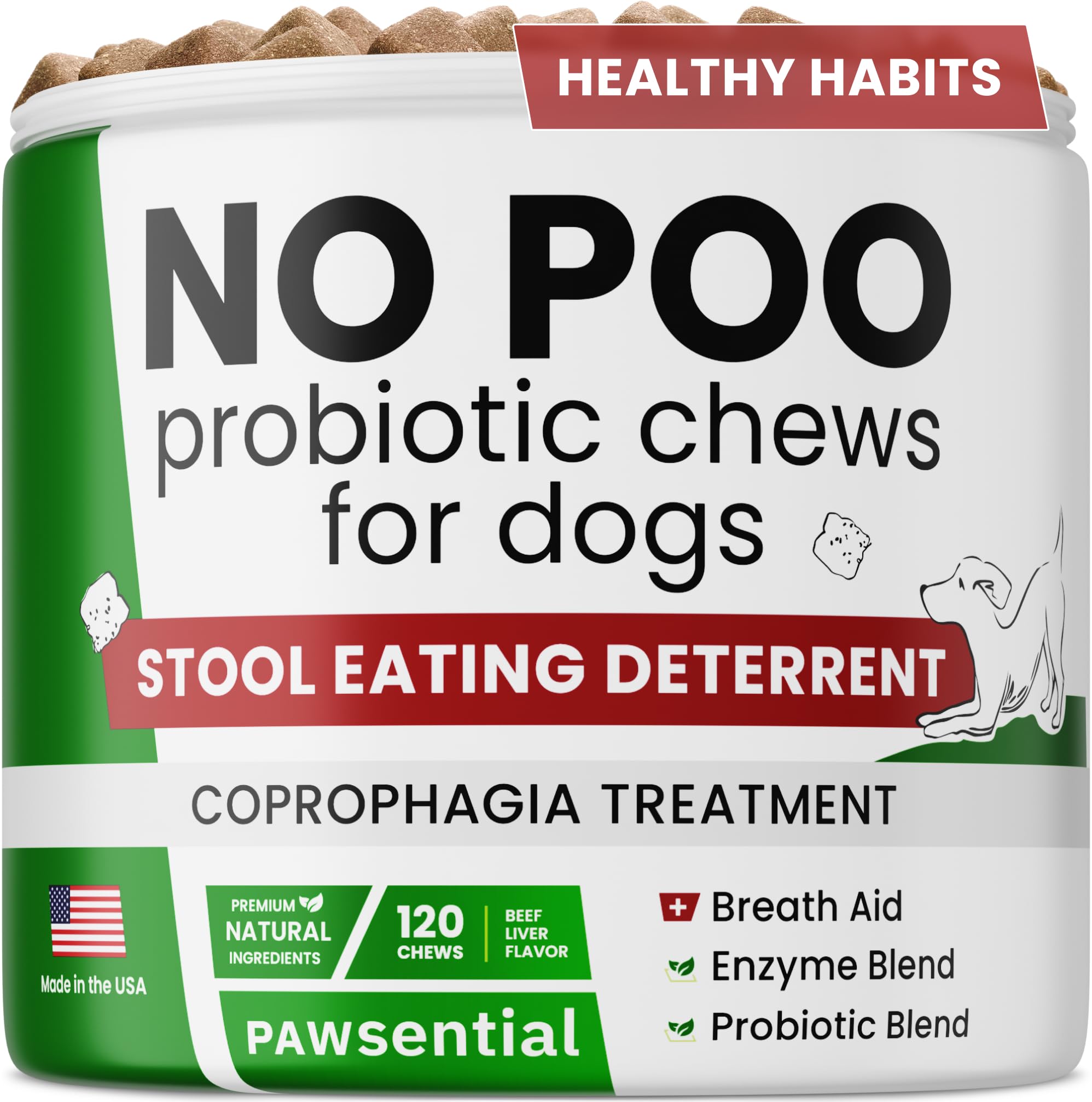
2. No Poo Chews for Dogs, Coprophagia & Stool Eating Deterrent
Beef liver chews with a probiotic and enzyme blend built for dogs that turn noses up at everything.
A 120-count bottle flavored with beef liver is the middle-of-the-road option here, and that is precisely its appeal. The active list is the interesting part: a probiotic blend, a proprietary enzyme blend, parsley leaf, chamomile, and yucca schidigera. Yucca is the ingredient that does the deterrence work — once digested it shifts how stool smells, and your dog’s interest drops. Parsley and chamomile carry the breath side.
Where this one separates from the pack is breadth. It is listed for all breed sizes, so a Chihuahua and a Great Dane sit on the same label, and the manufacturer states it is made in the USA and held to GMP standards. That range is convenient in a multi-dog house, but it also means the dose per chew has to cover a very wide span, and large dogs land on the higher end of the schedule.
The honest caveat is that this is the least predictable bottle on the list for sensitive dogs. There is a real report of a Golden Doodle vomiting after the first dose, and a couple of owners describe itching that got worse rather than better. Treat those as a fit warning — if your dog has a touchy stomach or a history of skin flares, introduce half a dose for a few days before going to the full schedule. For dogs with a sturdy gut, the beef liver flavor does the heavy lifting and owners say it goes down without a fight.
The real draw: a five-ingredient actives list that pairs a prebiotic with yucca schidigera for deterrence, plus parsley and chamomile for breath.
What to plan around: the all-breed label means large dogs sit at the top dose, and a sensitive stomach can take a few days to adjust.
The fit: a household with dogs of mixed sizes that wants one bottle to cover everyone and a flavor that gets eaten on sight.
The trade-off: if your dog has a sensitive stomach or a history of itchy skin, start with a partial dose and watch the first two days.
3. No Poop Eating for Dogs
A chicken-flavored powder that stirs into every bowl in the house, not just the poop eater’s.
This is the only powder in the lineup that explicitly builds its pitch around multi-dog households, and the logic is smart. If one dog eats the others’ stool, the fastest fix is to make stool from every dog in the house unappealing. Sprinkling powder into each bowl means the deterrent travels with the stool, not just with the dog that has the habit. The jar holds 230 scoops.
The formula is a 7-enzyme blend with parsley and zeolite for odor absorption, plus yucca schidigera to shift the smell of stool. It is chicken-flavored and the allergen line lists it as dairy free. The other ingredient worth noticing: it is a coenzyme and bitters additive, so the stool gets a bitter edge on top of the smell change. That is a training aid, not a switch.
Here is the honest part. This is the most divided product on the list, and the reviews split cleanly between owners who saw the habit end and owners whose dogs never changed. The one pattern that matters: the owners who report success often fed it to the dogs whose stool was being eaten, not only to the eater. That single detail is the difference between a product that works and one that sits in the cabinet. Digestibility and taste also draw mixed reports, and some owners note the jar empties faster than the stated serving count. Treat this one as a plan, not a pill.
Why multi-dog homes should look here
- 230 scoops per jar means a long runway for a whole-house feeding plan
- Yucca schidigera shifts stool odor, and the coenzyme and bitters additive adds a bitter taste
- Dairy-free chicken flavor stirs into kibble without a separate feeding step
- Breath support built in through parsley and zeolite odor absorption
The honest complications
- Results are genuinely split — some dogs shift quickly and others never respond
- Success often depends on dosing the non-eater’s food, which is an extra step
- The jar can empty faster than the stated scoop count suggests
Try this one if: you run a multi-dog house and are willing to powder every bowl so the stool itself loses its appeal across the household.
Think twice if: you have a single dog with a firm habit — the evidence is polarized and you may be better served by a chew plus a training plan.
4. STRELLALAB No Poo Chews for Dogs
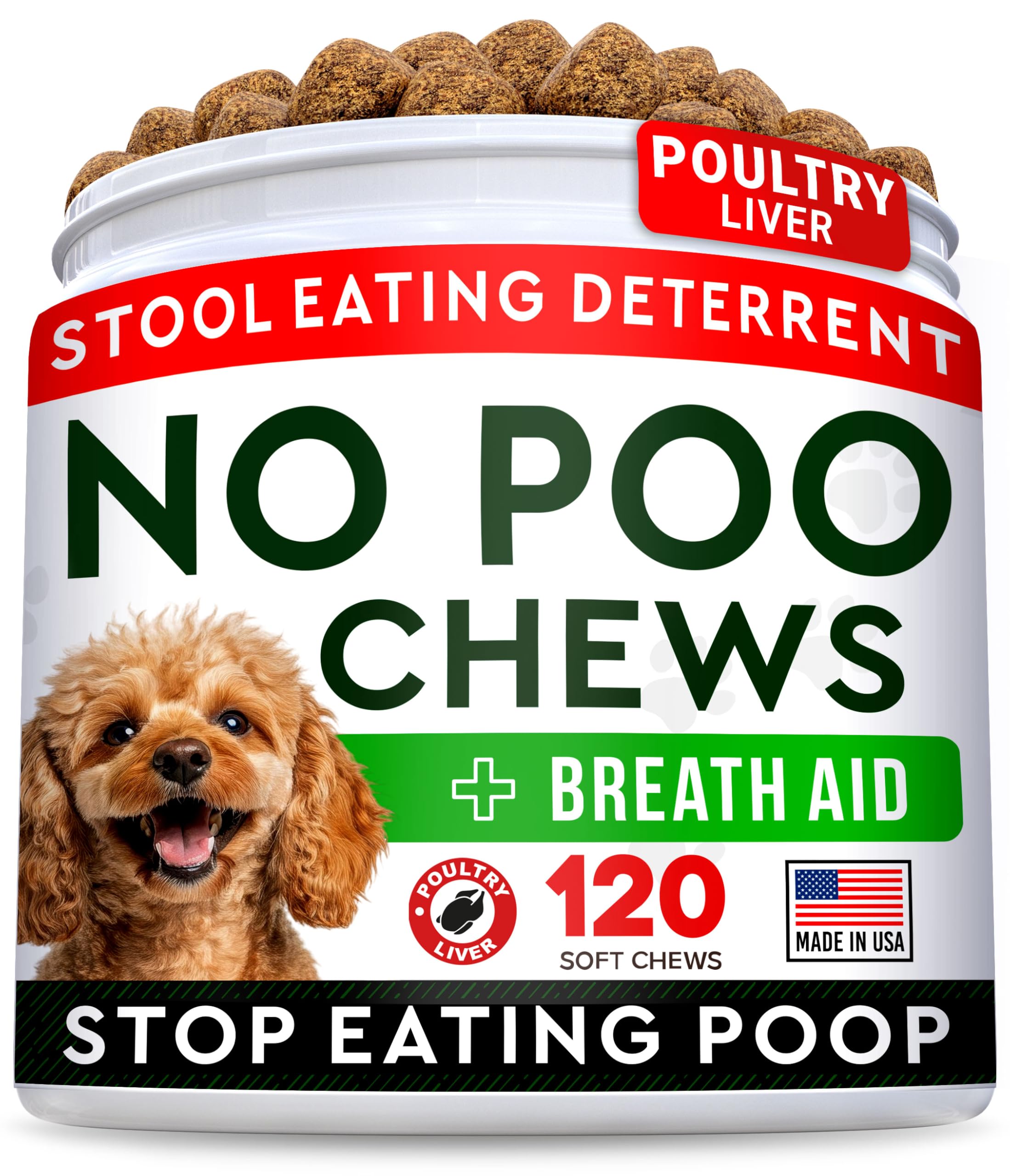
A soft-chew built for the dog that spits out anything that tastes like medicine.
The texture pitch is real: these are soft chews flavored with chicken and liver, sized to be eaten like a treat. There is no pill pocket, no crushing, no peanut butter disguise. If your dog rifles through the bowl and leaves anything unfamiliar behind, a soft chew removes that fight. The label says regular use can reduce coprophagia behavior in 2-4 weeks, so plan on a multi-week trial rather than a next-day fix.
Under the flavor, the formula leans on digestive enzymes, yucca, and chamomile for gut support, with parsley and chamomile for the breath side. Made in the USA and listed with 120 chews per tub.
The unvarnished truth is that this is one of the weaker performers on the list. Plenty of owners mention no change at all, and a fair number say their dogs ate the chews happily and kept eating stool anyway. Some do report success — a puppy that stopped within days, and a gradual reduction over months for another owner. The split is wide enough that this is best approached as a low-risk first try rather than a guaranteed fix.
Texture-first reasoning: a soft chew flavored with chicken and liver beats an effective formula that never gets swallowed — this is the pick for the dog that rejects everything else.
Go in with eyes open: results are genuinely mixed, and a 2-4 week window is the earliest honest expectation of change.
Best suited to: a picky dog that turns down tablets and powders, and an owner willing to give a soft chew several weeks to build any effect.
Not the one if: you want the strongest evidence of success — the formula draws split results and a firmer track record sits elsewhere on the list.
5. Coprophagia Deterrent for Dogs & Cats, 1 Pk

The vet-cabinet classic: sprinkle a packet on dinner and the stool turns unappealing from the inside out.
FOR-BID has been on the market long enough to have a listing date back to November 2004, and the label claims 50+ years of veterinary use. The format is the story here: 12 individual packets, each sprinkled and lightly mixed into food. There is no flavor to mask because the product is designed not to change the taste or smell of the food itself — only the stool after digestion. For a dog that refuses chew after chew, that is a genuine advantage.
The active approach is straightforward: once digested, the formula makes stool taste unpleasant, and consistency is what keeps the effect alive. Customers note the habit returning when the packets stop and clearing again on restart, which tells you this is a maintenance tool, not a cure. The other detail worth flagging: the manufacturer’s own note says the formula contains MSG, and one owner points out that makes it a short-term trial rather than a long-term daily.
Where this one gets tricky is the stomach. There are clear reports of loose stool and vomiting, and a couple of owners say the taste ruined the food entirely for their dog. It is also the shortest supply on the list at 12 packets, so a multi-dog house goes through a box fast. For a single dog with a recent habit and a sturdy gut, the sprinkle format and the long veterinary history are the reasons to try it. For a sensitive dog or a long-standing multi-dog problem, look at the powder or the dual-action chews first.
The case for a packet format
- No change to the food’s taste or smell — the deterrent only works after digestion
- 12 pre-measured packets, no scoop, no guesswork
- Decades of veterinary use and a listing history that goes back to 2004
Where it can go sideways
- Shortest supply in the lineup — 12 packets go quickly in a multi-dog home
- The label notes MSG, so it reads as a short-term trial rather than a forever daily
- Some dogs have loose stool or vomiting, and a few refuse the doctored food entirely
Reach for it when: you have one dog with a fresh habit and a reliable stomach, and you want the simplest possible daily step.
Pass if: your dog has a sensitive gut or you are feeding three dogs — a larger powder jar or a chew serves that setup better.
6. PAWFECTCHEW No Poo Chews for Dogs

Weight-banded dosing makes this the easiest bottle to get right for a big dog or a small one.
The dosing chart is the cleanest feature here. Up to 40 lbs gets one chew, 41 to 80 lbs gets two, and over 80 lbs gets four. That is a bottle you can plan around, and it means a small dog stretches 120 chews a long way while a giant breed knows exactly how fast the tub will empty. The formula pairs probiotics with digestive enzymes and is made in the USA.
What wins people over is the taste. Reviewers point out dogs eating these like treats, which is the single biggest compliance hurdle cleared. The opposite side of that coin shows up in multi-dog homes: the dog whose stool is being eaten sometimes refuses the chew while the poop eater wolfs it down. One owner tried crushing it into cottage cheese and hiding it in peanut butter without luck. If your household has two dogs — one eater, one supplier — you may need a different plan for the supplier.
The value question is the recurring theme. Chew acceptance is high, but owners frequently question whether the results justify the cost. Some dogs stop immediately, others never shift. If you have a young dog with a fresh habit and an eager appetite, the flavor and the clean dosing make this a reasonable shot. If you need a guaranteed outcome, temper expectations and pair it with the obvious management move: clean up immediately and block access during the other dog’s business.
The simple strength: a three-band weight chart and a flavor dogs accept as a treat, which removes the two most common reasons a deterrent goes uneaten.
Pick this when: you want a chew your dog will take without a fight and a dosing chart that fits anything from a terrier to a mastiff.
skip it if: the obstacle in your house is a dog that refuses the chew while the eater keeps eating — in that case the delivery method is the problem, not the formula.
7. Vet Classics Stop Stool Eating Supplement for Dogs

The chew that also freshens breath and calms gas — a three-way support for a dog with a stool habit.
Vet Classics has been making pet supplements since 1994, and this soft chew carries the veterinarian-formulated label along with glutamic acid, the ingredient that changes the taste of stool. It also packs enzymes and probiotics and doubles as a breath freshener, which matters because a dog with coprophagia tends to have breath to match. The label also claims it eases excess gas and reduces urine and stool odors.
What owners consistently like is the taste — these go down like treats, and a small dog starts on half a chew. One owner found the half dose did nothing and a full chew started to work. That pattern is worth keeping in mind: dose by weight, but do not be afraid to go to the full chew if a partial one has no effect.
The catch is the lag. This is not a fast product. Owners who report success talk about two weeks, and one notes firmer stool after the first dose. Others gave it a try and saw no change at all, and a few report the dog’s breath stayed foul. With 90 chews per tub, a small dog on half a chew gets a lot of runway to test it. A large dog on multiple chews will go through the tub quickly, and that is when the value question starts to sting.
Where it shines: glutamic acid to shift stool taste, plus enzymes, probiotics, and breath-freshener support in a single soft chew.
Where it stalls: about a two-week window before you can judge it, and a 90-chew tub that runs out fast for a large dog.
Good match for: a small-to-medium dog with a stool habit and a breath problem, where a half-to-full soft chew is easy to manage.
Check your patience first: give it a full two weeks and a proper weight-based dose before deciding it failed.
8. PRN Pharmacal CoproBan Anti-Coprophagia Soft Chews for Dogs, 40 Count

The one built for the cat box: fed to the cat so the dog’s midnight raid loses its appeal.
This is the only product here with an explicit cat-litter-box angle. CoproBan can be fed to cats, which means you can treat the source rather than the raider — the cat’s stool becomes unappealing and the dog loses interest. That single use case makes it the pick for any house where the dog treats the litter box as a buffet. The chews are roast beef flavored and contain MSG and cellulose to help break down fiber.
The supply is the tightest here at 40 chews, and that matters. Vet-recommended status and a company history going back to 1978 earn it a spot, but 40 chews is only a short trial. Owners who use it alongside a training plan report the behavior drops in frequency without disappearing entirely, and the effect can linger for a couple of weeks after the last chew.
What to know before you buy: a 40-count bottle is not a long runway, and for multiple dogs the daily cost climbs quickly. There are also reports of loose stool and one case of severe diarrhea where the owner stopped use. The texture has drawn complaints too — some boxes arrive soft and chewy while others arrive hard. For a single dog and a cat-box problem, the dual-species angle is reason enough to try it. For a household with more than one dog, a larger tub or powder makes more financial sense.
Why it earns its place
- Can be fed to cats, which addresses litter-box raiding at the source
- Roast beef flavor with MSG and cellulose to assist fiber breakdown
- Veterinary-recommended and backed by a manufacturer history since 1978
Keep these in view
- Only 40 chews, so a multi-dog home burns through it fast
- Some dogs have loose stool, and the texture has varied between boxes
- Reduces the behavior in many dogs rather than ending it outright
Choose this if: your dog raids the cat box or eats another pet’s stool, and you can feed the cat as easily as the dog.
Consider size first: a single 40-count tub is a trial, not a program, so a larger household should plan on repeat buying.
9. Zesty Paws Coprophagia Deterrent for Dogs
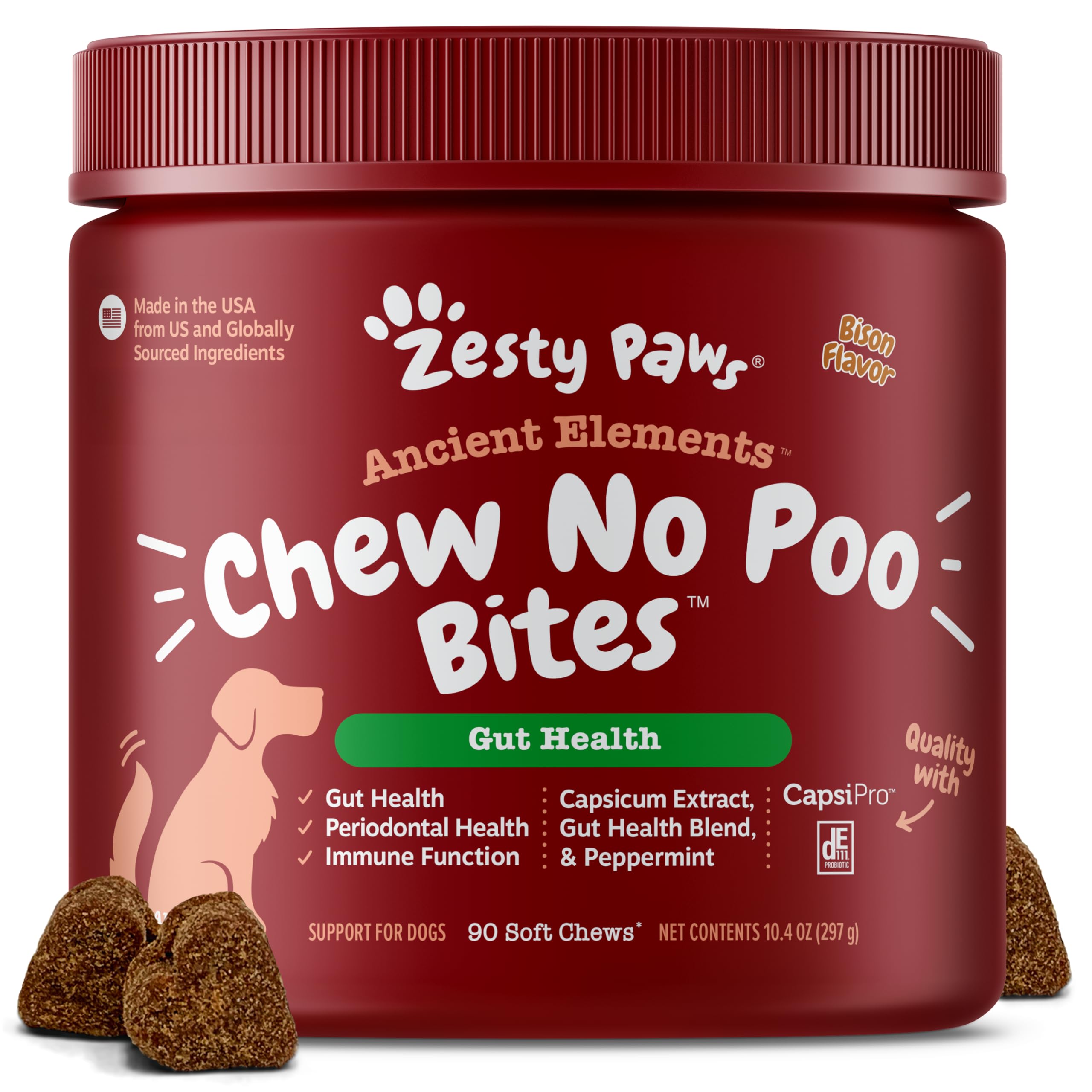
Bison-flavored chews that work on the stool, the gut, and the teeth in the same daily bite.
The standout ingredient is DE111, a Bacillus subtilis strain Zesty Paws describes as clinically studied for gut health and immune support. The deterrence comes from Capsimax, a controlled-release capsicum extract that gives stool a more unpleasant taste. There is also an ancient grain base and a teeth-and-gum blend, so the chew does more than one job. The flavor is bison, and the allergen line lists it as corn-free.
Where it separates from the crowd is the periodontal side. Most deterrents focus on stool and gut; this one adds gum and teeth support, which matters for a dog that spends a lot of time with its mouth where it shouldn’t. Shoppers say the chews going down as a treat, with the stool habit dropping within a few days to a week in some dogs and easing over a few weeks in others. A senior Chihuahua who raided other dogs’ poop on walks showed fewer attempts after a few weeks without any adverse reactions.
The counterweight is real. This is among the pricier picks, and at 90 chews the tub is a shorter commitment than the 120-count bottles. There is also a clear failure case: a dog that loved the chews and kept eating poop anyway. If your dog is food-motivated enough that anything edible gets eaten, the chew itself is not the deterrent — the after-digestion taste change is, and that is where the formula has to earn it. For a dog with a touchy stomach and a stool habit, the gut and gum support make this the most complete single chew on the list.
What puts it ahead: DE111 for gut flora, Capsimax for the stool taste change, and a teeth-and-gum blend — three support lines in one bison chew.
What to weigh: a 90-count tub and a premium position mean this is the highest-commitment chew on the list, and it is not immune to the occasional dog who eats it and keeps eating stool.
Worth it for: a dog with a sensitive stomach and a stool habit, where gut support, gum care, and deterrence in one chew justifies the premium.
Look at the 200-count option instead if: volume matters more than the added gum support and you want the longest runway from a single tub.
Know the Specs
Chew count vs. dose count
A bottle’s chew count tells you how many pieces are inside. The number that actually matters is how many doses that represents for your dog’s weight. A 200-chew bottle dosed at four chews per day is roughly 50 doses, while the same bottle at one chew per day is 200 doses. Before you buy, read the weight chart and divide. This one number predicts how long a tub lasts and whether the value holds up for a large dog.
Deterrence ingredients: yucca, glutamic acid, capsicum
Stool deterrents work through a handful of actives. Yucca schidigera shifts the odor of stool after digestion. Glutamic acid changes its taste. Capsicum extract, often in a controlled-release form like Capsimax, adds an unpleasant edge. None of these affect the food itself — they act on the stool after it passes through. That is why consistency matters more than dose size: the effect only exists while the ingredient is in the system.
Probiotics and digestive enzymes
Probiotics add live bacteria to support the gut, and digestive enzymes help break food down more completely. The practical link to coprophagia is simple: poorly digested food leaves more nutrients in the stool, which makes it more attractive. Firmer, better-digested stool is less appealing to revisit. That is why so many deterrents pair with a probiotic — the two jobs reinforce each other.
Training is not optional
No supplement replaces management. Owners consistently report the best results when the deterrent is paired with cleaning up immediately and blocking access during another dog’s business. The product makes stool less appealing; the cleanup and access blocking close the gap. Do both, not one.
Common Questions
How long does a poop-eating deterrent take to work?
Can I give a poop-eating deterrent to my cat as well as my dog?
Why does my dog eat poop in the first place?
Is a chew or a powder better for stopping stool eating?
How do I dose a poop-eating deterrent for a multi-dog household?
What should I do if my dog vomits or gets diarrhea after a deterrent?
Does MSG in a stool deterrent matter?
Will a poop-eating chew also help with my dog’s bad breath?
Can a poop-eating deterrent be used long term without stopping?
Is a probiotic deterrent better than a plain stool deterrent?
The Bottom Line
For most households dealing with a stool-eating dog, the dog supplements for poop eaters that holds up best is the No Poo Coprophagia Chews 200 ct, because it pairs a deterrent with probiotics in one chicken chew and gives you roughly 50 doses from a single bottle. If the problem lives in a multi-dog house, the Nature’s Pure Edge powder with its 230 scoops lets you treat every bowl, which is the move that changes outcomes. And for a dog that raids the cat box or has a touchy stomach, the PRN CoproBan chews and the Zesty Paws Chew No Poo each solve adifferent problem — the first treats the litter box at the source, the second backs the deterrent with gut and gum support. Pick the one that matches how your dog actually eats, then give it two full weeks before you decide.
No deterrent works alone. These products make stool taste unappealing after it passes through your dog, but the owners who report lasting success also clean up immediately and block access while another dog does its business. Start with a format your dog will swallow every day, dose it by weight, and stay consistent. Deterrent plus cleanup is what ends the habit.
How we choose
We do not accept paid placement. Every pick is matched to a real buyer and a real use-case; we do not hands-on test units.
Sources
Specifications: manufacturer listings and product documentation. Review insights: verified customer reviews, as of October 2026. Pricing: not shown on this page (it changes often); check the current price via the retailer link.
As an Amazon Associate, How Dog Care earns from qualifying purchases. This does not affect which products we feature.