Disclosure: This post may contain affiliate links. As an Amazon Associate I earn from qualifying purchases, at no extra cost to you. Learn more
Specs are compiled from manufacturer listings and verified buyer reviews and can change over time — please confirm the key details on the product page before buying.
If your dog sleeps outside, the real question is not which heater is strongest — it is which one warms your dog’s actual shelter without baking it, tripping a breaker, or dying in the first cold snap. The short answer: match the heater’s type to your house. A wall-mounted forced-air unit for a drafty kennel, a flat mat for an insulated igloo or a tote. Matching the heater type to your shelter matters more than the wattage on the box.
This guide is built by comparing the manufacturers’ published specifications and the patterns across verified customer reviews, so you get each pick’s real strengths and trade-offs instead of marketing spin.
Below you’ll find nine shelter warmers sorted by how they actually get used, plus plain notes on wattage, thermostats and chew-resistant cords. Every pick here is built to run inside a dog house, and this breakdown of dog house heaters covers what each one really does.
Top Picks
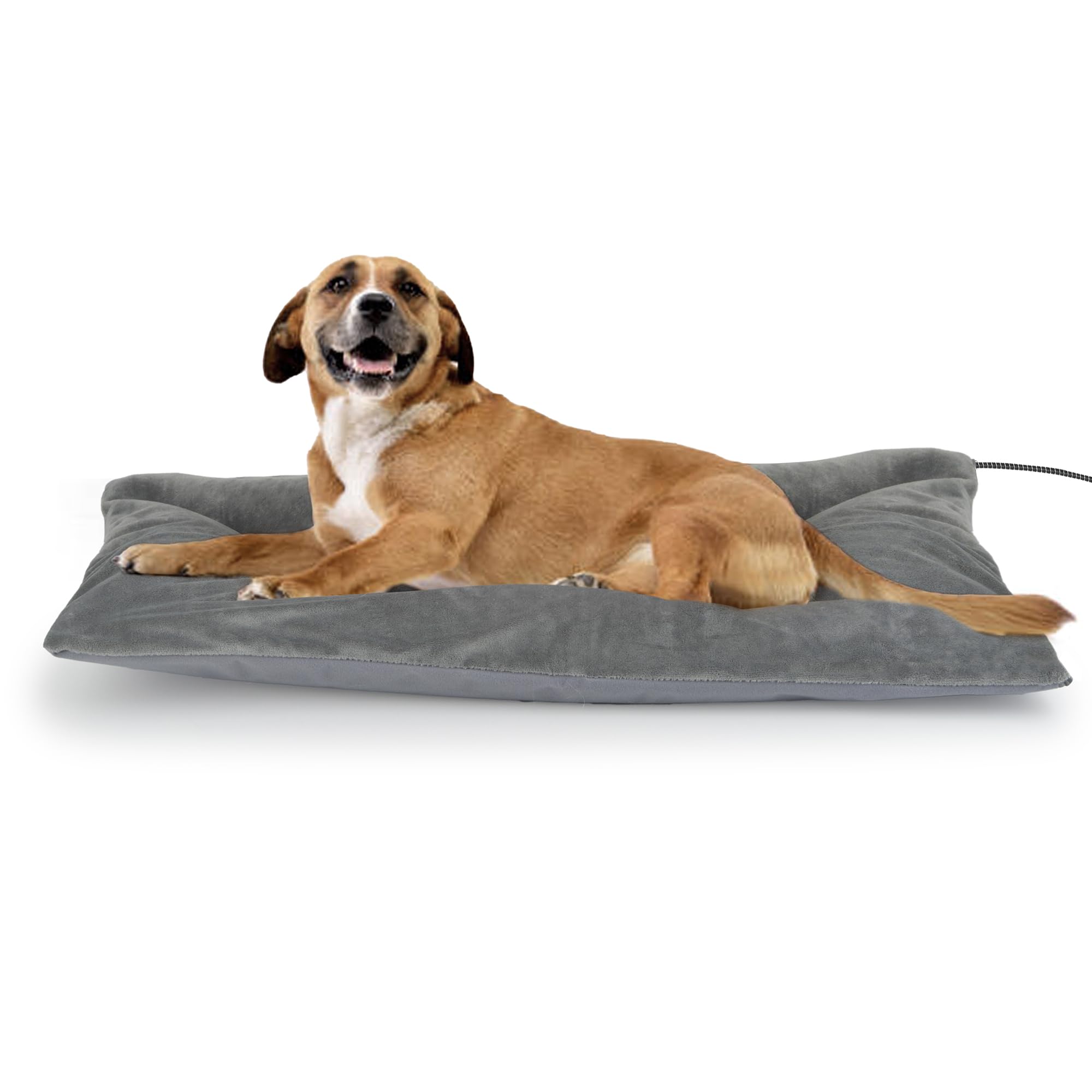
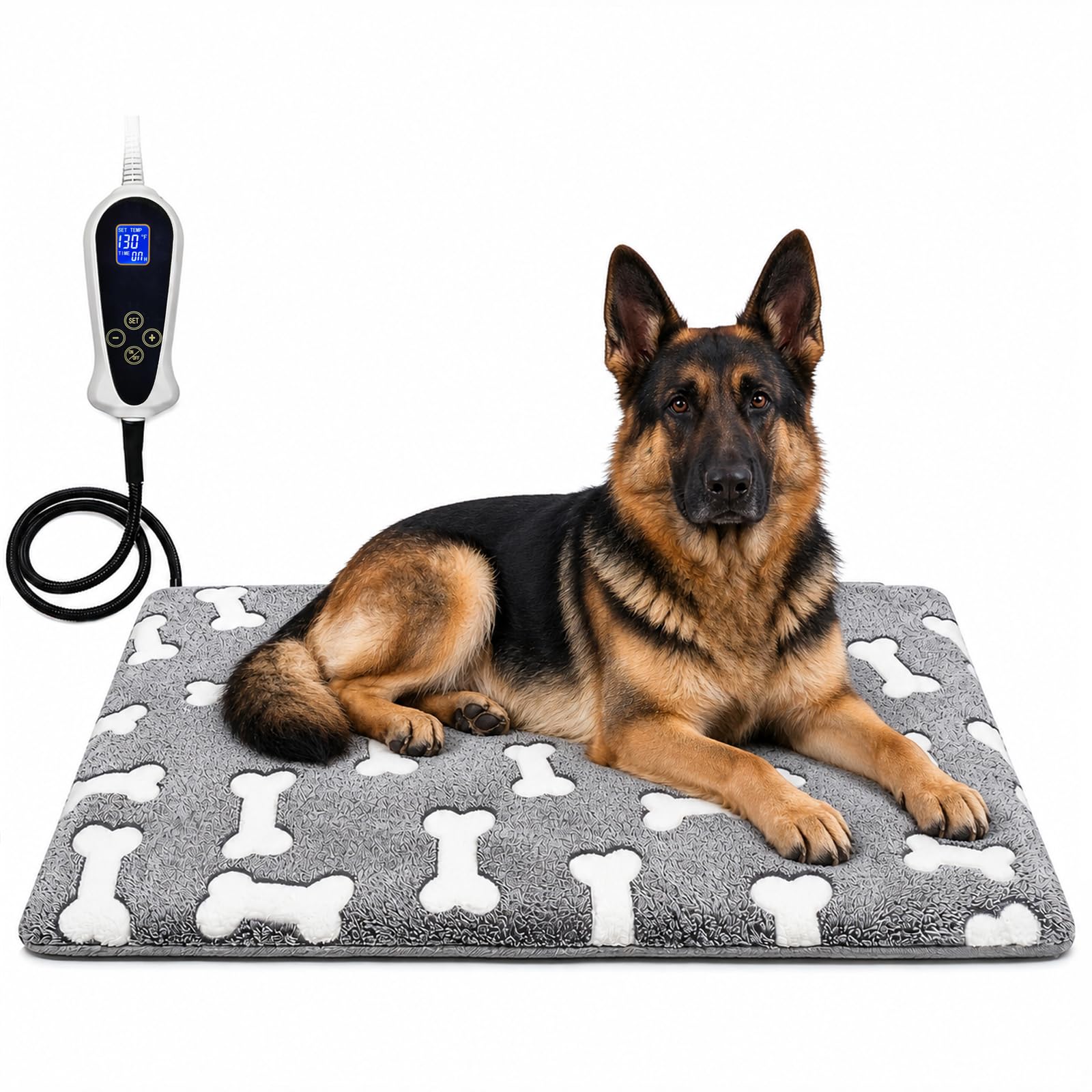

How To Choose The Best Dog House Heaters
Buying a dog house heater is really two decisions stacked on top of each other. First, does the heat need to fill the air inside the house, or does it just need to warm the surface your dog lies on? Second, how much heat can your dog’s shelter hold? A thin-walled, open-front doghouse leaks warmth as fast as you put it in. A sealed tote with a hole cut in the side holds it.
Flat mats versus wall-mounted forced-air heaters
A heated mat (a flat pad your dog lies on) works by contact. The heat goes into the dog’s body and the bedding around it, not into the air. That makes mats efficient in small, insulated spaces like igloo-style houses, totes and crates. A wall-mounted heater uses a fan to push warm air around the whole interior, so it suits a larger kennel or coop where your dog moves around rather than curling in one spot.
Why the thermostat matters more than the wattage
A thermostat is the part that switches the heat down when the shelter hits a set temperature and back on when it drops. Without one, a heater runs flat out all night and the shelter can get too warm. Several picks here have their own built-in thermostat or adjustable temperature range, which means you set a target and the unit cycles to hold it. That is the feature to check first if your winters swing between mild days and freezing nights.
Chew-resistant cords and what they actually protect
Every heater on this list runs on household electricity, so the cord is the part a bored or anxious dog will find first. A chew-resistant cord wraps the wire in a steel coil or metal sheath, which is what you want if your dog is a chewer. Understand the limit too: the sheath protects the cord, but the pad or housing material is a separate matter. A determined heavy chewer can still tear a soft mat cover, so pick the construction to match your dog’s habits.
Sizing the heater to the dog and the house
Heating coverage is written two ways in this category and they are not the same thing. Some units list coverage in square feet (floor area), and some in cubic feet (the air volume of the shelter). Read the number as air volume if you can, because a tall, drafty doghouse needs more than a low, tight one. Then think about your dog’s size: a small mat under 20 inches wide leaves a large dog hanging off the edge, while a 35-inch pad swallows a cat house whole.
Side-by-Side Comparison
| Model | Best For | Heating Type | Rated Output | Footprint / Coverage | Amazon |
|---|---|---|---|---|---|
| Petace Outdoor Dog Heating Pad★ Best Overall | Garages and open shelters for cats and medium dogs | Heated mat (contact) | 80W | 35.4″ x 23.6″, 1″ thick | Amazon |
| Bestio Large Dog Heating PadBest for Seniors | Large dogs and arthritic seniors in heated dog houses | Heated mat (contact) | Not listed | 34″ x 21″, 0.5″ thick | Amazon |
| DEOMAN Pet Heating PadMost Adjustable Warmth | Timed warmth in sheds, barns and garages | Heated mat (contact) | 30W–60W | 34″ x 21″, 0.25″ thick | Amazon |
| Dreyoo Dog House Heater | Insulated dog houses and coops with its own thermostat | Wall-mount forced air | 300W / 600W | Up to 105 sq ft | Amazon |
| Kiroto Outdoor Pet Heating Pad | Small cat houses, totes and porch beds | Heated mat (contact) | 35W | 20″ x 16″, 0.6″ thick | Amazon |
| TURBRO Neighborhood Dog House Heater | Medium dog houses and coops | Wall-mount forced air | 200W / 400W | 100 ft³ | Amazon |
| K&H Lectro-Kennel Igloo Pad | Round igloo-style houses and kennel runs | Rigid heated mat (contact) | 60W | 24″ x 15″, 0.5″ thick | Amazon |
| DRATO Resin Dog House with Heated Pad | Small-breed shelters in windy yards | Shelter with heated mat | Not listed | 31.02″D x 26.73″W x 19.09″H | Amazon |
| Heat Tec Pet Warmer | Small sealed cat houses and dogloos | Wall-mount forced air | 300W | 53.7 sq ft | Amazon |
Detailed Reviews
1. Petace Outdoor Dog Heating Pad, 35.4″ x 23.6″, 80W, Grey
Our pick — 4.5+★ from 800+ verified ratings; the strongest balance of quality and price.
The one that warms a garage floor so well a freezing possum tried to move in.
Here is a mat built for the space your dog actually uses. It runs 35.4 inches long and 23.6 inches wide, so a medium dog can stretch out full-length instead of balancing on a postage stamp. The 1-inch thickness is the number that separates it from flatter pads — twice the thickness of the Bestio pad’s 0.5 inch. That extra loft gives your dog something soft under the hips, which matters for older dogs that lie down hard.
What sells owners on this one is how it handles a real, unheated space. It works through a water-resistant bottom and an air valve that lets you pump more loft into the filling, so you can tune how much cushion sits between your dog and the heat. It adjusts itself to a preset warmth once your pet settles in, which means you are not fiddling with a dial every night. The 5.6 ft steel-wrapped cord is the honest limitation: it runs shorter than the DEOMAN pad’s 6.8 ft, so measure the distance from your outlet to the shelter before you commit.
Buyers report it “worked great for an outside cat that lived in a garage over the winter in New England.” That is the review-page consensus — this pad earns its spot in garages, porches, barns and feral cat shelters where the cold floor is the real problem. That story sits behind 1,000+ ratings, and the pad holds 4.5+ stars across 820+ of them. One recurring note: the inflate feature does not puff up as much as people expect, so buy it for warmth first and cushioning second.
What earns it the top spot
- 80W of contact heat over a 35.4″ x 23.6″ surface — plenty for a garage or porch bed
- Full inch of loft, double the thickness of the slimmer Bestio mat
- Removable, machine-washable cover makes muddy-paw season manageable
- Air valve lets you adjust the fill loft for a softer or firmer surface
Where it asks for care
- The 5.6 ft cord is shorter than the DEOMAN’s 6.8 ft — plan placement first
- The inflate option disappoints some buyers; it never puffs up much
- Must be covered before use and never folded while running
Reach for this if: you need to warm a garage, porch or barn floor for a medium dog or a feral cat colony, and you want the pad with the most loft.
Look elsewhere if: your outlet sits far from the shelter — the shorter cord will decide your layout for you.
2. Bestio Large Dog Heating Pad 34x21in
A large-dog mat that runs cool enough to leave an arthritic dog on all day.
Set the dial and walk away — that is the whole pitch here. This pad holds a temperature anywhere from 80 to 130°F, and you can schedule it for anywhere from 1 to 24 hours, including a normally-open ON setting that keeps it running without a countdown. For a senior dog that parks on its bed for hours, that range is the useful part: the low end gives gentle warmth instead of a hot spot. Bestio also offers a 2-year warranty on the unit, which is longer coverage than most mats in this price band.
Where it lands differently from the DEOMAN pad is the heat ceiling. This one tops out at 130°F; the DEOMAN reaches 136°F and goes as low as 86°F. A wider low-to-high range sounds better on paper, but owners here tend to run this pad on the bottom of its scale and leave it there. The double-helix heating wire warms up in about 10 minutes, and an LCD switch shows temperature and time together so you can check it from the door.
The comfort story is what wins people over. A German Shepherd owner reports it running outdoors by the fire pit, and seniors with joint stiffness settle on it without prompting. It is genuinely thin at 0.5 inch, though — owners add a blanket or a second pad underneath because there is no cushion built in. The suede cover zips off for washing after a muddy season.
The honest shape of it: this is a heat-delivery pad, not a bed. If your dog needs padding under its joints, budget for a layer underneath. If your dog just needs steady warmth for hours on a door-controlled timer, the 8-layer protective build and the built-in sensor do that job without babysitting.
You’ll be happiest here if: your dog is older, stiff or just likes to stay in one warm spot, and you want a set-and-leave timer on a large pad.
Think twice if: you want plushness from the start — this surface is flat, and a cushion has to come from you.
3. DEOMAN Pet Heating Pad, 34″ x 21″, Waterproof with Timer
Nine temperature steps and a steel-jacketed cord for dogs that chew first.
If you want to dial warmth in small increments, this is your pad. Nine temperature settings cover 86 to 136°F, which is the widest range here — beating the Bestio pad’s 80 to 130°F span. It also heats fast, reaching working warmth in about eight minutes, and the timer gives you 4, 8, 12 or a 24-hour continuous option for the deepest cold. The low total draw of 30W to 60W keeps it gentle on a household circuit.
For chewy dogs, the cord is where DEOMAN earns its keep. It runs 6.8 ft through a stainless steel dual hose — longer than the Petace pad’s 5.6 ft and about a foot longer than the Kiroto and Bestio cords. That stainless wrap is the point: it is the cord a gnawer hits first. Just be clear about what it protects. The cover is a PVC (a wipe-clean plastic) surface, but it is not a chew toy — owners with determined pit bulls watched the stitching go the first night, so the cord guard protects the wire while the mat itself is a separate question.
Where buyers split is on heat output, and you should know that going in. Some run it on setting 4 or 5 at 14°F and say it holds a stray cat warm through wind, snow and rain. Others find it never truly warms and one unit stopped after a couple of months. The pet-preference factor is the loudest signal in the review pages — dogs and cats genuinely take to it. That pattern says this pad works when it is used flat, uncovered by heavy bedding and matched to a sheltered spot, not an open run.
Why it fits the fussy-heat buyer
- Nine settings across 86–136°F — the widest knob-to-knob range on this list
- 6.8 ft stainless steel chew-resistant cord, the longest of the mats here
- 4, 8, 12 or 24-hour shut-off lets you run it overnight without worry
- Fast warm-up in about eight minutes
Set your expectations here
- Heat output is uneven between units, so some feel it strongly and some do not
- The PVC pad surface is tough but not chew-proof — heavy chewers have torn covers
- Must run flat, unfolded, and wiped clean rather than soaked
Worth it if: you want fine control over temperature and a cord that can survive a curious mouth, and you’ll be using it inside a shed or garage.
Not your fit if: you expect a soft, plush sleeping surface — this is a wipe-clean PVC mat.
4. Dreyoo Dog House Heater with Thermostat, 600/300W
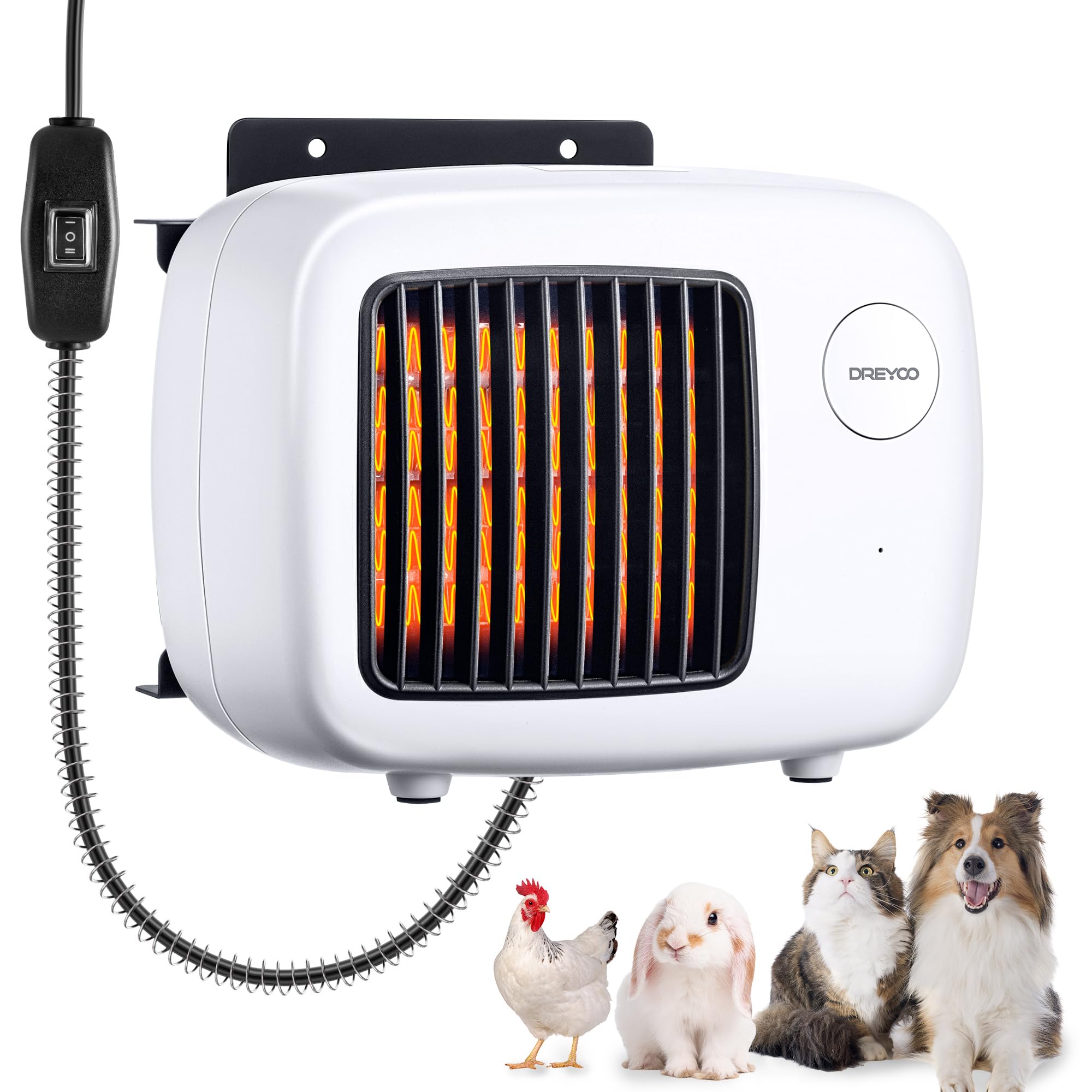
The heater that shuts itself off at 78.8°F so you don’t have to.
This is the pick for a dog house you want warm, not roasted. It mounts on the wall, sits at 6.7 by 6.3 by 4.7 inches, and runs on a 300W or 600W setting. what separates it is the thermostat (a built-in temperature switch) already inside: the heating element cuts out when the room passes 78.8°F (26℃) and kicks back on below 68°F (20℃). You do not buy a separate thermostat. That self-cycling design is why a wildlife rehabber used it in a weatherproofed squirrel cage and held 65°F inside with the outside dropping near 0°F.
The numbers make the coverage claim clear: Dreyoo rates it for up to 105 square feet, and it heats in about 3 seconds. The catch in that number is in the listing itself — coverage depends on a space being airtight. In a loose, wind-blown dog house, you will not reach 105 square feet of warm air. In a sealed 4x4x3 ft shelter, the heater kept it warm at 20°F outside, and the housing never got hot to the touch thanks to the insulated surface.
One maintenance habit belongs with this unit. The magnetic hair guard on the back pulls off so you can clear pet hair and dust, and reviewers are blunt that it needs doing — airflow drops when the intake clogs, and the heater stops putting out real heat until it is blown clean. Do that once or twice a week in shedding season and it runs like new. It also uses a PTC (a flameless ceramic) heating element, and the 6 ft steel-wrapped cord adds a chew barrier.
The trade-off to plan around: this heater needs you to keep the intake clean, and it will not blast a large, drafty run warm. It rewards a well-sealed dog house.
The right call for: an insulated dog house or coop where you want automated cycling and no extra thermostat to wire up.
Skip it for: a wide-open kennel or a dog that sheds heavily and will not get its filter cleared.
5. Kiroto Outdoor Pet Heating Pad, 20″ x 16″, Gray
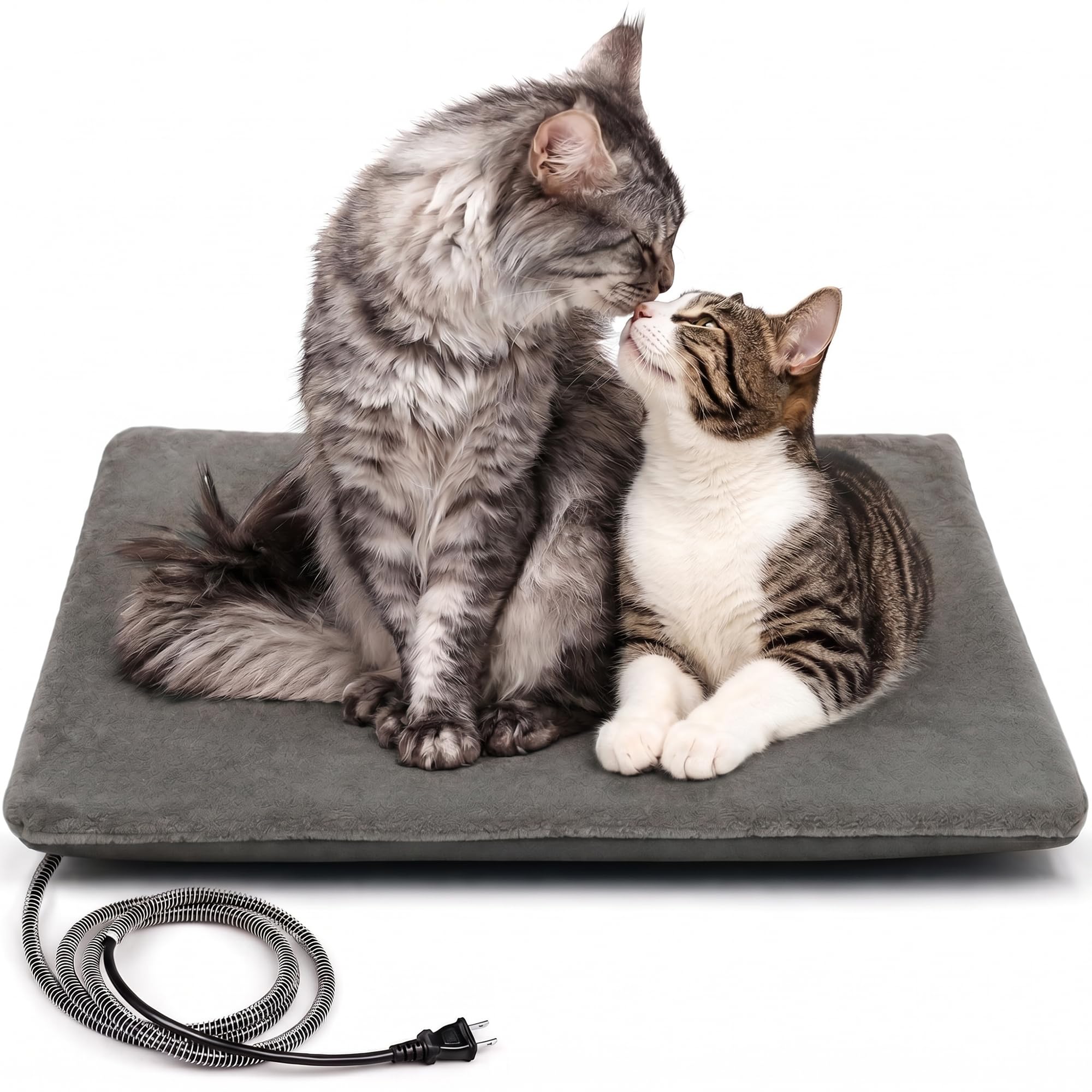
A tiny mat for a covered porch, a tote, or a cat that refuses to go inside.
Not every shelter is a dog house. Plenty of people build a winter spot from a storage tote and a hole saw, and this pad fits that job. It measures just 20 by 16 inches and 0.6 inch thick, so it drops into small houses, crates and porch beds where a big mat would not lie flat. It draws 35W, the lowest on this list, so it is the friendliest option for a shed outlet or a solar setup’s limits.
There is no thermostat dial here — the auto thermal system holds between 100.4°F and 107.6°F on its own, which means you plug it in and let it work. If you prefer to set an exact temperature, that self-regulation will feel like a limitation; if you would rather not think about settings at all, it is a relief. The cover is waterproof and the bottom is non-skid, and the 6 ft cable is wrapped in a metal coil to discourage chewing.
What wins people over is how well it handles real weather. It has kept feral cats warm inside covered porches and garage beds through cold snaps in New York and Colorado, and it warms when a body lies down on it rather than pumping heat into empty air. It is rated to 15 pounds, so know the ceiling — this is a cat or small-dog pad. A large dog will hang off the edges. A recurring few owners did receive dead units, which is worth a quick test on arrival before the return window closes.
Why it suits a tote or cat house
- 35W draw — the gentlest on a shed circuit of any pick here
- 20″ x 16″ footprint slips inside small houses and crates
- Waterproof cover and non-skid bottom handle damp garage floors
- Self-regulating at 100.4–107.6°F, no dial needed
The fine print
- Rated to just 15 pounds — not meant for large dogs
- No user-set temperature; the pad decides its own warmth
Your best bet for: a small cat house, tote shelter or porch bed that needs quiet, low-watt warmth with zero adjustment.
Not designed for: a big dog’s house — the 20″ x 16″ size and 15-pound rating rule it out.
6. TURBRO Neighborhood Dog House Heater, 400W, Wall Mount

A fan-forced wall heater that circulates warmth instead of baking one spot.
This one is for the dog that lives in a house it can walk around in. A built-in fan pushes hot air through the space, and TURBRO rates it for up to 100 cubic feet. Note that unit — cubic feet, the volume of air, so a tall doghouse gets a fair rating a flat square-foot claim would miss. You get a low 200W and a high 400W level, which lets you match the output to how cold the night turns.
The cord is the longest on this list at 9.8 ft, and it is chew-proof, so you can mount the heater high and still reach the outlet. The controller is IPX4 waterproof, which means you can adjust the heat level from outside the dog house without opening it. In a 12 by 12 ft coop, owners found it could not warm the whole space but did keep the water bowl from freezing below freezing — the honest read on coverage limits. It is UL tested and has built-in overheating protection.
Installed properly, it keeps pups sheltered about 10 degrees above freezing when nights drop into the teens, especially in a structure wrapped with hay bales and a metal roof. One design note worth knowing: the airflow is straight out, not angled down, so a doghouse with the heater mounted high can end up with only the top half warm. Owners who added a downward tilt got full coverage. The 4.2 pounds and small wall-mounted frame make it simple to hang.
What you should know up front: this heater helps a medium, enclosed shelter rather than a huge kennel, and its airflow is directional. Mount it tilted toward the floor and it works at its best.
Fits your setup if: you have a medium dog house or coop and want fan-circulated heat with a long reach to the outlet.
Pass if: your shelter is large and open — the 100 ft³ rating assumes a reasonably tight space.
7. K&H Pet Products Lectro-Kennel Igloo Heated Pad

A hard plastic pad shaped to drop into a round igloo and stay put.
Most mats here are soft and flexible. This one is not, and that is deliberate. The rigid ABS (a hard plastic) shell measures 24 by 15 inches and 0.5 inch thick, it is semi-circular to sit flush in a round or dome-shaped igloo, and it runs at 60W. Because the shell is solid, it will not bunch or slide the way a soft pad can. Owners screw it down to the floor and run the cord through the back groove, and in cold Ohio winters it warms the straw bedding inside the house for a dog that would otherwise be sitting on bare plastic.
The warmth it produces is well judged for a resting dog. It responds to temperature changes on its own and settles near a dog’s normal body temperature — owners measured the surface at about 72°F. MET Labs certifies it for indoor and outdoor use on 110/120V current, so it is rated to sit out in the weather. The removable fleece cover helps with the hard surface, though it needs help staying in place on an active dog.
Here is the honest part about the shell. This is molded plastic exposed to freeze-and-thaw cycles, and some units have cracked around the edges and middle after a winter or more. The heating element itself often kept working — the concern is the shell, not the wire. If your dog is gentle and your igloo is sheltered, that risk is small. If your dog paws and digs at its bed, a soft mat may suit better.
Read this before you buy: the rigid shell is what makes it fit an igloo cleanly, and it is also the part to watch as it ages. It is not a soft bed and it is not flexible, so match it to a shelter where it will stay put.
The answer for: round igloo-style houses, kennel runs and crates where a rigid pad stays in place and lasts through cold seasons.
Keep shopping if: your dog digs at its bedding — a hard plastic pad with a loose cover will not survive a determined digger.
8. DRATO Resin Dog House with Raised Floor and Heated Pad

A whole house and a warm floor in one snap-together box.
This is the odd one out on the list, and that is the point. Instead of a heater for the house you already own, you get the house and the warmth together. The resin shell is raised off the ground on spiked legs that grip grass or soil, so the floor stays out of the snow and the structure stays put in wind. Inside sits a heated pad, which is removable so you can scrub out the space in spring. Louvered vents let air move but angle the slats to block rain, and the sloped roof sheds water.
Assembly is the part owners talk about most. It snaps together without tools, and the parts lock in place so the build takes minutes rather than an afternoon of swearing at screws. Reviewers describe it as a solid, good-looking structure that survived extremes from 100°F summer heat down to -30°F winter. What the page cannot do is heat the air around a small dog on a freezing night, so pair it with one of the mat picks above if your winters bite hard — the pad it comes with is a starting warmth, not full forced-air heat.
The size is where opinions diverge, and it is worth reading carefully. It is marketed for small breeds, yet the interior works out roomy enough for some owners’ medium dogs, while others find it snugger than they pictured. The other practical note is wind: it is lightweight, and in an open, exposed yard a storm can lift the roof. Owners weigh the roof with a brick and set it in a sheltered spot. Do that, and it earns its keep.
Draws that matter
- Raised floor and spiked legs keep the resting space off cold, wet ground
- Tool-free snap assembly gets it up in minutes
- Louvered vents move air without letting rain straight in
- Weather-resistant resin stands up to summer heat and hard winter cold
What to plan for
- Light enough that high wind can flip the roof — shelter it and weigh it down
- Small-breed sizing runs snug for some dogs despite the roomy look
Worth the money if: you need to buy the shelter and the warmth at once, and you want an easy, weather-tough house for a small dog.
Look past it if: you already have a sturdy dog house — this replaces it rather than heats it.
9. Heat Tec Pet Warmer, 400W Dog House Heater
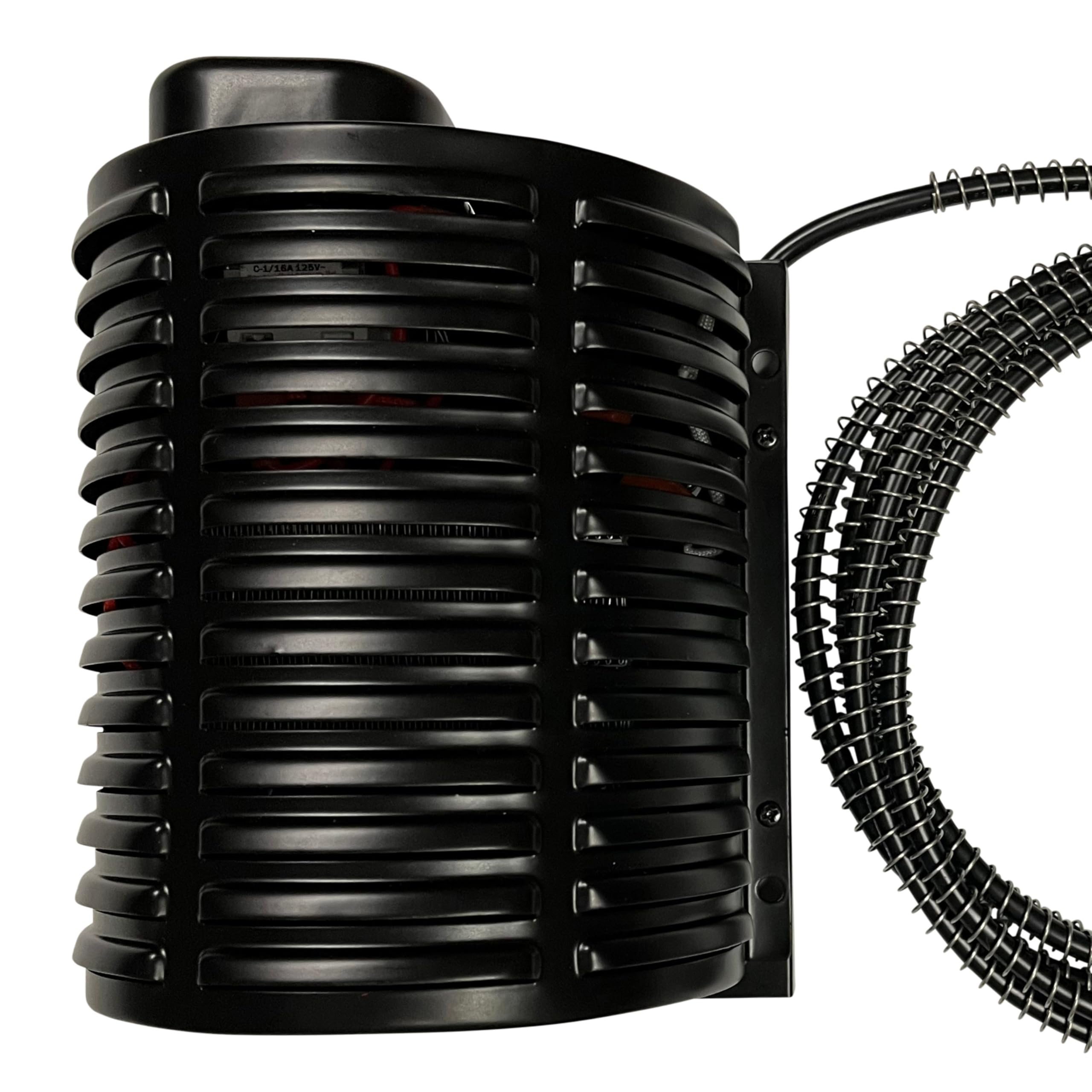
A well-built heater with a rated minimum setting that tells you its low end.
Installation is a four-screw job here, so it is about as simple as a wall heater gets. The housing measures 4.25 by 6.25 by 7.75 inches, and it runs on 110V with the thermostat controlling when it fires. The listing rates it for 100,000 on/off cycles, so the thermostat can cycle all night without wearing out the switch. Its minimum temperature setting is 32°F, so you can see the low trigger point before it fires.
The heat delivery is where buyers disagree, and you should hear both sides. One owner kept a 4×4 insulated cat house at a steady warmth all winter without it ever running too hot, and a tortoise keeper sings its praises for an oversized Dogloo. On the other side, one unit barely warmed its medium dog house even at high and was sent back. The reliable pattern is that it shines in a small, sealed house where dry heat needs to fill a tight space — it will not overpower a loose, drafty run.
The safety story is the strongest part. The cord is chew-resistant, the corners are rounded, and an internal heat shield carves a barrier between the heating element and the wiring. A metal grill keeps paws off the hot core. Set clearances as directed, keep the intake clear, and it is a tidy, low-traffic little heater that suits cat houses, dogloos and other tight shelters. Read the switch to the control as the first thing to check — several buyers found it switched, and the ones who dialed it in got steady warmth.
The main thing to know: this heater’s strength is precise, self-cycling warmth in a small sealed space. Its weakness is any space too big or too leaky to hold that warmth.
Made for: a small, insulated cat house or dogloo where you want a thermostat-controlled heater with real safety features.
Avoid for: a medium-to-large dog house with drafts it cannot seal against, where the heat will leak out faster than it builds.
Know the Specs
Wattage and what it really means
A watt is a measure of how much electricity a heater uses per moment, and the number tells you roughly how much heat it moves. A 35W pad relies on direct contact with your pet, while a 400W forced-air heater pushes warm air into the space. The wattage you pick should match the job: a mat for a close, insulated spot, a fan unit for a larger kennel. High watts in a small house can overheat it, and low watts in a huge one will not keep up. Read the number with the space in mind, not on its own.
Thermostat and auto-cycle
A thermostat is the switch that turns the heat down when the shelter reaches your target and back on when it cools. Some heaters here, like the Dreyoo unit, cycle at set points; others, like the Kiroto pad, self-regulate without a dial. A good thermostat means you do not have to remember to unplug the unit, and it saves on running cost because the heater rests when the space is already warm. In a sealed dog house it is the difference between steady, even warmth and an over-warm box.
Chew-resistant cord construction
Because these units plug into household power, the cord is the weak point that matters most. A chew-resistant cord wraps the wire in steel or metal, which is what you want if your dog likes to bite things. That protection covers the cord, not the pad or housing. A soft mat cover and a rigid shell each wear differently, so match the material to your dog’s habits — a gentle sleeper and a busy gnawer need very different picks.
Square feet versus cubic feet
Some heaters list coverage in square feet (floor area) and some in cubic feet (the air inside the shelter). A square-foot figure tells you how much floor it can warm, while cubic feet tells you the volume of air it can fill. Because warm air rises, a tall dog house is harder to heat than a low one of the same floor size. When both only say a number, picture your dog house’s shape and judge whether the heater can realistically fill it.
Common Questions
Can I use a heated mat in an outdoor dog house?
Is a heated mat or a wall heater better for a dog house?
How much wattage does a dog house heater need?
Do I need a thermostat for a dog house heater?
Will a heated dog house pad survive a dog that chews?
Can a dog house heater run all night unplugged?
Is it safe to leave a heated pad in a dog house alone?
How do I keep rain out of an outdoor heated dog house?
What size dog house do I need for a large dog?
Can a dog house heater help an arthritic older dog?
Do heated dog house pads use a lot of electricity?
Why does my heated pad barely feel warm?
The Bottom Line
For most people looking for the best dog house heaters, the winner is the Petace Outdoor Dog Heating Pad because it puts 80W of contact warmth across a 35.4″ x 23.6″ surface with an extra inch of loft — the most cushioning and the most surface area of any mat here. If you want fine temperature control and a long steel-jacketed cord for a chewy dog, grab the DEOMAN Pet Heating Pad with its nine settings and 6.8 ft guard. And if your dog house is a sealed box that needs circulating air rather than a warm floor, the Dreyoo Dog House Heater runs its own 300W or 600W thermostat cycle without any extra gear.
The Petace pad earns its 4.5+ stars across 820+ ratings in garages and barns, where the cold floor is the real problem. Whichever you choose, match the heater to the shelter, keep the cord clear and the intake clean, and your dog gets what it actually wants: a warm spot it can trust all winter.
How we choose
We do not accept paid placement. Every pick is matched to a real buyer and a real use-case; we do not hands-on test units.
Sources
Specifications: manufacturer listings and product documentation. Review insights: verified customer reviews, as of October 2026. Pricing: not shown on this page (it changes often); check the current price via the retailer link.
As an Amazon Associate, How Dog Care earns from qualifying purchases. This does not affect which products we feature.