Disclosure: This post may contain affiliate links. As an Amazon Associate I earn from qualifying purchases, at no extra cost to you. Learn more
Specs are compiled from manufacturer listings and verified buyer reviews and can change over time — please confirm the key details on the product page before buying.
If your older dog is bumping into doorframes, missing the couch on the jump, or waking up with crusty gunk in the corners of both eyes, you want to know which eye supplement is actually worth buying before you spend another dollar on something your dog refuses to eat. The short answer: start with a formula built around lutein and a whole antioxidant blend, and start with the pick the widest group of owners keeps coming back to. The nine picks below are sorted by what each one does best — vision support for aging eyes, tear-stain control, or a liquid format for dogs who fight pills.
This guide is built by comparing the manufacturers’ published specifications and the patterns across verified customer reviews, so you get each pick’s real strengths and trade-offs instead of marketing spin.
Some formulas are built for cloudy-eye support, others for teary stains on pale fur, and a couple come as chews soft enough to hide in dinner. This guide breaks down the best dog eye supplements by ingredient list, form, and how easily your dog will actually take them.
Top Picks


How To Choose The Best Dog Eye Supplements
The first thing to get straight is what you’re actually trying to fix. A dog whose tear ducts make rusty-red tracks down pale fur has a very different problem from a twelve-year-old dog whose eyeballs are turning hazy and who misjudges the stairs. Some formulas lean toward tear-stain control with cranberry and eyebright; others stack lutein, zeaxanthin, and astaxanthin for aging retinal support. Match the ingredient list to your dog’s actual issue before anything else.
The nutrient blend matters more than the flavor
Look for a formula that names its active ingredients and their sources on the label rather than a vague “eye health complex.” Lutein and zeaxanthin are the pair most often included for the lens and retina; bilberry brings anthocyanins (plant pigments that act as antioxidants); astaxanthin is another antioxidant that shows up in the premium formulas. A formula that combines several of these in one daily serving saves you from stacking three separate bottles.
The form your dog will actually swallow
This is where most supplement purchases die. Soft gels can be snipped and squeezed over wet food; soft chews work as treats; tablets need crumbling or hiding. A picky dog or an older dog with bad teeth will make your decision for you, so read the form carefully. Liquid tinctures are the fallback for dogs that turn their nose up at anything solid.
How long before you know if it’s working
Eye changes move slowly. Most owners who report real differences talk in terms of weeks to a couple of months, not days. Buying a full multi-month supply up front is smart only if you’ve confirmed your dog will eat the stuff — otherwise start with the smaller jar and test acceptance first.
Side-by-Side Comparison
| Model | Best For | Form | Count | Flavor | Amazon |
|---|---|---|---|---|---|
| Ocu-GLO Vision Supplement★ Best Overall | Aging eyes, small dogs | Soft Gel | 45 Count | Unflavored | Amazon |
| VetriScience Eye & Vision Health ChewsEasiest to Give | Fussy eaters needing a treat | Chew | 60 Count | Chicken | Amazon |
| Mighty Paw Mighty EyesTear Stain Fighter | Tear stains on pale fur | Chew | 120 Count | Bacon, Cranberry | Amazon |
| NOVEHA Eye Supplement | Senior daily wellness | Chews | 90 Count | Chicken | Amazon |
| Pet Wellbeing Organic Bilberry | Dogs that refuse pills | Liquid | 2 oz | Bacon | Amazon |
| Pawfy Dog Eye Chews | Peanut-butter-loving pups | Chews | 30 Count | Peanut Butter | Amazon |
| OcluVet Vision Chews | Multi-species households | Chew | 60 Count | Chicken Liver | Amazon |
| Coco and Luna Eye Health Support | Broadest antioxidant list | Soft Chew | 90 Count | Chicken | Amazon |
| Nutrition Strength Eye Care | Longest supply per bottle | Tablet | 120 Tablets | Bacon | Amazon |
Detailed Reviews
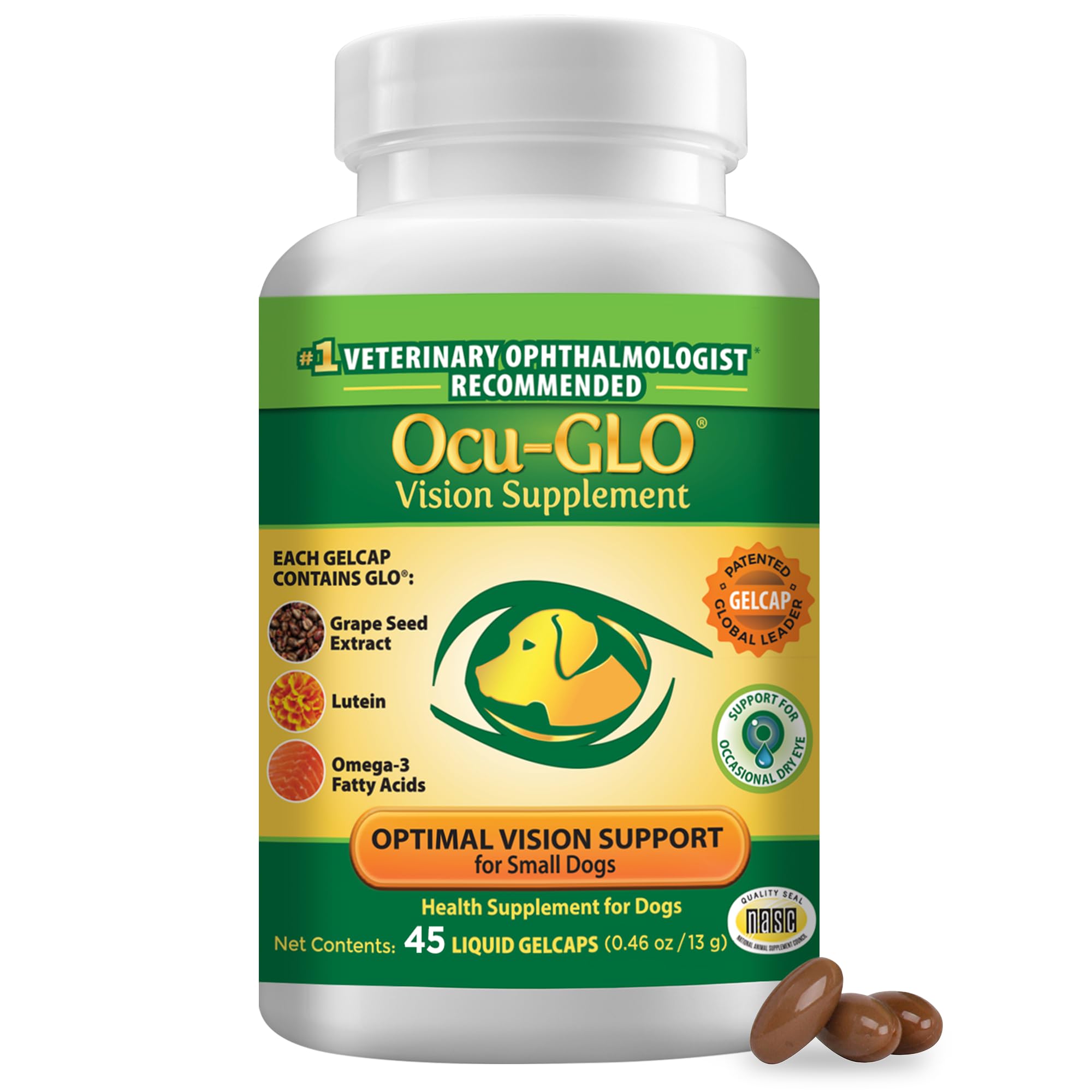
1. Ocu-GLO Vision Supplement for Small Dogs by Animal Necessity
Our pick — 4.0+★ from 950+ verified ratings; the strongest balance of quality and price.
The bottle that veterinary eye specialists keep coming up in the same breath, and the one owners stick with.
The label reads like a proper eye formula rather than a general multivitamin: 12 antioxidants in one daily serving, with lutein alongside omega-3 fatty acids and grape seed extract. That combination is why so many owners land here after a specialist visit — this is the soft gel with the most recognizable name in canine eye care. For a small dog starting to show cloudy patches or night-time hesitation, that ingredient stack is the reason it sits at the top.
What wins people over is straightforward: it does what they hoped. The improvements owners describe cluster around the same themes — less crusting in the eye corners, less watery discharge, a dog that seems more comfortable in the evening. One 13-year-old dachshund owner described the eye crusties disappearing and the cleaning routine easing off. A pinched gelcap squeezed over dinner does the job for dogs that won’t take a whole pill, and unflavored means no fight over smell.
The honest catch is texture and cost. Some dogs eat the gelcap whole; others turn their head, and the squeeze-over-food trick becomes your routine. There are also reports of the gel staining, so keep it off pale carpet and light-colored bedding. The capsule itself is small and the bottle holds 45 — enough for a month and a half at one a day for a small dog, which is why a few owners grumble about the price per serving.
What earns it first place
- Lutein plus omega-3s and grape seed extract in a 12-antioxidant formula
- Unflavored soft gel can be given whole or snipped over wet food
- Effectiveness is the thing buyers praise hardest here
- Formulated for small dogs, so the serving size fits a little frame
The honest note before you buy
- Some dogs refuse the gelcap and need it squeezed out every time
- Reports of staining — keep it away from pale fabric
- A couple of owners find the price per serving steep
Reach for this if: you have a small or senior dog with hazy eyes or crusty corners and you want the formula specialists mention by name.
Think twice if: your dog is a stubborn pill-refuser who won’t tolerate a gelcap even squeezed over dinner.
2. VetriScience Eye & Vision Health Chews 60 Count
The chew that tricks a fussy old dog into thinking eye support is a treat.
Sixty chews at 5.6 ounces means this is a compact bag, and the chicken liver flavor is doing a lot of heavy lifting. A hydrolyzed chicken liver base is designed for dogs with sensitivities, and the chews are soft enough to break apart — which matters when your dog has lost a few teeth or is simply suspicious of anything new. The active trio is astaxanthin, bilberry, and grape seed extract, all antioxidant-forward ingredients aimed at retinal health and the light-induced damage that comes with age.
The results owners describe are the kind you notice in behavior before you notice in the eye itself. A twelve-year-old golden started catching thrown treats again after eight months of misses, and cleared furniture in the dark without stumbling. A sixteen-year-old Yorkie’s cloudy eyes held steady over a month of daily chews. Both dogs took the chew willingly, which is the pattern that shows up again and again — dogs treat these like a snack, not a chore.
Where it stumbles is the stomach. There are dogs that get sick from the chews, and that’s worth taking seriously if your dog has a sensitive gut or a history of liver issues. The price per chew also draws mixed feelings. It’s a solid second option, and a fraction of what you’d pay for the top-shelf brands, but it isn’t the cheapest bottle in this lineup.
What lands for owners: this is a bag your dog meets at the door. The treat-like delivery and the chicken liver flavor turn a supplement routine into something they run toward, and the astaxanthin-bilberry combo is aimed squarely at aging retinal tissue.
The trade-off worth knowing: a few sensitive dogs don’t tolerate the chews — if yours has a fragile stomach, introduce one slowly before committing.
Best fit: the senior dog who refuses pills but will happily eat a soft chicken treat every day.
A different route: dogs with a sensitive gut may do better on a liquid formula or a plain gelcap.
3. Mighty Paw Mighty Eyes Tear Stain Chews 120 Ct
Built for the dog whose face needs a cleanup every morning, not just vision support.
This is the tear-stain specialist of the group, and the biggest bag on the list at 9.31 ounces and 120 chews. That’s a lot more product than the VetriScience bag at 5.6 ounces, so if you’re feeding a small dog one a day, this bottle stretches noticeably further. The ingredient list is cranberry, lutein, and eyebright herb extract — a combination aimed at the rusty-red tracks that build up on pale fur around the eyes, with a bacon flavor that gets most dogs to eat it without a fight.
For a dog that’s been dragging a chronically draining, crusty eye around for months, the turnaround here is the story. One Shih Tzu owner reports the drainage nearly stopped within two weeks, and by one month the eyes looked brighter and the dog seemed more comfortable. Whatever the prior tear-stain chew had been, it hadn’t done that. Formulated by vets and made in the USA adds confidence for owners who check where their dog’s supplements come from.
Read the ingredient panel before you commit, though: brewers yeast shows up early on the list. If your dog reacts to yeast, this is not the formula for your dog — and that’s a genuine mismatch, not a flaw. Other owners find the smell strong, though it fades once the chew is in the dog rather than the bag. A few dogs that had done fine on another yeast-based brand also did fine here.
The thing everyone notices first: the drainage and staining clears, slowly but visibly. If you’ve been wiping the same two brown streaks off a white muzzle every single morning, this is the bottle that changes the routine.
Read the panel first: brewers yeast is high in the ingredient list — a dealbreaker only if your dog is yeast-sensitive.
Go here for: a pale-coated dog producing tear stains you’re tired of scrubbing off.
Check the label first if: your dog has ever reacted to yeast — this formula isn’t the right fit.
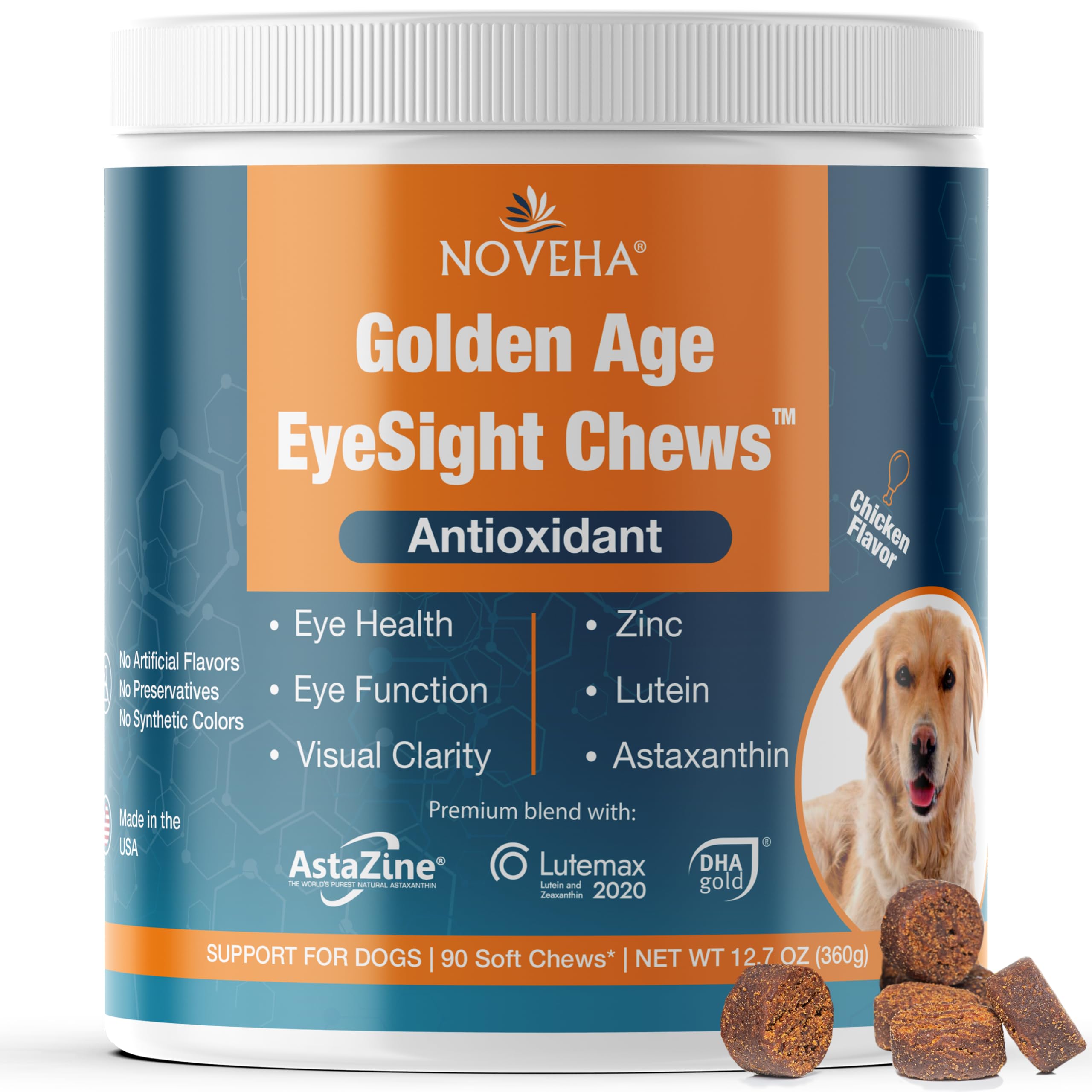
4. NOVEHA Eye Supplement for Dogs (90 Chews)
A gentle daily chew for the dog slowing down, not just the eye going cloudy.
Ninety chicken-flavored soft chews built around lutein and zinc, made in the USA. That’s a full three months of daily support for most dogs, and the soft chew format is easier on older mouths than a hard tablet. This one is pitched as everyday wellness for the senior years rather than an aggressive eye-specific formula, so if your dog is otherwise doing fine but starting to show the normal creep of age, it’s a reasonable everyday baseline.
Owners here tend to be focused on one thing: whether the dog will eat it. And it wins on that. An eleven-year-old Pomeranian takes them as a treat, and picky older dogs don’t turn their noses up at the chicken flavor. That’s the most-discussed aspect by a wide margin, and the second is taste, which tells you most of what you need to know — this is a chew that gets eaten without the hiding ritual.
Two things to plan for. First, there’s a chemical smell that some dogs don’t notice but owners do — mostly a small gripe, not a reason to skip. Second, sensitive stomachs need a slow introduction; starting at one chew a day for a week or so before going to the full serving avoids the mild upset that comes from ramping up too fast. Once you’re past the transition, most dogs settle in fine.
Why it earns a spot
- Ninety soft chews — a three-month supply at one a day
- Chicken flavor gets picky dogs to eat it as a treat
- Lutein and zinc in a gentle everyday formula
- Made in the USA, easy on older teeth
Plan around this
- Noticeable chemical smell bothers some owners
- Sensitive stomachs need a slow ramp-up
- Not the most eye-specific formula on the list — it’s a wellness baseline
Pair with: the senior dog who needs a low-friction daily supplement, not a heavy-duty eye formula.
Skip if: your dog already has significant cloudiness or diagnosed eye issues needing a more targeted blend.
5. Pet Wellbeing Organic Bilberry 2 oz

For the dog that won’t take a pill, a dropper of dark liquid that goes straight in the mouth.
A single-ingredient liquid tincture: organic bilberry fruit, in a natural vegetarian bacon flavor. The 2-ounce bottle lasts about a month for most dogs, and the delivery is the whole point — you can drop it directly into a mouth, mix it into wet food, or offer it from the dropper. Dogs that have spent years spitting out capsules often take this without a fight, and the flavor leaves little to negotiate over.
What bilberry is doing here has to do with anthocyanins — the plant pigments that give the berry its dark color and act as antioxidants. In an eye-support context, that’s aimed at the delicate capillaries and retinal tissue. A dog with age-related cloudiness can show improvement over weeks rather than days, and owners who use it tend to stay with it as a preventive for breeds prone to eye issues, like retrievers and poodles. That’s a slow-and-steady investment rather than a quick fix.
The dark liquid makes dosing harder than it needs to be. The dropper markings are hard to read against the near-black fluid, and a clear measuring cup solves the problem in about thirty seconds. Small gripe, but worth knowing before you’re in a hurry. The 2-ounce bottle is also smaller than the chew jars, so heavy dogs blow through it faster.
A liquid in a field of chews: this is the pick for the dog that closes its mouth around a pill and refuses to reopen it. Dropper to food, or straight into the mouth, and the routine is done.
One quirk: the dark berry liquid is hard to read against the dropper markings — a clear cup fixes it.
Pick this: your dog has refused pills for years and you want a no-fight daily routine.
Weigh the size: a two-ounce bottle lasts about a month for most dogs, so larger dogs will need a refill sooner.
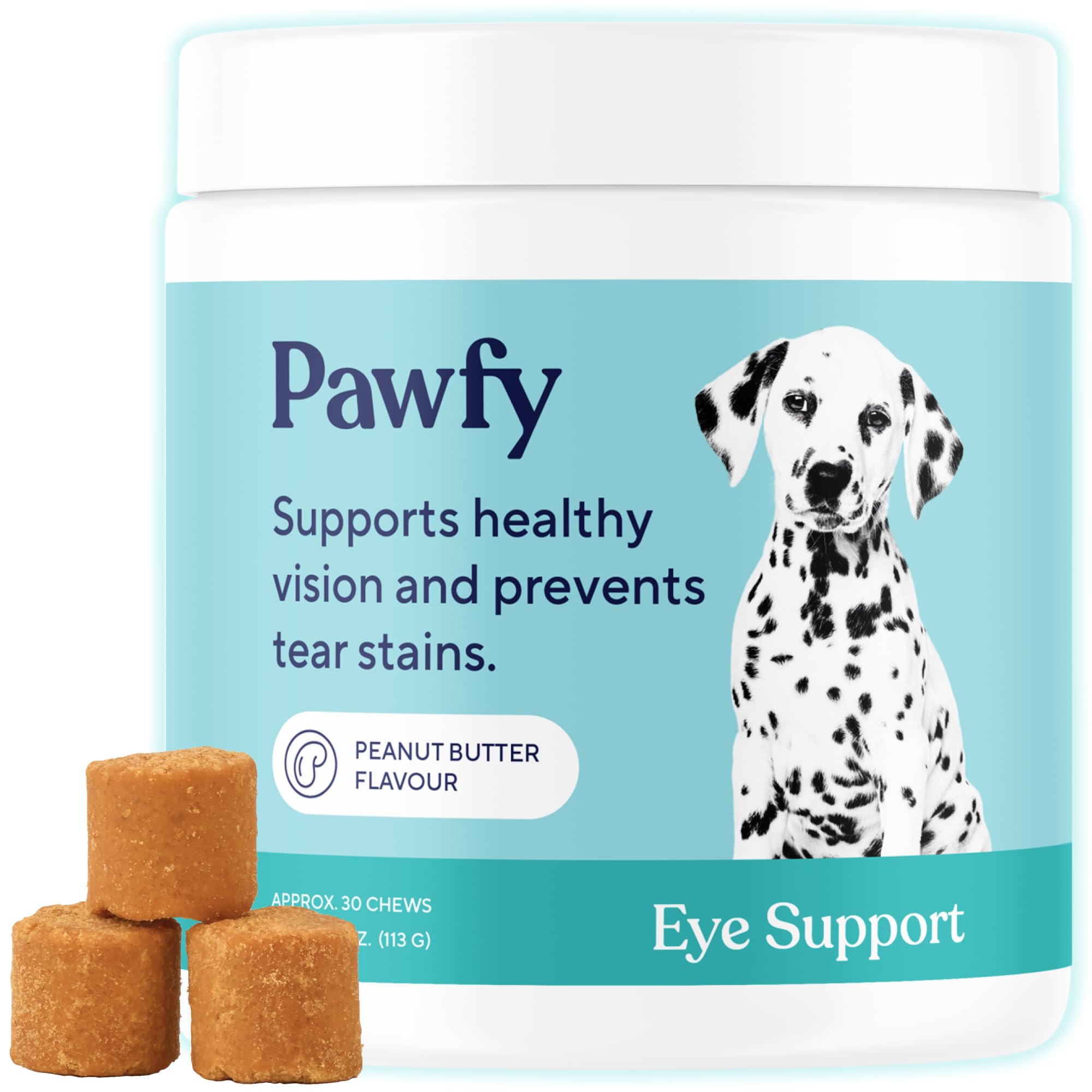
6. Pawfy Dog Eye Chews with Lutein & Cranberry
A peanut butter chew with a long ingredient label — but the results are genuinely uneven.
Thirty chews, peanut butter flavor, and an ingredient panel that runs long: krill oil, lutein, cranberry, vitamin E, acetyl L-carnitine, beta-carotene, folic acid, biotin. On paper, that’s an ambitious formula for both vision support and tear stains. The jar is the smallest on the list at 30 chews, so it’s also the shortest runway for judging whether it’s working.
Here’s the honest read: results are split, and not everyone comes away happy. Some dogs show reduced cloudiness within days, others show no visible change. The dogs that like the taste like it a lot; the ones that don’t will refuse the chew entirely. And the smell — a few owners describe it as chemical or solvent-like, and for a dog with a sensitive nose, that can be the deciding factor. This one is a gamble that pays off for some dogs and doesn’t for others.
Where it lands best is for dogs that start early. One owner saw a senior dog’s cloudiness ease for a temporary stretch, but the second cataract still matured — and their own takeaway was that starting sooner might have helped more. That’s an honest note on how much a supplement can do once changes are already advanced. Buy it if you want to try a peanut-butter delivery on a dog with early changes, not if you’re expecting to reverse a mature cataract.
An honest mixed bag: the ingredient list is long and the peanut butter wins over some dogs completely. But the results are genuinely mixed, and the smell is polarizing.
Best for early intervention: a dog with the first signs of cloudiness or tear staining, where you’re hoping to slow things down.
Try it if: you have a dog with early, mild changes and a strong peanut-butter preference.
Look elsewhere if: your dog’s already advanced, or your dog has a sensitive nose and a history of refusing strong-smelling chews.
7. OcluVet Vision Chews 60 Count

The only chew here that works for the cat too, if you happen to have one.
Sixty soft chews at 3.5 grams each, chicken liver flavored, and formulated for both adult dogs and cats. That dual-species targeting is unusual and genuinely useful in a multi-pet house. The ingredient approach leans on marine-sourced omega-3 krill, astaxanthin, lutein, choline, and glutathione — an antioxidant-heavy blend with particular attention to eye tissue support. The chews are softer than most, which helps for older dogs and cats with bad teeth.
The results owners describe are encouraging. A dog with early cataracts came back with clear eyes after several weeks on the chews. — the owner was using eye drops too, so the chews were part of a routine rather than working alone. A fifteen-year-old Chioodle showed better vision and less light sensitivity after five months of chews. The takeaway is that this is a slow-burn, stacking-with-other-care product, not a standalone rescue for a sudden change.
The honest limitation: not every dog tolerates the chew. There are reports of dogs throwing up after taking it, and if that happens once, it’ll probably happen again. For those dogs, the drops or a gelcap are the better route. The price per chew sits in the premium range, and the results timeline is long enough that you’ll want to be patient before deciding whether to renew.
The multi-pet advantage: if you have both a dog and a cat with age-related eye changes, one jar covers both. No other pick here can say that.
The honest limitation: a few dogs vomit after taking the chews, and if that’s your dog, you’ll need a different delivery.
Go for it when: you have a dog and a cat, both getting older, and want one supplement that works for both.
Stick with single-species if: your dog has a sensitive stomach — the chew is not the gentlest format.
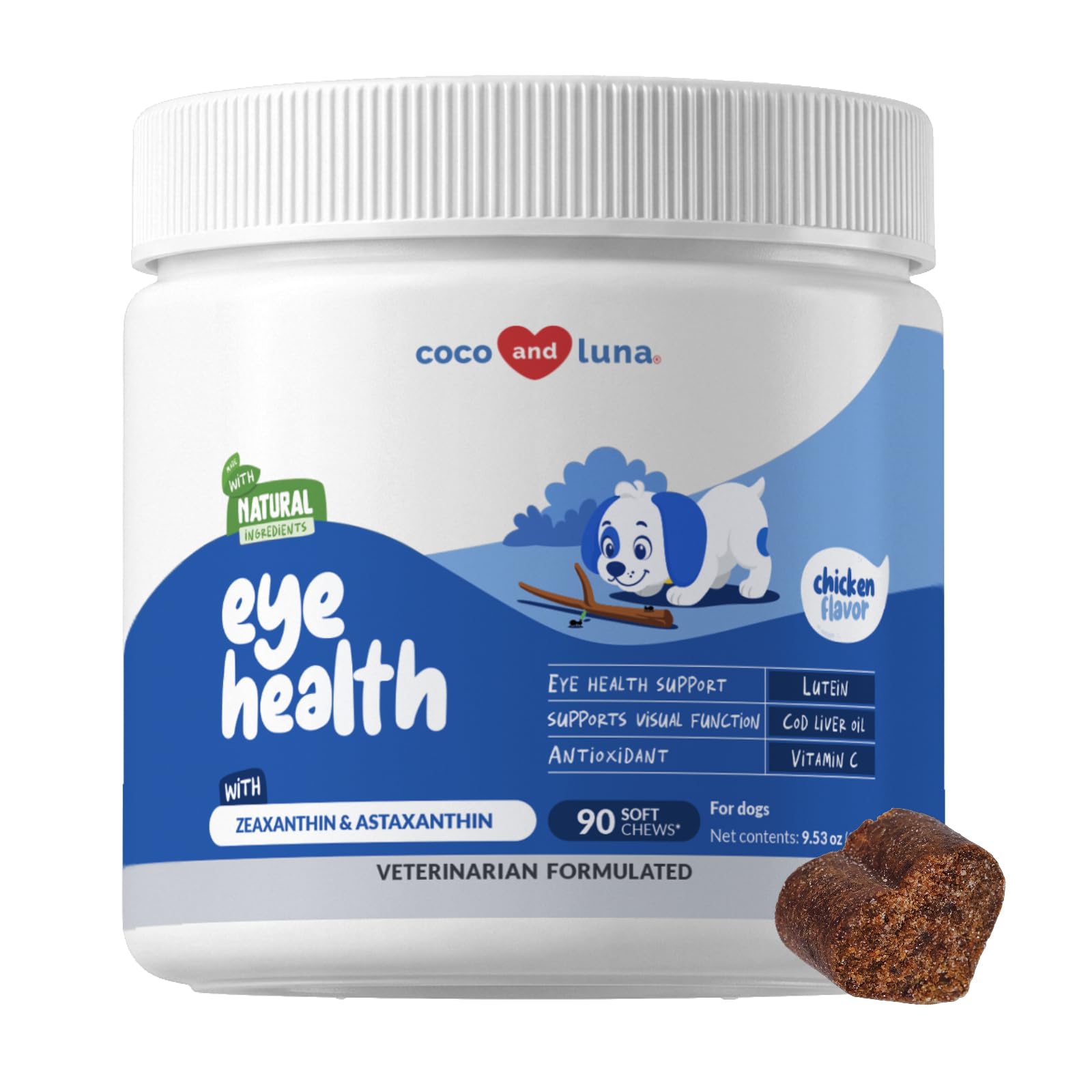
8. Coco and Luna Eye Health Support for Dogs, 90 Soft Chews
The longest ingredient panel on the list — cod liver oil, bilberry, lutein, zeaxanthin, and more.
Ninety soft chews with chicken flavor, made in the USA in FDA-registered facilities. The label reads like a nutritionist’s wishlist: cod liver oil (omega-3s), bilberry fruit, astaxanthin, vitamins C and E, lutein from marigold flower, zeaxanthin, zinc, lycopene, CoQ10. It’s the broadest antioxidant approach on this list, and it’s designed around the idea that eye health is really whole-body antioxidant support. For a dog starting to show low carotenoid levels or eye strain, that breadth makes sense.
The results buyers report tend to be surprising in their scope. A dog with glaucoma and one eye removed stayed stable over several months of daily chews. A dog with diabetes and a failing cataract stayed engaged with the flavor and didn’t fight the chew. Two dogs on the chews for a week showed less cataract cloudiness and less stair hesitation. Those are meaningful shifts, and the soft chew format is easy for older dogs to manage.
There’s a smell, and it’s worth mentioning. Cod liver oil has a strong scent, and that scent is in the chew. Most dogs eat it anyway; a few picky ones turn up their nose. The jar is 270 grams, which is a good three months for a small to medium dog, so the value is decent for what’s inside.
What you get: the most complete antioxidant stack in this lineup, with cod liver oil and a full carotenoid blend in a soft chew older dogs can manage.
The one drawback: cod liver oil smells strong, and picky dogs will notice it before they taste it.
Reach for this if: you want the widest nutrient list covering everything from lutein to omega-3s in one daily chew.
Pass if: your dog is very picky about smell — cod liver oil has a distinct scent and a few dogs won’t get past it.
9. Nutrition Strength Eye Care for Dogs Daily Vision Supplement

A four-month bottle with the specific eye nutrients vets tend to ask for, sealed in a tablet.
A 120-count tablet bottle, bacon flavored, with a long active-ingredient list that names exact amounts. Lutein at 10 mg, zeaxanthin at 5.5 mg, astaxanthin at 3 mg, bilberry fruit at 6 mg — these are the eye-specific nutrients most often referenced in canine vision support, and this bottle actually lists the milligrams rather than hiding them behind a “proprietary blend.” The 120-tablet supply is the largest in this article, and the labels call it a four-month supply for many dogs. Most importantly, the tablets are small and don’t require crushing.
The results owners describe are some of the most concrete in this lineup. One owner of a 13-year-old Weimaraner reported roughly 90% cataract clearing after three weeks on two tablets daily. Another described an end-of-life dog’s early-stage retinal atrophy easing enough for the dog to move more confidently in the dark. Those are exceptional outcomes, but they matter because they show what’s possible when the nutrient list is right and the dog is treated early. The tablet format helps — it’s easier to halve or hide than a chew.
The tablet format cuts both ways: this is not a chew, and a picky dog will let you know. The bacon flavor is beefy rather than stinky, which helps. A very small dog will need the tablet quartered or hidden in soft food. The price per tablet is fair given the 120 count, but the upfront investment is the highest of the three chew alternatives here.
Why the nutrient list earns attention
- Exact milligram amounts printed on the label: 10 mg lutein, 5.5 mg zeaxanthin, 3 mg astaxanthin
- 120 tablets — the longest supply per bottle here
- Small tablets that don’t require crushing
- A broad ingredient list covering eye-specific and general wellness nutrients
What’s not to love
- Tablet format, not a chew — a picky dog may refuse it
- Small dogs need the tablet quartered or hidden
- Highest upfront cost, even if the per-day cost works out well
Best for: the owner who wants a long supply, labeled ingredients, and a tablet they can split.
Better elsewhere if: your dog is a confirmed chew-or-nothing type who will reject a tablet.
Know the Specs
Lutein and Zeaxanthin
These two carotenoids (plant pigments) are the most common eye-specific ingredients in canine vision formulas. They concentrate in the lens and retina and are typically included at set milligram amounts — look for a label that states the number, like 10 mg lutein and 5.5 mg zeaxanthin, rather than a vague blend. They’re the nutrients most often referenced in eye-support formulas, and starting them earlier is generally better than after a dog’s vision has clearly declined.
Astaxanthin and Bilberry
Astaxanthin is an antioxidant derived from marine sources like krill; bilberry is a dark berry rich in anthocyanins, another class of antioxidant. Both show up in premium eye formulas as oxidative-stress support for delicate eye tissue. Neither does anything fast — expect weeks of daily use before you can judge a change, and don’t expect either to reverse an advanced cataract that’s already matured.
Soft Chew vs. Gelcap vs. Tablet vs. Liquid
The delivery format decides whether any of these ingredients ever get into your dog. Soft chews work like treats; gelcaps can be snipped and squeezed over wet food; tablets need to be halved, quartered, or hidden; liquids can be dropped directly into the mouth or mixed into dinner. Older dogs with missing teeth and picky dogs tend to do best with soft chews or liquids — a tablet is the format most likely to end up in a drawer.
Count and Supply
A bottle labeled 120 counts lasts twice as long as one labeled 60 at the same daily dose. That’s the only honest way to compare value across this category: divide the number of servings by your dog’s daily amount, and think in terms of months of supply. A three-month bottle and a one-month bottle cost roughly the same per chew; the longer supply just spreads your purchase out.
Common Questions
How long does it take for a dog eye supplement to show results?
Can a supplement reverse an advanced cataract?
What’s the difference between a tear-stain supplement and a vision supplement?
Can I give my dog more than one supplement at once?
Will a dog eye supplement help with dry eye?
Are these supplements safe for a dog with a sensitive stomach?
Does brewers yeast in a tear-stain chew matter?
Can I give a dog eye supplement to a cat?
How should I store these supplements?
Do I need a prescription for a dog eye supplement?
The Bottom Line
For most dogs, the dog eye supplements pick to start with is the Ocu-GLO Vision Supplement — the lutein-plus-12-antioxidant formula that specialists bring up by name, in a soft gel you can snip into dinner. The crowd has been behind it for years, and it’s rated 4.0+ stars across 900+ ratings, which is a real consensus. If your dog refuses to swallow anything, the Pet Wellbeing Organic Bilberry is the dropper-based alternative that gets past the stubborn-dog problem. And if tear stains are the main issue rather than cloudy eyes, the Mighty Paw Mighty Eyes is the one to reach for, with the caveat that it contains brewers yeast and isn’t right for yeast-sensitive dogs. Whichever you pick, start with one bottle, give it a few weeks, and watch whether your dog seems more confident in the evening — that’s usually the first sign you’re on the right track.
How we choose
We do not accept paid placement. Every pick is matched to a real buyer and a real use-case; we do not hands-on test units.
Sources
Specifications: manufacturer listings and product documentation. Review insights: verified customer reviews, as of October 2026. Pricing: not shown on this page (it changes often); check the current price via the retailer link.
As an Amazon Associate, How Dog Care earns from qualifying purchases. This does not affect which products we feature.