Disclosure: This post may contain affiliate links. As an Amazon Associate I earn from qualifying purchases, at no extra cost to you. Learn more
Specs are compiled from manufacturer listings and verified buyer reviews and can change over time — please confirm the key details on the product page before buying.
You want the door that ends the 6 a.m. scratching and the constant up-and-down to let the dog out. But a bad dog door trades one problem for another: a draft you feel across the room, or a flap your dog refuses to push through. The fix is matching the door to your wall or door thickness first, then to your dog’s shoulder height and weight.
This guide is built by comparing the manufacturers’ published specifications and the patterns across verified customer reviews, so you get each pick’s real strengths and trade-offs instead of marketing spin.
Wall-mounted doors and in-door flaps solve very different install problems, so the list below separates them clearly. Every pick here has a real opening size, a real wall or door thickness range, and a real sealing method you can check against your own setup before you commit. These are the dog doors worth measuring your wall for before you order anything.
Top Picks


How To Choose The Best Dog Doors
The single biggest mistake is buying for your dog’s weight and ignoring your wall thickness. A door rated for a 40 lb dog can still be the wrong purchase if your exterior wall is thicker than its tunnel can reach. Measure your wall or door thickness in inches before anything else — that one number eliminates half the list instantly.
Wall doors versus in-door flaps
A wall door needs a cutout through actual masonry or framing, so it only works where you own the wall and can cut it. An in-door flap mounts into an existing human door and needs the door to be flat and between 1/16 inches and 2 inches thick. If you rent, an in-door flap on an interior door is usually the only realistic route.
Match the opening to the dog, not the label
“Medium” and “Large” mean nothing across brands — only the flap opening in inches does. Read the actual flap opening — the PetSafe Medium measures 8 1/8 in wide by 12 1/4 in high, for example, which is a very different doorway than a large wall unit’s 14 1/3″ by 10″. A dog needs width at the shoulders and enough height to pass without ducking.
How the flap seals decides your comfort
A single flap lets some air through; two or three flaps create a pocket of trapped air between them. That layering is what keeps a winter draft off your ankles. Magnetic strips along the flap edge pull it shut behind the dog, so look for a magnet strong enough to seat the flap but light enough that an older or small dog can push through.
Side-by-Side Comparison
| Model | Best For | Wall/Door Thickness | Flap Opening | Frame Material | Amazon |
|---|---|---|---|---|---|
| Ideal Pet Products Wall Entry Double Flap★ Best Overall | Thick walls and big dogs | 4.25″–9.25″ | — | Plastic | Amazon |
| PetSafe Plastic Dog & Cat Door, MediumBudget Champion | Budget in-door flap | Up to 2″ | 8 1/8″ W x 12 1/4″ H | Plastic/Metal | Amazon |
| VEVOR Aluminum Frame Pet Door | Metal frame on a budget | 1.06″–2″ | — | Aluminum Alloy | Amazon |
| Amazon Basics Adjustable Dog & Cat Door | Small dogs, easy install | — | 9.5″ x 16″ | Plastic | Amazon |
| Eillion 3-Flap Wall Dog Door | Insulation on a wall | 4.1″–7.1″ | 8.1″ x 12.3″ | Aluminum | Amazon |
| ClawJaw Steel Large Dog Door | Big dogs, big openings | 3.9″–7.88″ | 14 1/3″ x 10″ | Alloy Steel | Amazon |
| ALUMANI Steel Frame Wall Dog Door | Looks and three modes | 3.94″–7.88″ | — | Alloy Steel | Amazon |
Detailed Reviews
1. Ideal Pet Products Wall Entry Pet Door Double Flap for Walls
Our pick — 4.5+★ from 400+ verified ratings; the strongest balance of quality and price.
The wall door that reaches through thick masonry and still shuts the draft out.
Here is the number that decides whether a wall door is even possible for you: 9.25 inches. That is the thickest wall this Ideal Pet Products unit will span, and it is the widest max-thickness figure on this entire list — the PetSafe in-door flap tops out at 2 inches, which is roughly a 4.6x narrower reach. If your exterior wall is brick, stucco, or anything built up beyond a standard framed partition, almost every other door here simply will not fit.
The double clear vinyl flaps are the other half of why this one earns the top spot. Two flaps create a pocket of trapped air between them — an air lock — so the outside wind never gets a straight path into your room. The softer vinyl lets the animal push through on feel alone.
What wins people over is the build itself — the structural foam frame is the thing buyers bring up most, and with good reason. The kit ships complete: template, masonry drill bit, screws, and caps, so there is no separate wall kit to buy. What buyers report about sizing is worth borrowing: “Slightly oversized (14″+ vs 12″ dog) but allows easy passage for small Chi-pin without crouching.” In other words, measure your dog’s shoulder height, then respect the size chart rather than assuming smaller is safer.
Where It Wins
- Reaches walls from 4.25″ to 9.25″ thick — the deepest range here
- Double vinyl flaps form an air lock that blocks drafts and wind-blown debris
- Ships complete with template, masonry bit, and screws for solid walls
- Animal lock-out slide included for keeping pets in when you need to
What To Know First
- At 10.8 pounds it is a heavy unit — plan for two people at install
- Size runs generous, so smaller dogs may find the opening roomy
- An occasional unit arrives chipped, and support can be slow to respond
Reach for this if: you are cutting through a real wall — brick, block, or stucco — and need one door that spans the full depth without extra framing.
Think twice if: you want a quick weekend install into a hollow interior door, where a simple flap is far less work.
2. PetSafe Plastic Dog & Cat Door Medium
The plain, cheap in-door flap that most dogs figure out in under a minute.
If you have a standard human door and a dog under 40 lb, this is the least fussy way in. The flap opening measures 8 1/8 in wide by 12 1/4 in high, and the frame mounts into any wood, PVC, metal, or paneled door between 1/16 inches and 2 inches thick. That 2-inch ceiling is the whole trade-off in one number — it is an in-door flap, not a wall unit, so it cannot solve a brick wall the way the Ideal Pet Products door can.
What owners consistently credit is how fast the animal adapts. As owners mention, “It took my dachshunds about 30 seconds.” The magnets hold the flap shut against wind while staying light enough for an older dog to nose open, and the paintable plastic frame lets you color-match the door so it stops looking like an add-on.
The honest catch is the closing panel. It snaps onto the front face rather than sliding into a track, and a determined dog can pop it off — which is fine if you only need it occasionally, less so if you rely on it to contain a pet. Installation also runs longer than the how-to clips imply; a first-timer with a helper should budget an afternoon, not twenty minutes. For an interior room divider or a dog that just needs porch access, none of that gets in the way.
The value read: a paintable frame, a snap-on cover, and a magnetic flap that seals, at the entry-level end of this list. For a single medium dog and a normal door, it does the job without overbuilding it.
Best fit: a renter or first-timer putting a flap in an existing interior door for a dog up to 40 lb.
Look elsewhere if: you need the panel to hold a strong, motivated dog in — the snap-on cover is the weak link.
3. VEVOR Pet Door Aluminum Frame
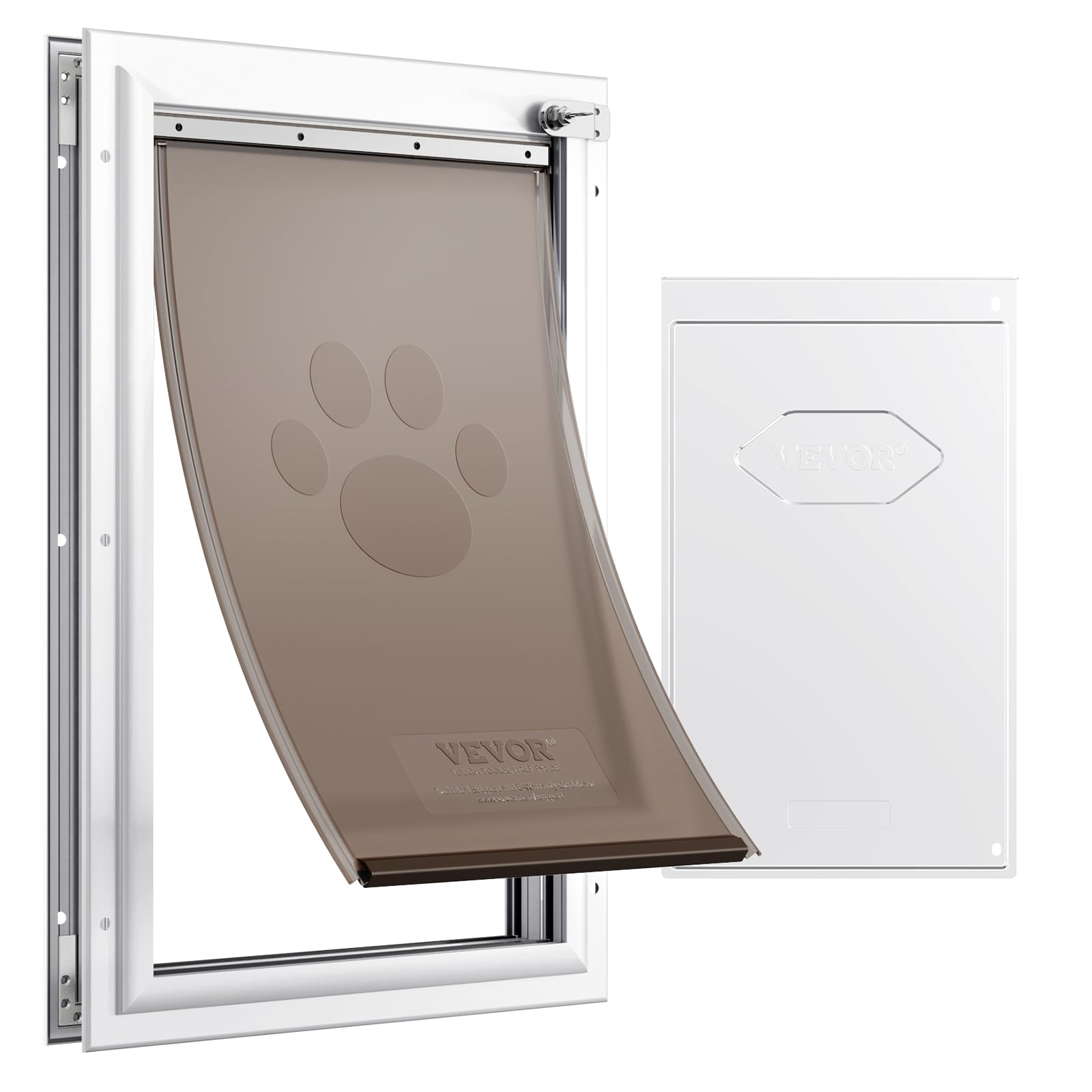
A metal frame and a metal lock plate for not much more than all-plastic.
Most budget flaps are plastic top to bottom, which is exactly what owners of this VEVOR unit keep pointing out as the difference. The frame is aluminum alloy and the closing panel is metal, not the thin plastic slide you get on cheaper doors. It weighs 4.7 pounds and fits existing doors from 1.06″ to 2″ thick — the same in-door territory as the PetSafe above, but with a sturdier shell around the flap.
The flap itself is frosted PVC on a hinge with a magnetic closure, so it swings quietly and seals against drafts rather than clacking shut. That magnetic bottom strip is the detail that keeps it from flapping in wind and dragging patio debris inside. It is a single-flap design, so you get one seal rather than an air-lock layer — worth knowing if your door faces a windy side of the house.
The one wrinkle installers run into: on a standard-thickness door, the two frame halves may not overlap fully, leaving a slim moisture gap you would want to caulk on an exposed exterior door. Inside, or on a covered porch, it is a non-issue. Durability gets mixed word of mouth — solid aluminum, but the moving parts take the wear, so treat the slide gently.
Why it earns its place: the all-metal frame and lock plate at the value end of the list make it the pick for someone who wants a sturdier door than plastic without jumping to the premium wall units.
The right buyer: a homeowner putting a flap in an exterior human door who wants metal where it counts and does not mind a little caulk on a windy wall.
Not quite for you if: your dog needs a deep double-flap wall install — this is an in-door unit with a 2-inch ceiling.
4. Amazon Basics Adjustable Plastic Dog and Cat Door, Large

A big 9.5 by 16 inch opening you can mount in a door or a wall.
The entrance is the headline: 9.5″ by 16″, the roomiest flap opening on this list short of the ClawJaw’s 14 1/3″ by 10″. That extra height is what lets a small dog pass without ducking, and it is why this one works for cats as well as dogs up to the small-dog range. The adjustable design means it can go in an interior door, an exterior door, or a wall space — one unit covering more installs than a fixed in-door flap.
The build is the part buyers praise most, with installation close behind — the plastic frame feels more solid than the price tier suggests, and the components and screws come in the box. Where it gets finicky is the weather stripping: the adhesive can loosen and swing into the flap’s path, and re-gluing it properly solves it. It is also built for a standard door, so a thin screen door leaves a gap you would have to shim or seal yourself.
There is one genuine gotcha to plan around. The slide lock can drift into the locked position on its own, which is annoying if you want the door permanently open — some owners simply pull the slide piece out when they do not need it. That is a design quirk, not a dealbreaker, and it frees you to keep the flap open for a pet that comes and goes all day.
Points In Its Favor
- 9.5″ x 16″ entrance — generous height for small dogs and cats
- Mounts in interior doors, exterior doors, or wall spaces
- Solid plastic build with all screws included
Worth Planning For
- The slide lock can slide into locked position unbidden
- Not sized for thin screen doors — expect a gap
- Weather-strip adhesive may need a re-glue on some units
Pick this for: one adjustable door that covers an interior door or a wall cutout and suits a small dog or a cat that needs headroom.
skip it if: you are working with a flimsy screen door or need the lock to stay reliably engaged.
5. Eillion 3-Flap Wall Dog Door

Three flaps stacked like a storm door for the windiest wall in the house.
Three flaps instead of one is the whole idea here; the maker claims 50% better insulation than traditional doors, which is a claim, not a lab result. In practice, three layered flaps with magnetic seals and an iron closing panel mean the draft has to pass through multiple gates. The flap is 8.1″ by 12.3″ and suits pets up to 40 pounds, so this is a medium-dog wall door rather than a big-dog one.
The telescoping all-metal tunnel adjusts to walls from 4.1 to 7.1 inches thick and needs a cutout of 9.2″ x 14.6″. It is made with laser-welded aluminum, so it feels sturdier than a plastic wall kit and holds shape against the frame screws. Owners clearing the install describe a tape-and-guide-hole method that keeps the cutout tidy, and a multi-tool gives cleaner siding cuts than a jigsaw.
The small catch: on some units the inside closing plate’s slot is partly blocked by the spring lock, and trimming a sliver off the plate edge makes it seat. That is the kind of five-minute fiddling you want to know about before install day, not a reason to pass on an otherwise well-built wall door.
What stands out: a metal telescoping tunnel that spans 4.1–7.1 inches plus a three-flap air lock — the insulation-focused choice among the wall doors here.
Suits you if: you have a framed exterior wall in the 4–7 inch range and want a medium dog to keep porch access without a draft.
Consider the Ideal instead if: your wall runs deeper than 7.1 inches — this tunnel stops short where that one reaches 9.25″.
6. ClawJaw Steel Large Dog Door for Exterior Wall

Built for the 110 lb dog that would bend a plastic wall door out of shape.
The flap opening of 14 1/3″ by 10″ is the widest on this list, and the door is rated for dogs from 0 to 110 pounds — a range no plastic unit here claims. The telescoping steel tunnel fits walls from 3.9 to 7.88 inches, and the double flaps plus sliding lock panels manage wind and drafts. This is a door for the big-dog household that wants a steel tunnel rated to 110 lb.
The build is what owners talk about most, and it holds up under real traffic — the telescoping door is the sturdy part, and the steel frame resists the bumps a large dog throws at it. The double-door design even keeps small intruders out, which matters if your dog’s door sits near a garage or crawlspace.
The one part to size honestly: the plastic closing panels and flap holders are lighter than the steel shell, and a very large, very determined dog can crack them over months of use. The maker’s support is quick to send replacements. Note too — the slide locks can get bumped out of position by a big dog pushing through, so treat them as occasional-use rather than permanent.
The verdict: the widest opening and heaviest dog rating here, in a steel frame that shrugs off contact. Just accept that the thin plastic panels are the wear point and keep the maker’s support line handy.
Right for you if: you have a large or extra-large dog and a wall from about 4 to 8 inches thick that needs a heavy-duty door.
Step back if: a 110 lb dog will not use it — the lighter plastic panels will simply last longer with a smaller, gentler pet.
7. ALUMANI Steel Frame Dog Door for Wall, Double Lock Panels

A steel wall door whose coffee-colored frame reads as trim, not a cutout.
Plenty of wall doors install fine and then look like a hole with a flap. This ALUMANI unit is the one buyers describe as blending into the wall — the coffee-colored alloy steel frame reads as intentional trim, and the polished edges are smooth with no burrs on a pet’s nose. It spans walls from 3.94 to 7.88 inches thick, covering stucco, wood, and brick alike.
Two self-closing magnetic flaps drop shut behind the dog and seal the draft out — the thing the household notices most is that heat stays in and the AC stays in during summer. The two sliding panels give you three modes: fully open for play, fully closed for privacy, and half-open to slow a dog down. It is a thoughtful setup for a house where the door needs to switch roles through the day.
One honest measurement warning: the telescoping tunnel is built for exact thickness, and an 8-inch wall against a 7 7/8″ spec leaves a shortfall you would fill before it seals. Measure your wall precisely, and where the tunnel comes up slightly short, plan a filler strip. The thin lockable slide is the part to handle with a little care.
Reasons To Say Yes
- Polished alloy steel frame with smooth, burr-free edges
- Three position settings via two sliding panels
- Double magnetic flaps that seal heat in and drafts out
- Coffee finish that reads as trim rather than a cutout
The Honest Caveats
- Needs exact wall thickness — an 8″ wall falls short of the 7 7/8″ spec
- The lockable slide is thin and wants careful handling
- Flaps can leave a slim side gap that heat-conscious buyers may seal
Choose it for: a visible interior or exterior wall where appearance matters as much as the opening and you want multiple open/closed settings.
Double-check first: your wall thickness lands inside 3.94 to 7.88 inches, or budget a filler strip for the shortfall.
Know the Specs
Wall and door thickness range
This is the measurement that decides whether a door fits at all. A wall unit lists a min and max in inches — the Ideal spans 4.25″ to 9.25″, while an in-door flap like the PetSafe tops out at 2 inches. Measure your wall or door with a tape, then check both numbers, not just the maximum.
Flap opening size
The opening is measured as width by height, and it is what your dog’s shoulders pass through. A 8 1/8″ by 12 1/4″ opening suits a 40 lb dog, while a 14 1/3″ by 10″ opening gives a big dog shoulder room. Always match the opening to your dog’s shoulder width, not the label on the box.
Number of flaps
One flap gives one seal. Two or three flaps trap a pocket of air between them, which blocks drafts and wind-driven leaves. More flaps mean better insulation but also slightly more resistance for the dog to push through — pick based on how exposed your wall is.
Frame material
Plastic is light and inexpensive; aluminum and alloy steel are heavier and hold shape against a determined dog. Metal frames also resist warping at the hinges, which is where cheap flaps tend to fail first.
Common Questions
Can I install a dog door in a brick or stucco exterior wall?
What wall thickness does a wall dog door need?
Will a dog door fit my existing human door?
How do I keep the cold air out with a dog door?
What size dog door does my dog need?
Can I lock the door to keep my dog inside?
How long does a dog door take to install?
Do flaps stay shut in the wind?
Is a metal frame better than a plastic frame?
Can a dog door fit through a wall without a wall kit?
The Bottom Line
For most homes, the winner is the Ideal Pet Products Wall Entry Double Flap — its 9.25-inch max wall thickness covers brick, stucco, and thick framing that no other door here reaches, and the double flaps keep the draft out. If you want metal over plastic in an existing door, the VEVOR Aluminum Frame gives you an alloy shell and a metal lock plate at the value end. And for a big dog against a deep wall, the ClawJaw Steel Large brings the widest 14 1/3″ by 10″ opening and a 0–110 lb rating. Measure your wall thickness and your dog’s shoulder height first — the right door is the one whose numbers fit yours.
How we choose
We do not accept paid placement. Every pick is matched to a real buyer and a real use-case; we do not hands-on test units.
Sources
Specifications: manufacturer listings and product documentation. Review insights: verified customer reviews, as of October 2026. Pricing: not shown on this page (it changes often); check the current price via the retailer link.
As an Amazon Associate, How Dog Care earns from qualifying purchases. This does not affect which products we feature.