Disclosure: This post may contain affiliate links. As an Amazon Associate I earn from qualifying purchases, at no extra cost to you. Learn more
Specs are compiled from manufacturer listings and verified buyer reviews and can change over time — please confirm the key details on the product page before buying.
Buying a crate is really two decisions: how much chew-proofing your dog actually needs, and how much floor space you are willing to give up. A dog that sleeps through the night in a wire crate does not need a steel fortress. A dog that has already bent two doors does. This guide separates those two buyers and matches each one to a crate that fits the job.
This guide is built by comparing the manufacturers’ published specifications and the patterns across verified customer reviews, so you get each pick’s real strengths and trade-offs instead of marketing spin.
The picks below run from fold-flat wire kennels to furniture-grade wooden dens and steel escape-proof cages. Weigh your dog’s chewing habit against your room layout, then use this list of dog crates to skip the models that fight back.
Top Picks


How To Choose The Best Dog Crates
Start with the dog, not the cage. A 20-pound terrier and a 90-pound shepherd need completely different frames, and the wrong pick shows up fast as bent bars or a dog that refuses to walk in.
Measure the dog standing up, then add room to spare
Have your dog stand naturally and measure from the nose to the base of the tail, plus the floor to the top of the head. Add a few inches to both numbers — Amazon Basics lays out this exact method — so your dog can turn around without crouching. Too tight a crate is the mistake most first-time buyers make.
Bar spacing is the quiet safety spec
Wire crates are built with a gap between bars, and that gap decides whether a small head or paw can slip through. The Midwest iCrate lists a 37.5 mm gap, while the Amazon Basics wire crate runs 15 mm. A finer gap is the friendlier choice for a puppy or a toy breed; a wider cage is fine for a big-boned adult.
Wire, wood or steel panels
A foldable wire crate is the travel-friendly option: it collapses flat and sets up without tools. A wooden furniture crate doubles as an end table and disappears into your living room. A steel-panel heavy-duty crate costs more and weighs far more, but it is built for dogs that pop latches and chew bars.
Cleanup hardware worth checking
Look for a removable or pull-out tray so accidents do not soak the frame. Some steel crates add a slatted floor grate above the tray with a second washable pallet underneath. If your dog has long nails, note that a bare metal grate can catch claws — a crate bed on top solves that.
Side-by-Side Comparison
| Model | Best For | Outer Size (L x W x H) | Style | Stated Weight | Amazon |
|---|---|---|---|---|---|
| Midwest 30-Inch Double Door iCrate★ Best Overall | Medium dogs 21-40 lbs | 30.67″ x 19.3″ x 21.46″ | Folding wire, double door | 17 lbs | Amazon |
| Amazon Basics Portable Metal Wire Dog CrateBest Value | Pets under 32 x 21 inches | 36″ x 23″ x 25″ | Folding wire, single door | 20.2 lbs | Amazon |
| HOOBRO Dog Crate FurnitureBest Looking | Medium and large dogs up to 90 lb | 38.6″ x 25.6″ x 26.9″ | Wood and steel furniture, double door | 41.9 lbs | Amazon |
| KOKOTANGS 48 Inch Heavy Duty Dog Crate | Strong, escape-prone dogs | 48″ x 31″ x 35″ | Steel panel cage, casters | 88 lbs | Amazon |
| Feandrea 48″ Heavy-Duty Dog Crate | Dogs 93-110 lb | 48″ x 29.3″ x 31.7″ | Metal wire, double door plus feeding door | 21.4 kg | Amazon |
| Oranland 48 Inch Heavy Duty Dog Crate | Dogs that destroy wire crates | 47.5″ x 31.5″ x 36″ | Steel panel cage, upgraded baseplate | 84 lbs | Amazon |
| Lyromix 43” XL Dog Crate Furniture | House-trained dogs in a shared room | 43.31″ x 29.92″ x 33.07″ | Wood furniture, 3 doors, stackable | — | Amazon |
| Diggs Evolv Modular Dog Crate | Dogs 18-22″ tall, 50-70 lbs | 38.1″ x 24.9″ x 25.6″ | Modular mesh, repositionable doors | 36 lbs | Amazon |
Detailed Reviews
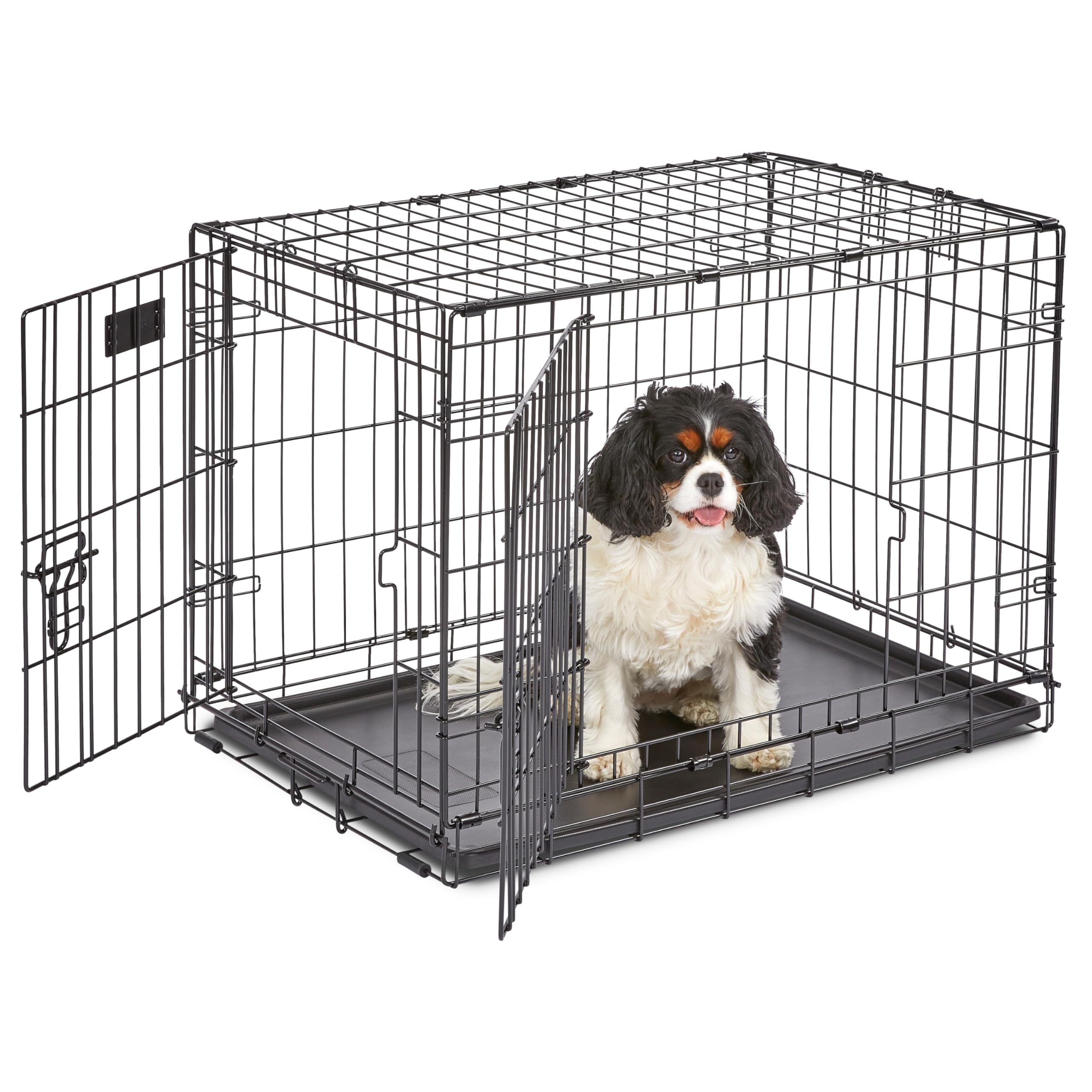
1. Midwest 30-Inch Double Door iCrate
Our pick — 4.5+★ from 70,000+ verified ratings; the strongest balance of quality and price.
The wire crate that grows with a puppy and still folds flat for the car.
This is the one most households should buy first. It is sized for dogs between 21 and 40 lbs, with an outer footprint of 30.67″ long, 19.3″ wide and 21.46″ high — small enough for a bedroom corner but roomy for a French Bulldog or a Dachshund. Midwest’s own advice is worth repeating: if your dog sits near the top of that 40 lb band, move up to the 36-inch model instead of squeezing.
Where it earns its keep is the detail work. The slide-bolt latches carry a Paw Block (a small guard that keeps toes away from the latch), the corners are rounded so nothing snags a passing leg, and the whole thing sets up tool-free. A divider panel is included so you can shrink the space for a puppy and open it up as the dog grows. The leak-proof tray slides out for washing, and rubber feet keep it from skating across hardwood.
Owners of bigger dogs confirm the sizing logic holds higher up the range too — as buyers report, one noted that the 42-inch iCrate “fits 50lb Collie/Heeler well, extra 6″ vs 36″ lets dog stretch out.” The honest limit is escape talent. This is a wire crate, and a determined door-pusher can work a latch loose, so add a clip for a known escapee. The 37.5 mm gap between bars is also wide for toy breeds — that is where finer-mesh crates beat it.
Where it pulls ahead
- Divider panel included, so the same crate fits a puppy and then a full-grown dog
- Two doors give you a loading angle on either side of the room
- 17 lbs with a carry handle — the lightest folding wire pick on this list
- Tool-free fold-flat setup and a pull-out leak-proof tray
What to weigh first
- A 37.5 mm bar gap is wider than the 15 mm on the Amazon Basics wire crate — not ideal for a puppy or a toy breed
- Slide latches can be nudged open by a dog that already knows how doors work
- Dogs near 40 lbs are better served by stepping up to the 36-inch size
Go this way if: you have a medium dog or a growing puppy and want one crate that flexes with both, at the lightest weight here.
Look elsewhere if: your dog is a confirmed latch-opener — the steel-panel crates further down handle that job.
2. Amazon Basics Portable Metal Wire Dog Crate
Tighter bars than the Midwest — the small-dog pick hiding in a plain wire frame.
Here is the spec that decides it for small animals: the gap between bars on this crate is 15 mm, against 37.5 mm on the Midwest iCrate above. Jaw and paw entrapment is the worry with a tiny breed or a nosy puppy, and the finer mesh closes that window. The crate itself measures 36″ long, 23″ wide and 25″ high, intended for pets under 32 x 21 inches — Corgi, Brittany, Cocker Spaniel and similar.
Assembly is the other strength. The frame pops up with no tools and folds back flat, and it carries a top handle for the walk to the car. The single door uses a manual locking mechanism, and there is a metal hook under the floor to stop the plastic tray sliding out — lock that hook after every tray change. Owners treat the sizing as the headline; it is the most praised thing about the crate, and assembly follows close behind in what people talk about. That reputation tracks: one senior female owner set hers up in roughly three minutes with no tools, despite the screwdriver and wrench shown in the listing photos.
The catch is durability at the edges. The plastic handle is thin and should not be trusted as a carry strap, and while most units hold up well, some arrive with bent metal bars.
Roomier than it looks: the 36 x 23 x 25 inch frame takes a medium dog with space to stretch, and the included divider shrinks it back down for a puppy.
One thing to accept: the tray hook and the slender handle both need attention in daily use — check the hook after cleaning and lift from the frame instead.
Pick it for: a small-breed dog or a puppy where the 15 mm bar gap is the safety spec that matters most.
Pass it over for: a dog over roughly 32 inches long or 21 inches tall standing, which outgrows this frame.
3. HOOBRO 38.6″ Dog Crate Furniture
An end table with a dog inside, sized 38.6 inches across.
If the crate is going in the living room, this one stops being an eyesore. The particleboard and steel body stands 38.6″ long, 25.6″ wide and 26.9″ high — against 30.67″ by 19.3″ by 21.46″ on the Midwest wire crate — and the top is flat enough for a lamp, a plant or a stack of pet supplies. Inside, the usable house measures 32.9″ long, 23.8″ wide and 23.2″ high, rated for dogs up to 90 lb.
Two openings matter more than you would guess. There is a front door and a side door, so you can position it against a wall without blocking access, and the pull-out tray slides free for cleaning. A dense bottom net keeps paws off the floor and catches what falls through. The rustic brown finish and the raised legs do most of the decorating work, and assembly is designed around numbered parts with photo instructions.
The trade-off is realistic sturdiness. The frame is particleboard and thin steel, not a steel-panel fortress, and a dog that has already escaped a wire crate will likely defeat this door too. Size is genuinely mixed in owner experience — a fine fit for a small dog or a cat, tight for a large one — so measure the dog before ordering rather than trusting the “large” wording. What buyers consistently like is the look and the build process; the decor match and straightforward assembly are the two things people bring up most.
Built for the front room: at 41.9 lbs it stays put once placed, and the side door plus front door let you load the dog from whichever angle your layout allows.
The honest limit: this is a furniture crate, so treat it as a calm-dog den and a décor piece, not an escape room for a determined jumper.
Reach for it when: the crate has to live in a room guests see, and your dog settles quietly inside.
Think twice if: your dog is large, strong or already a proven crate escaper — the steel cages below are built for that.
4. KOKOTANGS 48 Inch Heavy Duty Dog Crate
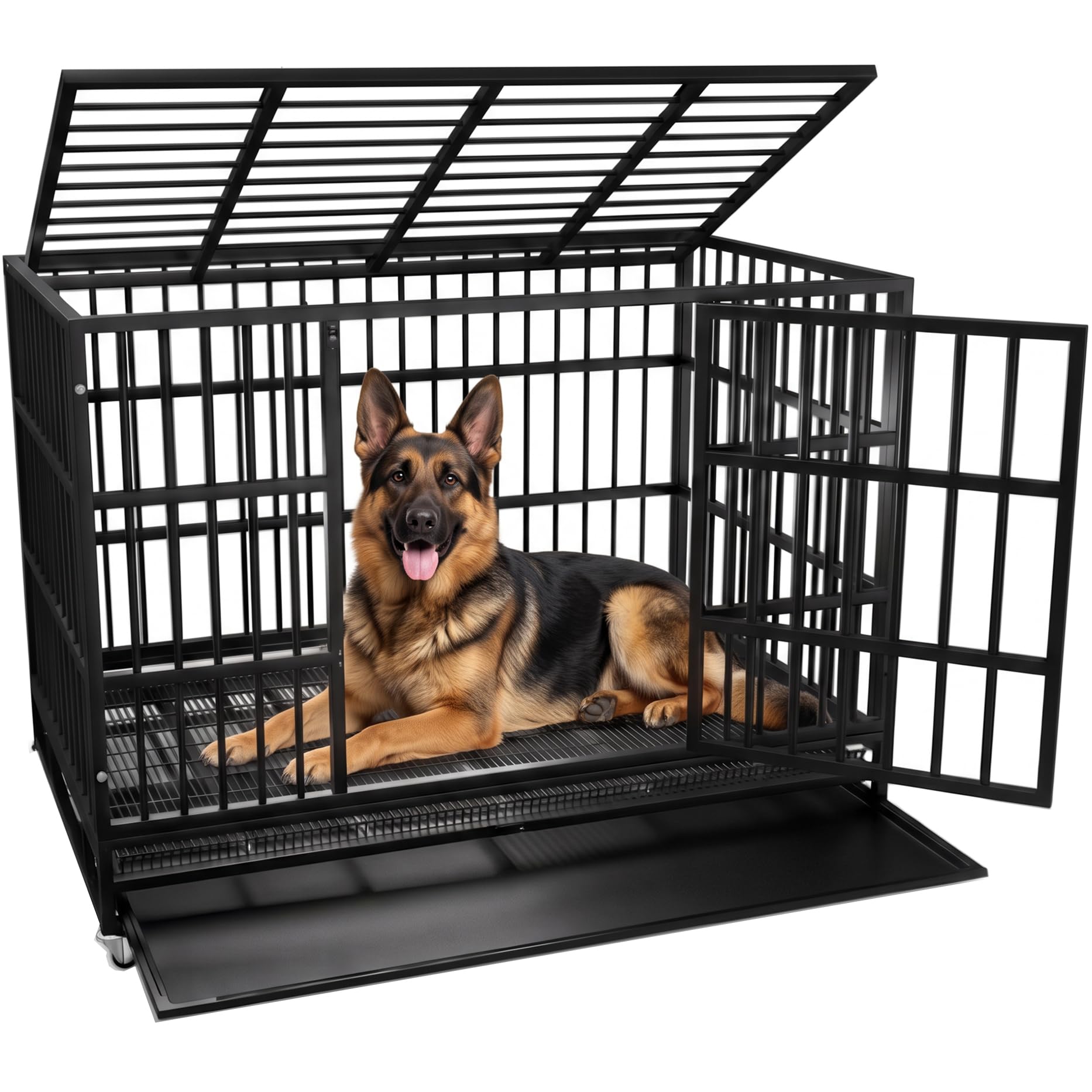
Built from steel tubing for the dog that treats wire crates as a puzzle.
The number that sets this apart is the tubing: 20-gauge steel panels with reinforced steel tubes built for dogs that are strong, powerful and hard on ordinary cages. The frame measures 48″ long, 31″ wide and 35″ high and takes medium, large and giant breeds. It is a 88 lb cage, so plan where it goes before it arrives — but four 360-degree casters, two of them lockable, let you roll it between rooms and then pin it in place.
Cleanup is handled from the bottom up. A slatted floor grate lets mess fall through to a slide-out tray underneath, and both the grate and the tray lift out for washing. The doors open front and top, which is useful for a nervous dog you would rather reach from above. Assembly is partly done from the start — you bolt the remaining parts together rather than building from scratch.
Two details deserve a fair warning. The gate latches hold a calm dog securely, but they rattle when a big dog shifts around, so this is not a silent crate. The metal floor grate is also firm underfoot and can catch a long nail, so a crate mat or bed over the grate is worth fitting. The sturdy construction is what people keep coming back to — the cage’s build is the quality buyers single out most, and it holds up to heavy, active dogs that have worn out softer options.
The case for the steel
- Steel panel and tube construction built for strong, high-anxiety dogs
- Four casters, two lockable, so an 88 lb cage still moves
- Slatted grate over a removable tray keeps the floor clean
- Top and front door access for cautious loading
Know before it lands
- Heavy at 88 lbs — you will want the wheels from day one
- Loose latches clatter when a large dog moves around inside
- The bare metal floor grate can catch nails without a bed on top
Best matched to: a big, strong dog that has bent or escaped a wire crate more than once.
Wrong fit for: a light sleeper sharing a bedroom, or a small dog that needs a light cage you can carry.
5. Feandrea 48″ Heavy-Duty Dog Crate

Two doors and a feeding hatch — the crate you can reach into without opening the main gate.
Sized for dogs between 93 and 110 lb, with an outer frame of 48″ long, 29.3″ wide and 31.7″ high, this is a proper large-breed kennel. Feandrea recommends it for German Shepherds, Alaskan Malamutes and Golden Retrievers. The build is a heavy-duty steel frame finished in rust-resistant wire with smooth, rounded edges, and five L-shaped locks hold the panels together.
The door setup is what makes it stand out. A large main door lets the dog walk straight in, and a smaller feeding door lets you top up a bowl or clip a leash without opening the whole cage. The threshold is kept low so short-legged dogs and older joints do not have to step up. Take the top lid off and the whole thing turns into a playpen; take the doors off entirely and it becomes an open enclosure. A pull-out tray handles cleaning.
The honest note here is latch strength versus a determined dog. The frame and bar quality are the strongest part of this crate — construction is the most praised thing about it, with assembly time a close second at around twenty minutes. But the latches are the weak link, and a dog with real separation anxiety and a habit of mouthing the door has defeated weaker cages before. Treat the panel latches as a starting point and add a clip for a known escape artist.
The flexibility is the sell: main door, feeding hatch, removable lid and removable doors mean one frame covers containment, feeding and play.
The limit worth knowing: the latches, not the steel, are the part to watch with a dog that works the door.
Suits you if: you have a 93-110 lb dog and want to feed or interact without bailing out of the main door.
Look elsewhere if: your dog has already chewed through latches — that is where steel-panel cages win.
6. Oranland 48 Inch Heavy Duty Dog Crate

A reinforced floor rated for 300 lbs and a five-minute build — the heavy-duty cage for a dog that’s already won.
The baseplate is the headline here. Oranland rates the redesigned floor at up to 300 lbs, and that panel is the piece a determined chewer or digger actually hits. The frame runs 47.5″ long, 31.5″ wide and 36″ high on 20-gauge steel panels with reinforced steel piping, and it sits on lockable casters so an 84 lb cage still rolls when you need it to. Two bottom pallets — one washable plastic, one metal — come with it, so cleanup is a lift-and-rinse rather than a scrub.
Setup is the other pleasant surprise. Most parts ship pre-assembled; you fit four wheels and a handful of bolts, and Oranland claims that takes under five minutes. The latches are designed as escape-proof, and the door configuration gives you front and top openings for a dog you would rather not handle from the front.
Weight is the obvious cost. At 84 lbs this is a two-person job to position, and if the crate has to move between floors you will want help. The bare metal grate underneath can also catch a long nail, so a soft bed on top is worth budgeting. The construction itself earns the shelf space: build quality is the most-cited strength, with assembly right behind it, and the escape-proof reputation is what owners talk about — dogs that destroyed wire crates have come out of this one still inside.
The reinforced floor is the point: a 300 lb rating on the baseplate means the part your dog pushes against is the part built to hold.
Plan for the weight: 84 lbs with casters is movable, but it is a fixture more than a travel crate.
The right call for: a large dog with a history of destroying crates — this is the most reinforced option on the list.
Not the pick for: car trips or a small apartment, where 84 lbs and a 47.5-inch frame get in the way.
7. Lyromix 43” XL Dog Crate Furniture

A wooden kennel you can stack, join or corner — furniture first, crate second.
Three doors is the unusual part. Lyromix builds this 43.31″ long, 29.92″ wide and 33.07″ high kennel from particle board and iron pipe with front and side access, so you can place it in a corner or flat against a wall and still get to the dog. The top doubles as a side table surface. Two of these units can be joined into a TV-stand-style run, stacked as a double-decker, or arranged in an L-shape if you have more than one dog.
The build is heavier and taller than a wire crate — 33.07″ high against 21.46″ on the Midwest — which gives a large dog room to sit and stand without ducking. Inside, owners fit a 55 lb dog with space to spare. Assembly is a clear-instruction job with the tools included, and the proportions suit a dog that is already house-trained and settles inside.
The honest catch is the latch. There is no secondary lock on the door, so a persistent escape artist can nose it open, and the piece is not the place for a dog still learning to hold it — urine can work into the seams of a wooden crate. Puppy teeth are a genuine risk too: a snout can wedge between the bars. Around 1.5 hours of build time is realistic. Once assembled, though, it carries its weight: sturdiness, appearance and size are what owners lean on most, and buyers consistently say it looks like proper furniture rather than a pet cage.
What it does better than wire
- Three doors for flexible placement in corners and against walls
- Tall 33.07″ frame that lets a large dog stand without crouching
- Two units combine into a stacked or L-shaped setup
- Looks like an end table in a shared room
What to plan around
- No secondary lock on the latch — a determined dog can work it open
- Wood seams and liquid accidents do not mix, so this needs a house-trained dog
- About 1.5 hours of assembly, and it does not fold for travel
Worth it for: a house-trained large dog in a room where the crate has to look like furniture.
Hold off if: you have a puppy, an escape artist, or a dog not yet reliable on house training.
8. Diggs Evolv Modular Dog Crate

Doors that move, a ceiling that lifts, and mesh that keeps paws out of the gaps.
The modular design is the reason to consider it. Evolv ships with two doors and lets you reposition up to four across the frame, so the crate fits odd corners and opens on the side you actually use. The outer frame measures 38.1″ long, 24.9″ wide and 25.6″ high, with internal space of 35.5″ by 22.3″ by 23.8″ — intended for dogs up to 18-22″ tall or 50-70 lbs, like a Standard Schnauzer or a Whippet.
The safety detail worth naming is the mesh. It is a diamond-shaped weave meant to stop a jaw or paw getting pinched in a square opening, and the corners are rounded rather than sharp. The doors carry dual locks, and the build is free of phthalates and heavy metals. Softer surfaces are the goal here — the sides flex enough that a muzzle is not biting into hard iron bars.
The fair caveat is durability at the joints, where plastic connectors are the part that gives way under a chewing dog, and assembly takes longer than the listing implies — closer to an hour the first time. It also does not fold, so travel means disassembly. Still, the quality is what buyers notice: build quality is the most-praised aspect of this crate, with the assembly process and the clean look close behind. It is the most expensive option on this list, and it earns that position for owners who want a good-looking, paw-safe kennel rather than a steel cage.
Where it leads: diamond mesh and rounded corners are the safest interior here for a dog that paws at the walls.
Where it gives ground: plastic connectors and a firm price make it a poor match for a heavy chewer.
Made for: a small-to-medium dog in a styled home where you want doors that move and a mesh wall.
Not built for: a dog that chews plastic joints or needs a crate to fold flat for the car.
Know the Specs
Bar spacing and mesh gap
This is the distance between the bars or mesh strands on the cage wall. A small number means a small gap, which keeps a puppy’s head or paw from slipping through. Wire crates range from 15 mm on the Amazon Basics to 37.5 mm on the Midwest, and steel cages tend to be about 0.6 inches. Match the gap to your dog’s size — finer for toys and puppies, wider is fine for a large adult.
Tray, grate and baseplate
The tray is the removable pan under the floor that catches mess; a grate sits above it to keep the dog off the wet surface. Steel crates add a baseplate or slatted floor, which can be rated for the weight of the dog pushing on it. A pull-out tray is easiest to clean; a grate needs a bed over it if your dog has long nails.
Folding versus fixed frames
A folding crate collapses flat and sets up tool-free, which makes it the travel and storage choice. A fixed steel or wooden frame is sturdier but heavy and does not fold, so it stays in one room. If the crate has to go in the car, a folder wins; if it has to stop a determined dog, the fixed steel frame is safer.
Latch strength and locks
Latches are what keep the door closed, and they are the usual failure point. Slide bolts work for a calm dog; a dog that already opens doors needs a secondary clip or a crate with heavy-duty latches. The number of locks and how tightly they seat matters more than how the cage looks.
Common Questions
How big should a dog crate be for my dog?
What bar spacing is safe for a puppy?
Will a wire crate hold a dog that escapes?
Do heavy-duty dog crates have wheels?
Is a wooden furniture crate as strong as a wire one?
What does a pull-out tray actually do?
How long does a dog crate take to assemble?
Can a dog crate double as an end table?
Do steel crates have a floor grate that catches nails?
Is a modular crate worth the extra cost?
The Bottom Line
For most households, the dog crates winner is the Midwest 30-Inch Double Door iCrate because it folds flat, includes a divider, and weighs only 17 lbs — enough containment for a medium dog without a steel cage’s bulk. If fine bar spacing matters for a puppy or toy breed, the Amazon Basics wire crate closes that gap at 15 mm. And for a dog that has beaten a wire crate more than once, the Oranland 48-inch steel crate is the reinforced pick worth reaching for.
The one honest nudge: start with your dog’s real size and chewing habit, not the price tag. A calm medium dog does not need a steel fortress; a determined escapee will defeat a wire cage no matter how nice it looks.
How we choose
We do not accept paid placement. Every pick is matched to a real buyer and a real use-case; we do not hands-on test units.
Sources
Specifications: manufacturer listings and product documentation. Review insights: verified customer reviews, as of October 2026. Pricing: not shown on this page (it changes often); check the current price via the retailer link.
As an Amazon Associate, How Dog Care earns from qualifying purchases. This does not affect which products we feature.