Disclosure: This post may contain affiliate links. As an Amazon Associate I earn from qualifying purchases, at no extra cost to you. Learn more
Specs are compiled from manufacturer listings and verified buyer reviews and can change over time — please confirm the key details on the product page before buying.
Riding with your dog attached to the bike is only worth doing if the setup keeps you upright when the leash goes tight. That is the whole decision. A good dog bike leash soaks up the yank in a spring or elastic buffer, holds your dog clear of the pedals and rear wheel, and lets you keep both hands on the bars. This guide covers nine real bike-mounted systems, from a six-foot buffer-ray rope design to a heavy steel-spring veteran, and tells you which one fits the dog you actually own.
This guide is built by comparing the manufacturers’ published specifications and the patterns across verified customer reviews, so you get each pick’s real strengths and trade-offs instead of marketing spin.
A quick honesty note before you shop: this list uses flexible, human-like matching for products that attach to a bicycle as a bike-mounted leash system. Not every pick is the exact number you searched, but the nearest same-type design serves the same job. Read on for dog bike leashes matched to the rider and the dog at the other end.
Top Picks


How To Choose The Best Dog Bike Leashes
The first thing to get straight is that you are not buying a leash. You are buying a mounting system with a buffer built into it. The clamp holds the whole thing to your bike, the arm keeps your dog away from spinning parts, and the spring or elastic rope turns a hard yank into a soft stretch. Get those three pieces right and the ride feels calm. Get them wrong and every squirrel becomes a crash risk.
Match the buffer to how hard your dog pulls
A buffer is anything that stretches or springs when the leash goes tight — either a steel spring inside a tube or an elastic bungee section. A dog that trots calmly beside you is fine with a light bungee. A dog that hits the end of the leash at full speed needs a real spring. Look at what the maker lists as the dog weight range, then think honestly about whether your dog is calm or explosive, because weight alone does not tell you the whole story.
Where the mount sits changes your balance
Seat-post mounts sit high and central, so the pull arrives low and close to your body — that tends to feel steadier. Rear-axle mounts sit back at the wheel, which keeps the leash away from your legs but puts load on the axle hardware. Neither is wrong. Just know that a rear mount with a heavy pulling dog puts stress on parts you are not watching mid-ride.
Clearance is the safety spec people skip
Ask how far the arm or pole holds your dog from the wheels and pedals. Anything that leaves your dog able to reach the rear wheel with a stretch is a tangle waiting to happen on a tight turn. A fixed arm or an improve pivot that holds the leash out to the side is what keeps paws and rope out of spokes.
How long the leash should be
Shorter leashes keep your dog close and easy to control in traffic. Longer elastic sections give a running dog room to stretch out. Some designs adjust from a snug length to a looser one, which lets you pick control on busy streets and freedom on open paths. Decide which matters more to your usual route before you buy.
Side-by-Side Comparison
| Model | Best For | Mount Point | Leash / Rope Length | Rated Dog Size | Amazon |
|---|---|---|---|---|---|
| Pietenjoy Hands Free Buffer Rope★ Best Overall | Steady city and trail commutes | Seat post | 6 feet | Large, Medium | Amazon |
| Sherpa CycleashTwo-Dog Ready | Households with two dogs | Seat post (under saddle) | 34.5 inches | Medium | Amazon |
| Sunlite Bicycle Dog LeashRear-Axle Classic | Small, calm dogs behind the bike | Rear axle / chainstay | 24 inches | Medium | Amazon |
| petbetf Dog Bike Leash | Two dogs, one on each side | Seat post (left or right) | 6 feet | Large, Medium | Amazon |
| Unicam Retractable Bicycle Dog Leash | Small dogs and long open paths | Seat post (clamp) | 30 inches elastic, 16.5 inch pole | Small | Amazon |
| BIKE AND DOG Harness System | Leash-trained dogs, no tools | Frame via cable ties | Not listed | Small | Amazon |
| iPetba Dog Bike Leash Attachment | Universal e-bike fit | Seat post (under saddle) | 24 to 35.5 inches adjustable | Large | Amazon |
| Springer Hands-Free Dog Bike Leash | Hard tuggers and heavy dogs | Seat post (clamp, either side) | 18 inches | Large | Amazon |
Detailed Reviews
1. Hands Free Dog Bike Leash Large Dogs
Our pick — 4.0+★ from 100+ verified ratings; the strongest balance of quality and price.
The six-foot buffer rope that turns a hard lunge into a soft stretch.
What makes this one the pick for most riders is the combination of a six-foot leash and a spring-loaded buffer inside it. That length gives your dog real room to trot or run, while the elastic section eats the sudden jolts when they spot something worth chasing. The company builds the body from high carbon stainless steel, which is the part clamped to your bike, and the leash itself is reinforced elastic nylon. If your usual ride is a commute, a greenway loop, or a fire road, this is a setup that does not fight you.
Setup is the friendly part. The clamp tightens to a standard seat post and works on mountain, road, hybrid, and electric bikes, with mounting tools in the box. The pole unscrews for transport, and the connection point releases in about a second so you can clip off at a coffee stop without pulling the whole mount. The improve pivot arm holds the leash out to the side, away from wheels and pedals, which is the spec that stops the classic tangle. Owners with a sixty-pound puller describe slow, calm rides where the dog sets a pace and the bike follows — exactly what a buffer is for. One with a ninety-pound dog calls the leash strong enough for the job, and the material quality is the thing buyers praise most.
The honest catch: the seat-post mount puts the pull close to your hips. It rewards a dog that has already learned not to cross in front of the front wheel. Softening that learning curve takes a few short sessions in a quiet parking lot before you trust a busy street. Riders who want zero training time should look at a harness-first system instead.
What earns it the top spot
- Six-foot elastic nylon leash gives a running dog room while the buffer absorbs sudden pulls
- Mounts to standard seat posts on mountain, road, hybrid, and electric bikes with tools included
- improve pivot arm keeps the line clear of wheels and pedals
- Quick-release connection detaches in a second without removing the base
What to plan around
- Seat-post position puts the pull close to your hips, so a dog that crosses the front wheel needs training first
- The pole can work loose and rotate toward the pedaling path; a quick re-tighten fixes it
Reach for this if: you want one buffer-rope setup that handles a medium or large dog on real roads and trails without a long install job.
Look elsewhere if: your dog has never run beside a bike and you want the leash to teach the habit for you.
2. Sherpa Cycleash Hands Free Dog Bike Leash
A dual-dog seat-post clamp built from ultra-light alloy and shock-eating TPR.
This one lets two dogs run at once, one on each side, because the seat-post clamp is double-headed. In a two-dog household that changes everything, since a single leash with two dogs usually ends in a tangled mess. The body is ultra-light alloy with a zinc clamp. The arm fits on the left or right and comes off without taking the mount apart. A TPR element (a rubbery polymer that gives instead of jerking) softens the pull before it reaches your seat post.
Compared with the Pietenjoy at number one, this mount sits under the saddle, which means you will likely raise the seat three or four inches to keep clearance. That is a small thing for a tall rider and a real adjustment for a shorter one. What buyers notice is the steadiness under a strong dog — a husky owner on a Rad Mini e-bike reports no balance trouble and no wrong-direction pulling, with the dog holding position. The attachment job takes a bit more mechanical care to get the clamp firm, so plan on a proper tightening session rather than a quick slap-on.
That is a wear part on a well-used tool, not a failure on day one, and customer service has a record of replacing units quickly. If you ride hard every day, expect to treat that sheath as something that eventually needs attention.
Where it separates from the pack: the sixteen-inch-plus alloy build is quick to relocate, and the left-or-right arm means the leash can sit on the side your dog already prefers. A Rottweiler owner trained a seven-month-old to run beside a bike on this with the help of the included directions.
Who it truly suits: families with two active dogs, and anyone who wants a lighter mount than the heavier steel-spring kits further down this list.
The strongest argument for it: two dogs, one mount, and an arm you can pull off without tools.
Worth knowing: the under-saddle mount will change your seat height, and the bungee sheath is the part that ages first.
3. Sunlite Bicycle Dog Leash
A low rear mount that trails your dog behind the bike and out of the pedals.
This one takes a different approach from the seat-post kits. It attaches low at the rear axle and chainstay, so your dog runs behind the bike rather than alongside your hip. The low attachment point means pulling force arrives nearer the ground, which owners credit for a stable feel, and the design keeps the dog away from wheels, chain, and frame. The leash itself is 24 inches long and the whole piece weighs in the region of 1.3 pounds.
Stability is what wins people over here, along with the exercise — the kind of long pull session that leaves an energetic dog flat out. But you need to read the fit carefully before buying. The mounting hardware is built for a bolted axle setup, not every quick-release skewer, and the printed guidance is thin. Buyers who got it onto their bike did so with velcro and wire to hold it steady, and many swap the supplied leash for their own bungee line to get more give.
The serious warning belongs here, plainly: someone with a 100-pound dog saw the rear quick-release axle bend and the wheel loosen on a ride, and a bike shop confirmed it had seen the same thing. Treat this as a fit for small or easy-going dogs on a bolted axle, or for a rider who can thread the nut properly. A hard-pulling large dog on a quick-release hub is the wrong pairing, not a knock on a simple rear-mount design.
Why a rear-mount fan picks it
- Low attachment point keeps the dog behind the bike and away from the pedal line
- Runners report the dog pulls for miles and comes home tired
- Simple, low-cost design that weighs around 1.3 pounds
The fit you must check first
- Hardware expects a bolted axle; quick-release hubs need work to hold it steady
- Printed instructions are minimal — a line drawing, not a step-by-step
- Large, hard-pulling dogs on quick-release axles are the wrong pairing
Good match if: your dog is small or calm, your bike has a bolted rear axle, and you want the dog trailing behind rather than beside you.
Skip the pairing, not the product: a 100-pound puller on a quick-release hub is asking too much of a low-cost rear mount.
4. petbetf Dog Bike Leash with Quick Connect Mechanism

A collet-mount alloy-steel rig built to be bought twice, one per side.
What you get is a six-foot leash on an alloy steel body with a compression spring inside the tube, and the spring is the part that turns a sudden pull into something your bars can absorb. The mount uses a collet with a silicone film inside the clamp, which stops the hardware chewing your bike’s paint, and it tightens without nuts so fitting is quick. It suits bikes with a seat post of at least 10 inches above the saddle clamp. The company lists a 1000-pound rope tension rating, a two-year warranty, and half-price replacement after five months.
Two dogs on one bike is the reason to look here. The mount goes on either the left or right side, so buying two gives you a dog on each side instead of both crowding one line. One buyer with two dogs did exactly that and reported it working great, with the leash clear of the tires. The quick-release lets the whole unit pop off and work as an ordinary leash once you stop.
Hardware is where you will spend your patience. The mount bolt has arrived cross-threaded on some units, which lets the pole rotate into your pedaling path until you fix it. The spring only takes up a modest amount of slack, and the supplied line is long enough that a determined dog can reach the rear wheel unless you shorten it. The clip stitching has come apart under a hard pull. All of these are fixable — re-knot and trim the line, swap the clip, chase the thread with a tap — but budget for a little garage time.
The two-dog math: side-by-side mounting is the standout idea, and the silicone-lined collet is a thoughtful touch for anyone with a freshly painted frame.
Who should pass: if you want a bolt-and-go experience with no thread or line-length tinkering, the iPetba or the Springer below will suit you better.
For two dogs on one bike: the left-and-right mounting option is genuinely useful and the paint-safe clamp is a bonus.
Heads up: plan on checking the thread, trimming the line, and keeping an eye on the leash clip.
5. Unicam Retractable Bicycle Dog Leash, Hands Free

A long guide pole and a retractable elastic line for dogs that like to roam.
Reach is the standout number here. A 16.5-inch guide pole holds your dog out from the bike and away from the wheels, so paws stay clear on a busy path. The retractable elastic rope extends to 30 inches, so a dog can stretch out and run. The rod body is hard stainless steel, and the handle is covered in silica gel for grip. The whole thing mounts to the seat post with a clamp a rider can fit, tighten, and remove in a few minutes. It works on any bike model the maker lists, and the elastic section is detachable, which is handy.
For a small dog on an open path this is a comfortable, roomy setup. Owners talk about the pole and elastic giving a dog space to run on either side without yanking them off their line when a squirrel appears. Riders doing multi-mile stretches report the dog getting real exercise out of it, and quality is what buyers praise most. On a mountain bike trail, in the words of an owner, it makes a good training tool because the elastic just gently tugs when the dog gets distracted.
The build quality of the small parts is the honest concern. One unit broke after four months of daily use when the bolt pulled off and stripped the female threads on the rod. Others have had the lockdown nut slip off until the screw ends were taped. The leash itself is the part most often singled out as the weak link, and a strong dog on rough ground scrapes the paint where the mount clamps. Treat it as a good-value entry point for an active small dog, and inspect the hardware regularly rather than treating it as a permanent fixture.
The length case: 30 inches of retractable elastic plus a 16.5-inch pole is more outstretched room than most seat-post kits on this list offer, and for a dog that likes to gallop, that is the whole point.
Where a budget-minded rider lands: as the maker-friendliest low-cost option for a small dog, with the understanding that bolts and nuts are the wear parts.
The pick for a little dog with big energy: the long pole and 30-inch elastic line give it room to run without crowding your leg.
Take note: check the bolts and lockdown nuts before each ride, because they are the first thing to work loose.
6. BIKE AND DOG Leash and Harness for Bicycle with 3 Rings
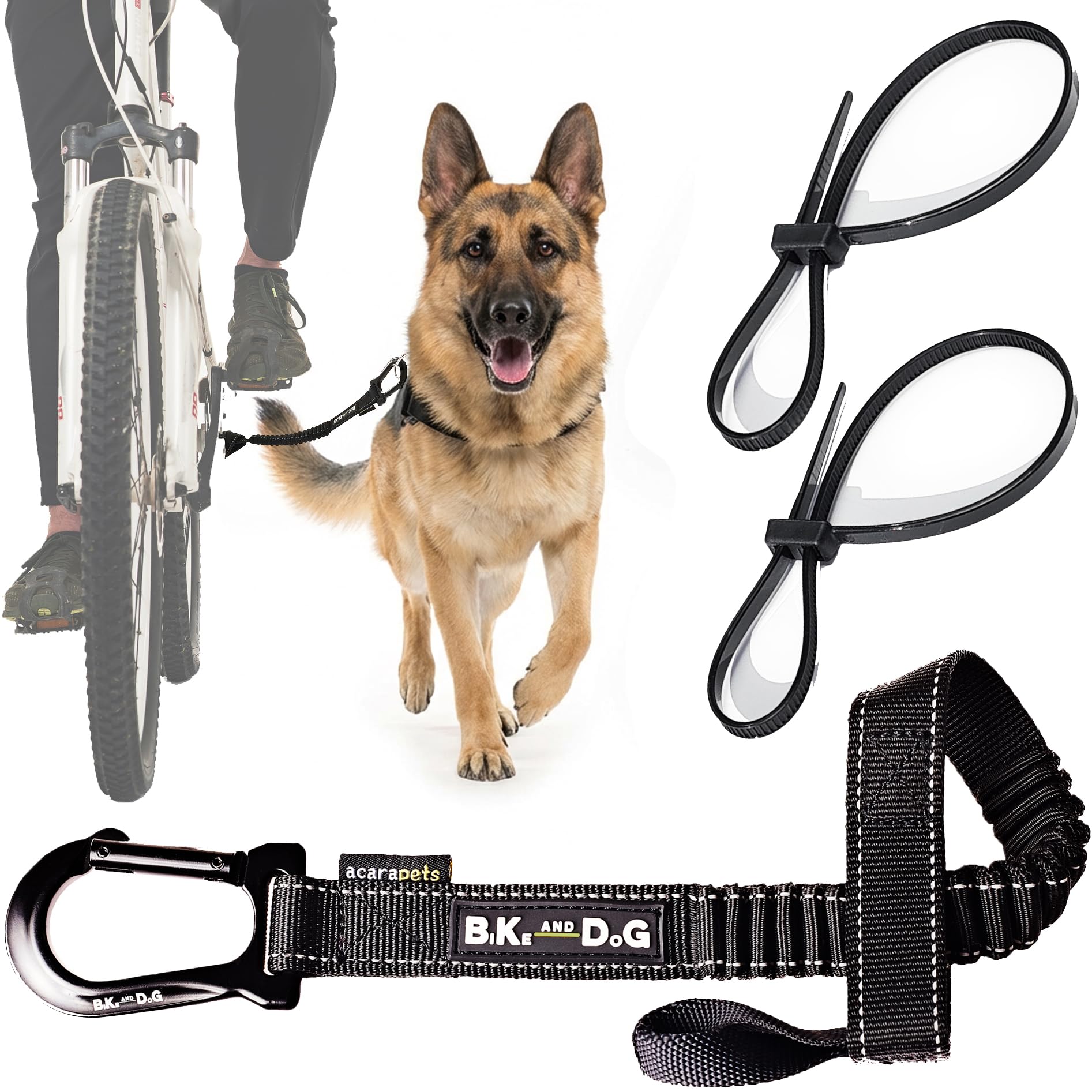
A patent-pending cable-tie system that folds onto the bike when you are done.
The genius of this kit is that there is no clamp and no bolt to lose. It uses two special bicycle cable ties to fix the anchor to your frame, and the whole strap folds flat over the bike when you are not riding. Setting it up and taking it down takes about ten seconds and no tools. The kit includes one leash, one harness with three metal rings — two of them side rings — and the two cable ties. You can also run two or more dogs from it, and it fits any bike size or model, though it weighs just 130 grams.
This one puts the harness first, which separates it from the spring-loaded kits. It sits at a lower center of gravity, so it has much less effect on the bike than the taller seat-post poles. The leash also stops a dog from switching sides and tangling into the rear wheel the way a waist leash can. That combination — lower, simpler, tangle-resistant — is why experienced riders with leash-trained dogs tend to get on well with it. A service-dog handler even hooked it to a wheelchair and found the length perfect, with enough flexibility for the dog to shift position without jostling them.
The trade-off is length and the training it demands. Some dogs find the line a touch close to the rear wheel, and a rider who wants more distance will feel it. It also expects a dog that already understands running beside a bike; one that tries to swap sides at speed can catch the line in a fender. That is a dog-training matter, not a design fault — but factor in a few practice sessions.
Why the minimalist approach works
- Fits in about ten seconds with two cable ties and no tools
- Folds flat against the bike when not in use
- Harness included, with three rings for a secure hold
- Lower mount keeps the ride steadier than tall seat-post poles
The honest catches
- Shorter line feels close to the rear wheel for some riders
- Needs a dog already trained to run alongside without side-switching
The travel-friendly option: nothing to bolt on, folds flat, comes off in seconds — ideal if you swap bikes or store the bike outside.
It asks for training: best after your dog has learned to hold its side beside a bike.
7. iPetba Dog Bike Leash Attachment for Medium & Large Dogs

A universal clamp tuned for e-bikes, with length you can fine-tune on the fly.
The clamp range is the most useful number here. It fits seat posts from 0.9 to 1.4 inches (28 to 35 mm), so it covers mountain, road, hybrid, commuter, and electric bikes — a common weak spot for seat-post mounts on e-bikes with thicker posts. The leash length adjusts from 24 inches for close control to 35.5 inches for more roaming, and the elastic band buffers sudden tugs. The improve pivot arm holds your dog about 13 inches out from the wheel, keeping paws and line clear of the pedals. The body snaps on or off in a second via a one-touch release. The nylon rope is rated for dogs up to 200 pounds, and reflective stitching aids low-light rides.
Owners with big dogs get on with it. A lab pulling at 80 pounds registered only a light tug through the spring, and the spring is what does the heavy lifting when a dog lunges. The value side of the equation — good quality for the money — comes up often, and people with a strong dog and both hands needed on the bars appreciate that the setup frees them up.
The recurring catch is how well the clamp grips on some bikes. The pole can loosen and swivel forward despite tightening, and the bracket has slipped under hard pulling. One rider had the pole swing into their leg while the dog lunged, sending it toward the front wheel. The leash ring’s small opening has let a line come free. These are addressable — a locking carabiner for the ring, extra tightening on the bracket — but if you have a strong, unpredictable dog, run a backup line for the first few rides and check the bracket every time.
The buy-side logic: for a 200-pound rope rating and a clamp that actually fits a fat e-bike seat post, this is the pick for riders who could not find a bracket that fit their frames.
The check-before-you-ride list: confirm the bracket is tight, swap in a locking carabiner to secure the line ring, and keep a backup tether for new dogs.
Best suited to: e-bike riders who need a clamp that spans 28 to 35 mm seat posts, and owners who want adjustable length in one kit.
Basic bet: add a locking carabiner and give the clamp a firm once-over before every ride, especially with a dog over 75 pounds.
8. Springer Hands-Free Dog Bike Leash Attachment

A heavy steel spring built to take 90 percent of a hard tug off your handlebars.
The spring’s 90 percent absorption rating is the number that matters here. The maker rates the low-mounted heavy-duty steel spring to absorb up to 90 percent of a dog’s unexpected tug. That low mounting point is why it feels so much steadier than a tall seat-post pole — the spring sits close to the bike’s center of mass, so a lunge from a big dog arrives as a soft dip rather than a twist of the bars. The kit includes an 18-inch leash, three safety releases, and a metal hook. A harness is not included.
The safety release is the feature to understand before you buy. If a post, tree, or hydrant comes between your dog and your bike, the leash detaches instantly, so your dog is freed rather than yanked to a halt with you. That is the difference between a bad accident and a startled dog, and it is why the Springer has such a long history. A husky owner says the plastic release lets the rider separate from the dog at obstacles and the dog settled quickly. It fits most regular, touring, and mountain bikes, works on either side, and comes off in seconds by releasing a cotter pin.
Install is where people stop short. The clamp needs a set amount of main tube or seat post, and heel clearance above the pedal is a real constraint. The included instructions are sparse and translated, and one buyer had the unit come apart on a first ride where the straight part fits into the corkscrew part. A bike shop install buys confidence if you are not a hands-on builder. Get the mounting right and this is the reliable starter for a strong dog — the one most likely to keep you upright.
Where it stands above the field
- Steel spring absorbs up to 90 percent of a hard tug, low-mounted for stability
- Safety release frees the dog at a post, tree, or hydrant
- 18-inch leash, three safety releases, and a metal hook in the kit
- Fits most regular, touring, and mountain bikes on either side
Where owners hit friction
- Sparse translated instructions; a bike-shop install is a common choice
- Clamp needs a set main-tube or seat-post size and heel clearance above the pedal
- One unit came apart where the straight part joins the spring — check that joint
Top choice for hard pullers: a dog that lunges at full force is the exact case this heavy spring and safety release were designed for.
Plan the fitting: get a bike shop to mount it if you are not confident with the clamp, and check the spring joint before every ride.
Know the Specs
Spring vs elastic rope buffer
A buffer is anything that stretches when the leash goes taut. A steel spring inside a tube is the strongest version, which is why the heavy Springer kit lists absorbing up to 90 percent of a tug. An elastic rope or bungee section is lighter and cheaper but can stretch out over time. Neither makes your dog safe on its own; both reduce how hard the bang reaches your bars.
Mount point and stability
Seat-post mounts sit high and central and feel steadier under a hard pull. Rear-axle mounts keep the leash away from your legs but load the axle hardware, which is why the Sunlite notes recommend a bolted axle for strong dogs. A frame-tie harness like the BIKE AND DOG system sits lowest and is simplest to fit, at the cost of a shorter line.
Safety release and quick connect
A safety release lets the leash detach when a fixed object comes between you and the dog — that is the whole point of the Springer’s three releases. A quick-connect lets you clip off at a stop without pulling the mount. Look for both if your routes pass trees, posts, and hydrants.
Wheel and pedal clearance
Clearance is the distance the arm or pole keeps your dog from the moving parts. The iPetba holds a dog about 13 inches from the wheel with an improve pivot. The Unicam uses a 16.5-inch pole and a 30-inch elastic line to keep the dog out wide. Where clearance is short, the line can reach the rear wheel on a turn — shorten the line or add a carabiner to fix it.
Common Questions
Will a dog bike leash fit my e-bike or hybrid bike?
What size dog can a bike leash handle?
Is a rear-axle mount safer than a seat-post mount for a strong dog?
Do I need a harness with a dog bike leash?
How long should the dog bike leash be?
Will a bike leash stop my dog reaching the rear wheel?
Can I ride with two dogs using one bike leash?
How much skill does it take to install a bike leash?
What maintenance do these bike leashes need?
Is a quick release safe around traffic?
Can I use a dog bike leash on a hand-cycle or recumbent bike?
The Bottom Line
For most riders, the dog bike leashes winner is the Pietenjoy Hands Free Buffer Rope. A six-foot elastic leash on a stainless steel seat-post mount with a quick-release pole covers the everyday ride — commute, greenway, or trail — without a long install. If two dogs share your household, the Sherpa Cycleash solves the crowding problem with a double-headed clamp. And when the dog is a hard puller that lunges at full speed, the Springer with its steel spring and three safety releases is the one built for that exact job.
My one nudge: buy for your dog’s pull style first, not the other way around. A buffer-rope mount that feels calm under a trotting dog will feel like a fight with a dog that sprints, and a heavy spring kit that tames a lunger can feel clunky with a small quiet companion. Get the mount to match the dog at the end of the line, and the ride takes care of itself.
How we choose
We do not accept paid placement. Every pick is matched to a real buyer and a real use-case; we do not hands-on test units.
Sources
Specifications: manufacturer listings and product documentation. Review insights: verified customer reviews, as of October 2026. Pricing: not shown on this page (it changes often); check the current price via the retailer link.
As an Amazon Associate, How Dog Care earns from qualifying purchases. This does not affect which products we feature.